
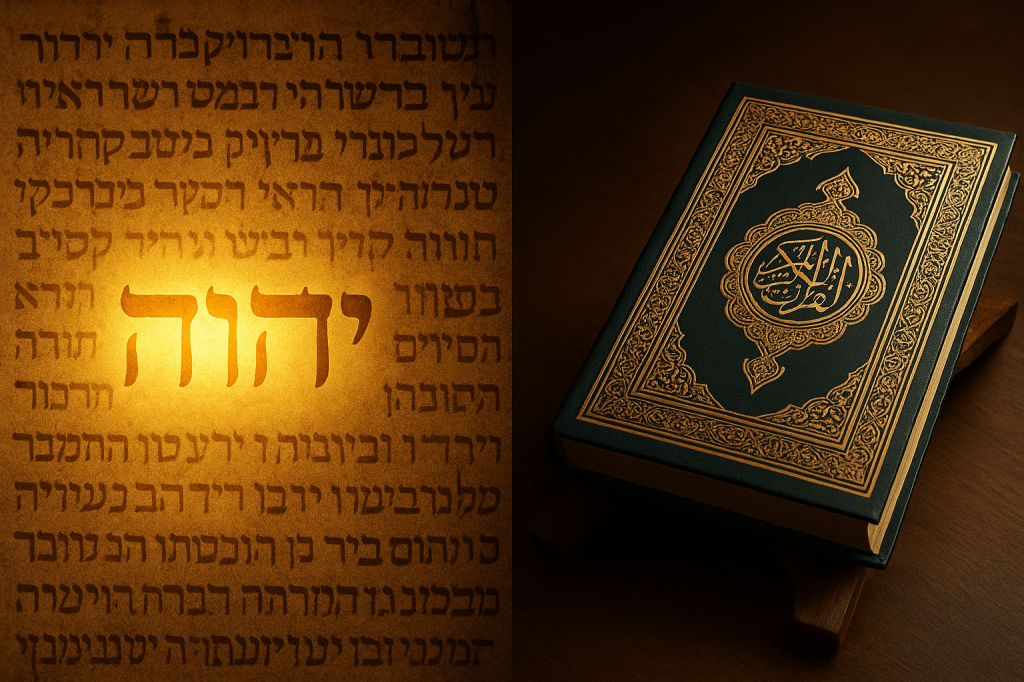
In Exodus 3:14–15, God revealed Himself to Moses as “I AM WHO I AM” (YHWH, Yahweh)—the eternal, self-existent God who was, is, and always will be. This name became the covenant name by which Israel would know their God, a name tied to His promises and faithfulness throughout the generations.
By contrast, Allah is simply the Arabic word for “God” (from al-Ilāh, “the God”). Arabic-speaking Jews and Christians also use “Allah” when speaking of the God of Scripture. Thus, in terms of language, “Allah” is not inherently foreign or wrong. However, the theology attached to the word in Islam is drastically different from the revelation of Yahweh in the Bible.
The Nature of God
Yahweh in the Bible
• One God, Triune in nature – “Hear, O Israel: The Lord our God, the Lord is one” (Deut. 6:4). Yet this one God is revealed as Father, Son, and Holy Spirit (Matthew 28:19; John 1:1; John 14:16–17).
• Relational and covenantal – Yahweh calls His people His children (John 1:12; Romans 8:15) and invites them into fellowship with Him through Christ.
• Love and holiness united – God is both perfectly just and perfectly merciful, forgiving sins while upholding righteousness through the cross (Romans 3:25–26).
Allah in Islam
• Absolute oneness (tawḥīd) – God is one with no division, and the concept of the Trinity is rejected as blasphemy (shirk).
• Master-servant relationship – Humans are primarily servants of Allah (ʿabd). There is no covenantal, familial intimacy like “children of God.”
• Mercy without substitution – Allah may forgive, but Islam denies the necessity of atonement through Christ’s death and resurrection.
Revelation
• Yahweh reveals Himself progressively through the Law, the Prophets, the Writings, and ultimately in Jesus Christ: “In these last days He has spoken to us by His Son” (Hebrews 1:2). Scripture is inspired and testifies consistently of God’s redemptive plan.
• Allah reveals himself in Islam primarily through the Qur’an, believed to be an eternal, uncreated book dictated to Muhammad. The Qur’an contradicts the Bible by denying Jesus’ divinity and crucifixion (Surah 4:157).
Salvation
• In the Bible: Salvation is by grace through faith in Jesus Christ, not by works (Ephesians 2:8–9). Forgiveness and eternal life come through the finished work of Christ on the cross and His resurrection.
• In Islam: Salvation depends on obedience to the Five Pillars of Islam, righteous deeds outweighing sinful ones, and Allah’s mercy on Judgment Day (Qur’an 23:102–103). There is no assurance of salvation, only hope that good deeds are enough.
Relationship with Humanity
• Yahweh calls believers His sons and daughters. Jesus taught His disciples to pray, “Our Father in heaven” (Matthew 6:9). Through Christ, believers are adopted into God’s family.
• Allah is never called “Father.” To ascribe sonship to God is considered blasphemous in Islam. Humanity’s relationship with Allah remains one of submission and servitude, not adoption or intimacy.
The Person of Jesus
This is the sharpest dividing line.
• Christianity: Jesus is the eternal Son of God, fully God and fully man, who died for our sins and rose again. He is the only way to the Father (John 14:6).
• Islam: Jesus (ʿĪsā) is honored as a prophet and born of the virgin Mary, but He is not divine, not the Son of God, and was not crucified. In Islam, to claim otherwise is blasphemy.
Without the cross and resurrection of Christ, the very heart of the gospel is denied.
Points of Overlap
To be fair, there are areas where both religions agree:
• Monotheism: There is only one God.
• God is Creator of all things.
• God is eternal, powerful, merciful, and just.
• Idolatry is rejected.
But agreement on attributes does not mean agreement on identity. Two portraits may both depict a king, yet if one is distorted, it no longer represents the true king.
Conclusion: Are They the Same God?
• Linguistically: Arabic-speaking Christians may rightly call the God of the Bible “Allah.”
• Theologically: The Allah described in the Qur’an and the Yahweh revealed in Scripture are not the same. Yahweh is revealed as Father, Son, and Spirit, fulfilled in Jesus Christ. Allah, as defined in Islam, denies the Trinity, denies the cross, and denies Jesus as Lord and Savior.
Thus, from a biblical perspective, Yahweh and Allah are not the same God. To equate them is to ignore the central revelation of God in Christ.
For Christians, the choice is clear: We worship Yahweh, the covenant-keeping God revealed through Jesus Christ, who alone saves.
 Feeding the Flock Ministry
Leave a comment