
The Beginning: Eve’s Choice
When Eve reached for the fruit, her decision was guided by what looked logical in the moment. Genesis 3:6 tells us she saw the fruit was:
• Good for food (appetite, physical desire)
• Pleasant to the eyes (appearance, attraction)
• Able to make one wise (ambition, human reasoning)
She leaned on what made sense to her rather than what God had spoken. That one decision reveals a timeless truth: whenever human wisdom stands against God’s Word, destruction follows.
The Biblical Pattern of Temptation
1. Israel in the Wilderness – They reasoned, “We are hungry, so God must not care,” even though He had already parted the Red Sea.
2. Jesus in the Wilderness – Satan tempted Him with food, spectacle, and power. But unlike Eve, Jesus stood firm on Scripture: “It is written.”
3. 1 John 2:16 – John summarizes this pattern as the lust of the flesh, lust of the eyes, and pride of life.
This is the same framework by which temptation still operates today.
The Clash With Human Philosophy and Science
The Bible is not against true science or thoughtful philosophy — both can glorify God when grounded in His truth (Psalm 19:1; Colossians 2:3). But history shows a dangerous pattern of human reasoning that mirrors Eve’s choice.
Philosophy Without God
• Ancient Greece: Philosophers like Protagoras declared, “Man is the measure of all things.” Human reasoning replaced divine revelation.
• Modern Relativism: The idea of “my truth” and “your truth” mirrors Eve’s desire to define reality apart from God’s Word.
• Atheistic Existentialism: Thinkers like Nietzsche and Sartre taught that life has no meaning unless we create it ourselves. This rejects God’s authority and echoes the serpent’s promise: “You shall be as gods.”
Paul warned of this in Colossians 2:8: “See to it that no one takes you captive by philosophy and empty deceit, according to human tradition, according to the elemental spirits of the world, and not according to Christ.”
Science Without God
• Naturalism: The belief that everything has a purely material explanation denies the Creator (Romans 1:20–22).
• Evolutionary theory (in its atheistic form): Teaches that humans are the product of chance, not made in the image of God.
• Trans humanism and AI ethics: Some modern movements believe technology can “perfect” humanity, even granting immortality through machines. This is the pride of life — seeking godlike power without God.
True science, however, points to design, order, and a moral lawgiver. Proverbs 1:7 reminds us: “The fear of the LORD is the beginning of knowledge.”
The Pattern in Today’s Culture
The same three categories of temptation still dominate society.
Lust of the Flesh (Appetite and Desire):
• Consumer culture trains us to indulge every craving instantly.
• The sexual revolution and digital pornography normalize the idea that if it feels good, it must be right.
• Addiction industries profit from unchecked appetite and broken lives.
Lust of the Eyes (Appearance and Attraction):
• Social media feeds comparison, envy, and the pursuit of a polished image rather than inner character.
• Fashion, beauty, and celebrity culture push the message that worth is based on appearance.
• Materialism convinces people their value is tied to possessions and lifestyle.
Pride of Life (Ambition and Self-Exaltation):
• Universities often celebrate human reason as the highest authority, sidelining Scripture as outdated.
• The gender identity debate is framed as humanity’s “right” to define reality according to self-perception rather than God’s design.
• Advances in technology promise control over life and death, but leave moral accountability behind.
All of this is the Garden replayed: humanity leaning on its own understanding, calling it progress, while ignoring God’s clear Word.
The Call for Believers Today
• Do not rely on human logic apart from Scripture. Proverbs 3:5–7 warns us not to be wise in our own eyes.
• Test every philosophy and scientific claim against God’s truth. Science and reason can be tools of discovery, but they cannot replace revelation.
• Follow Jesus’ example in the wilderness. When temptation comes clothed in logic, appetite, or ambition, answer with “It is written.”
Paul gives us the safeguard in 2 Corinthians 10:5: “We destroy arguments and every lofty opinion raised against the knowledge of God, and take every thought captive to obey Christ.”
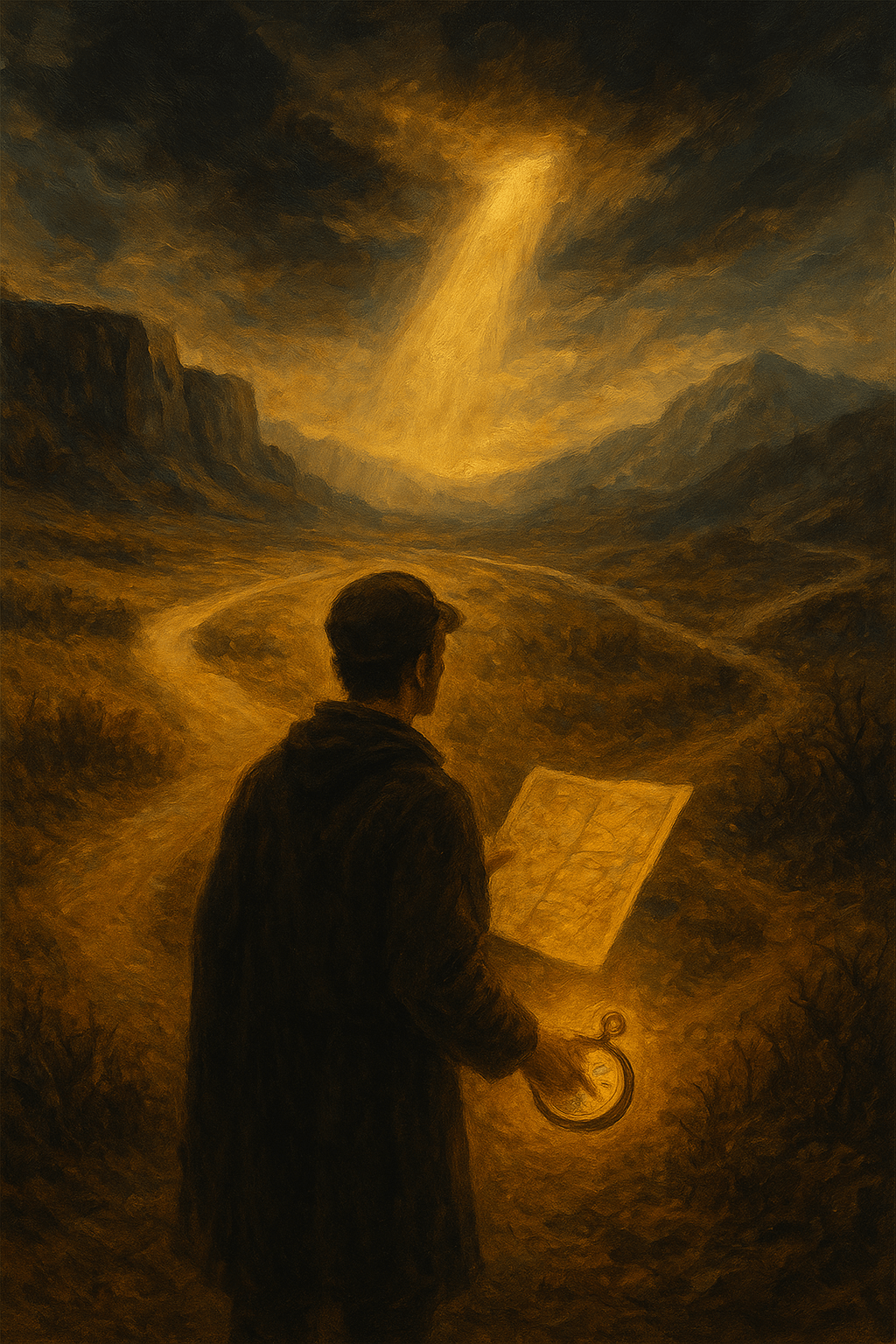
A Final Picture: The Compass and the Map
Imagine a traveler setting out across a vast wilderness. He has two tools in his hands: a compass and a map. The compass points north, and the map shows the right path. But instead of trusting them, he decides to follow his own feelings: “This direction looks easier. That valley looks more beautiful. This road feels right to me.”
At first, the way seems pleasant. The grass is green, the air is sweet, and the path looks wide. But soon he finds himself lost, surrounded by cliffs and thorns, far from his destination. Why? Because he trusted his own reasoning over the instruments designed to guide him safely.
The compass and map represent God’s Word. Human logic, appetite, and ambition without Him are like “gut feelings” that may seem good in the moment but lead to ruin. Proverbs 14:12 warns: “There is a way that seems right to a man, but its end is the way of death.”
Our world today is filled with people walking by their own reasoning — guided by shifting philosophies, cultural trends, and scientific pride — but without the compass of God’s truth. The result is confusion, division, and destruction.
For believers, the call is clear: hold fast to the compass and the map. Trust God’s Word even when human wisdom says otherwise. Only then can we stay on the narrow road that leads to life (Matthew 7:13–14).
 Feeding the Flock Ministry
Leave a comment