
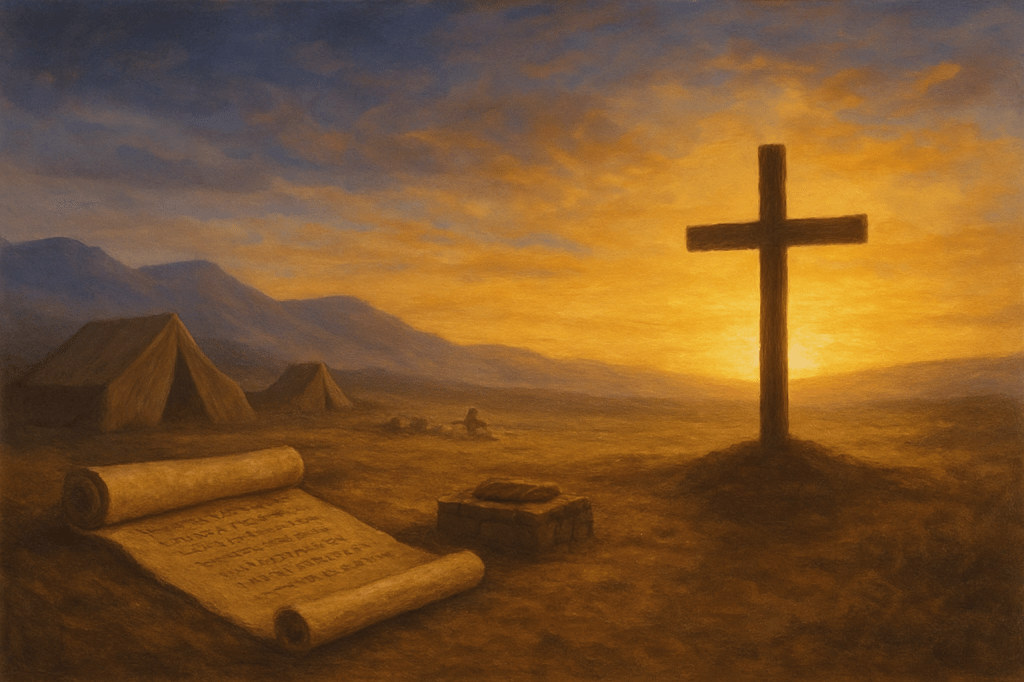
A Unified Story of Promise, Fulfillment, and Meaning
When people hear the terms Old Testament and New Testament, they often assume they are two separate religious systems, two different versions of God, or even two competing worldviews. Some see the Old Testament as harsh and outdated, and the New Testament as gentler and more spiritual. Others view the Bible as a collection of disconnected ancient writings with little relevance today.
In reality, the Old Testament and the New Testament form one continuous story—a long historical and theological narrative that unfolds over centuries. Understanding the difference between them is not about choosing one over the other, but about seeing how they fit together.
What the Word “Testament” Means
The word testament comes from a term meaning covenant or binding agreement. In the biblical sense, a covenant describes how God relates to humanity—what He promises, what He requires, and how that relationship is meant to function.
The Old Testament describes a series of covenants that establish God’s purposes in history. The New Testament describes the fulfillment and expansion of those purposes through the life and work of Jesus Christ.
The Old Testament: Foundations, History, and Promise
The Old Testament begins with the creation of the world and humanity’s earliest attempts to understand God, morality, and purpose. It tells the story of Israel, a people through whom God reveals His character, laws, and promises.
Key themes of the Old Testament include:
- God as Creator and moral authority
- Humanity’s struggle with sin, injustice, and rebellion
- The need for justice, accountability, and restoration
- God’s patience, mercy, and faithfulness across generations
Much of the Old Testament centers on the Law given to Israel through Moses. These laws governed worship, community life, and ethics. They were not arbitrary rules, but a framework meant to reveal God’s holiness and humanity’s inability to live perfectly on its own.
The prophets play a major role as well. They confronted corruption, warned of consequences, and spoke of a future hope—a coming Messiah who would bring restoration, justice, and peace. These promises are woven throughout the text, often in symbolic or poetic language.
The New Testament: Fulfillment, Clarity, and Expansion
The New Testament begins in the same world the Old Testament describes, but at a moment of expectation. It presents Jesus of Nazareth as the fulfillment of the promises made long before.
Rather than introducing a new God or a new moral system, the New Testament claims that Jesus embodies what the Old Testament anticipated. The sacrificial system, priesthood, and temple imagery are no longer central because the New Testament presents Jesus as the final and complete expression of reconciliation between God and humanity.
Key themes of the New Testament include:
- Grace rather than earned righteousness
- Internal transformation rather than external ritual
- God’s kingdom extended beyond ethnic or national boundaries
- A restored relationship with God made available to all
The New Testament also records the early Christian movement—how ordinary people spread these teachings across cultures, often at great personal cost. It concludes with a vision of ultimate restoration, justice, and renewal.
Not Two Gods, Not Two Moral Systems
One of the most common misunderstandings is that the Old Testament portrays a harsh God, while the New Testament presents a loving one. Historically and textually, this division does not hold.
Mercy, compassion, patience, and forgiveness appear throughout the Old Testament. Likewise, justice, accountability, and moral seriousness remain central in the New Testament. The difference is not in God’s character, but in how His plan unfolds over time.
The Old Testament exposes the problem—human brokenness and moral failure. The New Testament presents the resolution—restoration through Christ.
Why This Distinction Matters
For believers, understanding both Testaments prevents shallow faith and selective reading. For non-believers, it provides clarity about what the Bible actually claims, rather than what is often assumed about it.
The Old Testament without the New can feel unresolved. The New Testament without the Old loses its depth and meaning. Together, they present a coherent worldview that addresses questions of purpose, justice, suffering, hope, and redemption.
One Story, Two Movements
In simple terms:
- The Old Testament is the story of anticipation
- The New Testament is the story of fulfillment
They are not competing books, but two movements in a single narrative—one laying the groundwork, the other bringing the story to its intended climax.
Whether one approaches the Bible as a sacred text, a historical document, or a philosophical work, understanding the relationship between the Old and New Testaments is essential to understanding what the Bible is truly about: a long, complex, and deeply human search for meaning, truth, and restoration.
 Feeding the Flock Ministry
Leave a comment