
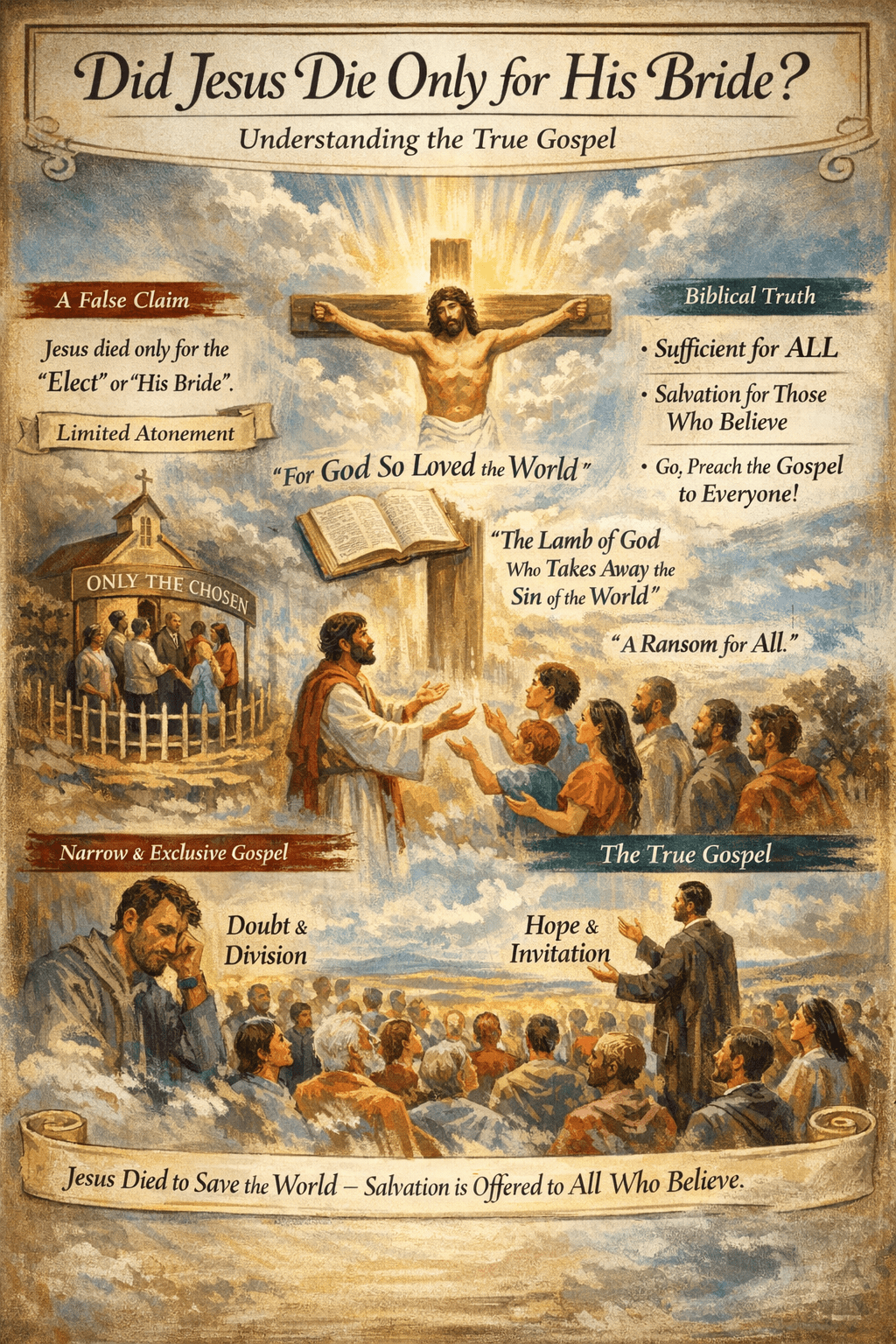
How a Popular Social Media Claim Distorts the Gospel
In the age of social media, theological claims are often reduced to sharp, provocative sentences designed to win attention rather than convey truth. One such claim—recently circulated by a public Christian speaker—asserts that “no one actually believes Jesus died for everyone” and concludes that Christ must have died only for a select group, described as His Bride. The statement is delivered with confidence, framed as if it exposes a hidden truth the church has refused to face. But confidence is not clarity, and boldness is not the same as faithfulness. When examined carefully, this claim does not represent the historic Christian gospel. Instead, it reflects a narrowing of Scripture that ultimately weakens the very message it claims to defend.
Where This Idea Comes From
The claim is rooted in a particular theological system most commonly associated with strict Calvinism, specifically the doctrine known as Limited Atonement or Particular Redemption. This doctrine teaches that Christ’s death was intended to save only the elect and that He did not die for humanity in any meaningful sense beyond that group. Within this system, verses that speak of Christ dying for “the world” are reinterpreted to mean the elect throughout the world rather than humanity itself. Over time, this interpretive move can harden into rhetorical certainty: Jesus did not die for everyone; He died only for His Bride. While this view exists within Christian history, it has never represented the consensus of the Church, nor is it the only faithful way to read Scripture. The difficulty arises when one theological framework is presented as the only possible Christian belief and all others are dismissed as incoherent or dishonest.
A Brief Word from Church History
The early church overwhelmingly spoke of Christ’s saving work in universal terms. The apostolic fathers and early theologians regularly proclaimed Christ as the Savior of humanity rather than a hidden subset within it. Writers such as Irenaeus, Athanasius, and John Chrysostom spoke freely of Christ assuming human nature in order to redeem humanity as humanity. While they affirmed judgment and the necessity of faith, they did not shrink the scope of the cross. The gospel was preached as a genuine offer to all rather than a coded message for the already chosen. Although early theologians did not agree on every detail, the language of Christ for the world is deeply embedded in the Church’s earliest witness.
The False Premise: Confusing Atonement with Salvation
At the heart of the social media claim is a crucial theological error: the assumption that if Jesus died for someone, that person must necessarily be saved. Scripture never makes this claim. The New Testament consistently distinguishes between the provision of salvation accomplished at the cross and the application of salvation received through faith. The Bible repeatedly affirms that Christ’s death is sufficient for all while salvation itself is received by those who believe. This is not theological sleight of hand but the plain teaching of the apostles. “God so loved the world that He gave His only Son” announces a universal offer, while “whoever believes in Him” defines the means of reception. To argue that Christ must not have died for Cain or for anyone who ultimately rejects Him because they were not saved is to collapse categories Scripture carefully keeps distinct. It turns the cross from a public declaration of God’s love into a private transaction limited in scope.
How Scripture Is Distorted
To sustain the claim that Jesus died only for a select group, Scripture must be consistently narrowed. The word “world” is redefined, “all” is qualified, and “whoever” is reshaped to mean only those already chosen. Yet the apostles themselves never preached in this way. They proclaimed Christ as the Savior of the world, the Lamb of God who takes away the sin of the world, and the One who gave Himself as a ransom for all. At the same time, they were clear that not all are saved, not because Christ withheld His life, but because many refuse Him. When Scripture is forced into a system rather than allowed to speak in its full witness, the gospel becomes smaller rather than sharper.
“He Died for His Bride” — A Truth, Not the Whole Truth
Scripture does indeed say that Christ gave Himself for His Bride, and this is a precious and essential truth. Yet this language describes the church’s relationship to Christ rather than placing a limit on the reach of the cross. The same Scriptures that speak of the Bride also speak of Christ dying for sinners, for the ungodly, and even of Christ weeping over those who refuse Him. To absolutize one biblical metaphor while silencing others is not faithfulness but imbalance. This critique does not deny election, God’s sovereignty, or saving grace; it simply refuses to reduce the gospel to a single doctrinal axis at the expense of the Bible’s full testimony.
The Danger of Social Media Theology
Social media rewards certainty without patience and provocation without precision. Short formats incentivize statements that sound decisive but collapse under careful examination. Theology, however, was never meant to be practiced in slogans. When complex doctrines are flattened into viral assertions, nuance is lost, and often the gospel itself is diminished. The Church does not need clever reductions; it needs faithful proclamation shaped by the whole counsel of God.
The Correct Way to Believe
The historic Christian confession holds together truths that Scripture never places in opposition. Jesus died to save the world, that salvation is genuinely offered to all, and salvation is applied only to those who confess and believe in Him. This framework preserves the sincerity of God’s love, the integrity of the gospel call, the necessity of faith, and the seriousness of human response. It allows the church to preach without qualification, calling all people to be reconciled to God, not on the basis of hidden election or speculative inclusion, but on the clear and open promise that whoever believes will be saved.
Why This Matters
When the cross is narrowed, evangelism becomes hesitant. When assurance is tied to speculation about election rather than trust in Christ, faith becomes inward and anxious. When public teachers declare vast portions of Christianity dishonest or incoherent, division replaces discipleship. The gospel is not fragile and does not need to be protected by reduction. It needs to be proclaimed as it was given. Christ died openly, Christ is offered freely, and Christ saves truly. And all who believe in Him will not be put to shame.
 Feeding the Flock Ministry
Leave a comment