
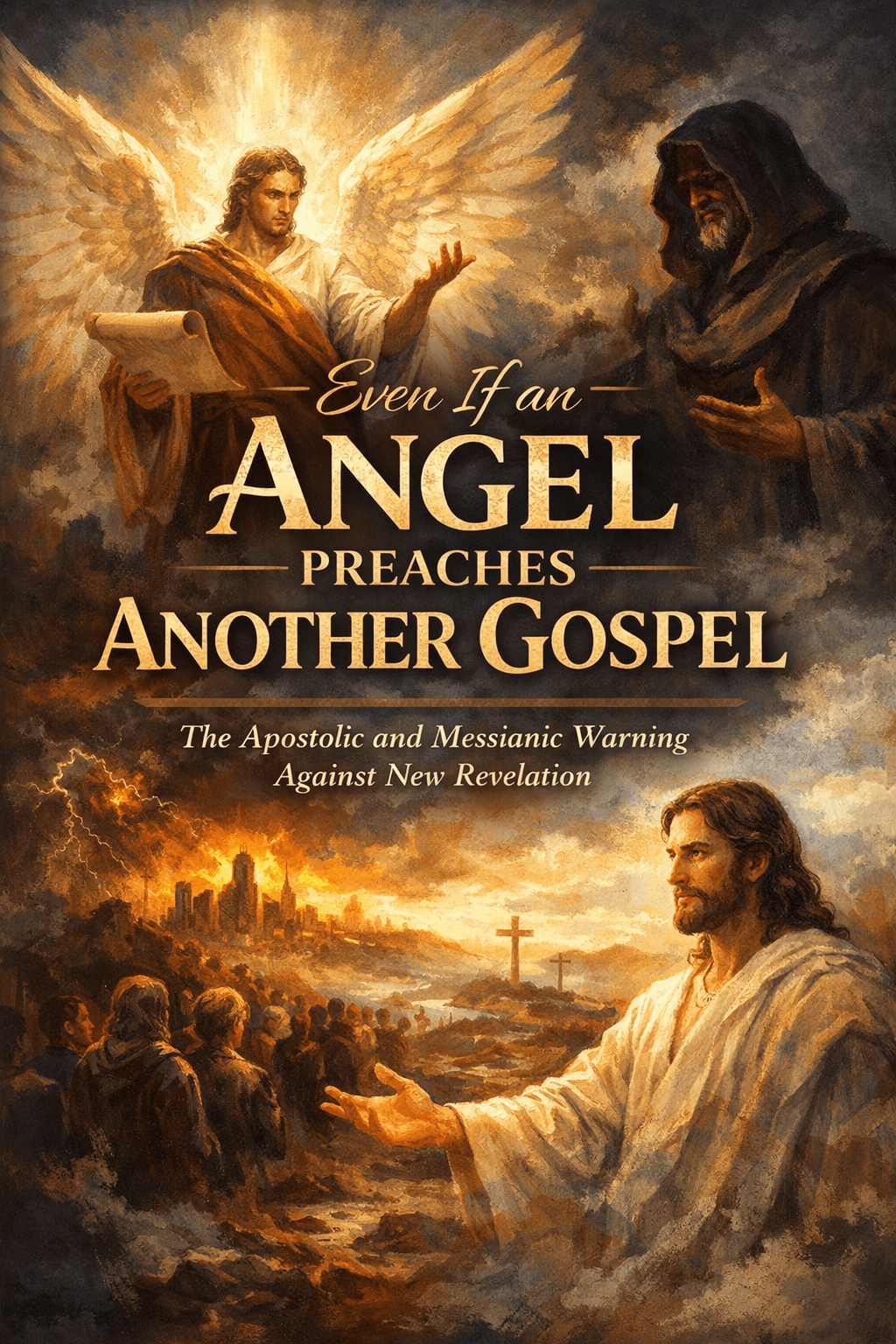
The Apostolic and Messianic Warning Against New Revelation
The apostle Paul issued one of the most severe warnings in all of Scripture when he told the Galatian churches that even if he himself—or an angel from heaven—should preach a gospel contrary to the one they had already received, that messenger was to be regarded as accursed. He then repeated the warning immediately, removing any possibility that this was rhetorical exaggeration. This was not an emotional outburst. It was a final boundary line. The gospel proclaimed by the apostles is not open to revision, correction, supplementation, or replacement—no matter how sincere, impressive, or supernatural the source of the proposed “update” may appear.
This principle did not originate with Paul. It came directly from Jesus Himself. While speaking privately with His disciples about the future, Jesus warned that many would come in His name claiming divine authority and would deceive many. He said false christs and false prophets would arise performing signs and wonders so convincing that even those firmly grounded could be shaken if God did not preserve them. He did not offer this as speculation. He said He was telling them these things in advance so they would recognize deception when it appeared. Paul’s warning, then, is not a later theological development—it is the apostolic application of Christ’s own words.
The Church was never promised safety through isolation from error. It was promised protection through remembrance.
What the Apostles Meant by “the Gospel”
Before false gospels can be exposed, the gospel itself must be defined. Paul told the Corinthians that what he delivered was of first importance: Christ died for our sins according to the Scriptures, He was buried, and He was raised on the third day according to the Scriptures. This is not moral reform or spiritual improvement. It is divine rescue. The gospel is not what we do for God. It is what God has done for us in His Son.
The moment the cross is softened, the resurrection reinterpreted, or salvation reframed as something that must be maintained by spiritual performance, the gospel has been exchanged. What remains may sound Christian, feel sincere, and produce visible activity—but it no longer carries the power to save or to settle the soul.
Jesus warned that deception would not usually arrive by openly denying Him, but by speaking in His name. The danger is not simply false religion. It is distorted Christianity that retains the vocabulary of faith while quietly abandoning its foundation.
Why Paul Mentions Angels
Paul did not randomly include angels in his warning. He understood human psychology. Encounters with the supernatural bypass critical reflection and go straight to awe. When something feels heavenly, people stop testing it.
Jesus said deception would come clothed in spiritual brilliance. Paul therefore anchored the Church to an immovable standard: no experience, however sacred it feels, can authenticate a message that contradicts the gospel of Christ. Truth is not validated by atmosphere, emotion, or spiritual intensity. It is validated by conformity to Jesus as He has already been revealed.
Muhammad and the Claim of Final Revelation
Islam rests upon the claim that Muhammad received a final revelation from God through the angel Gabriel, correcting Jews and Christians who were said to have misunderstood or corrupted previous Scripture.
But Jesus warned that false prophets would arise in His name. Paul then gave the Church its filter: if an angel delivers a message that denies the Sonship of Christ, rejects the cross, redefines salvation, or supersedes apostolic teaching, believers are commanded to reject it—regardless of the claim to divine origin.
God has already spoken definitively in His Son. The Christian faith is not awaiting repair.
Why “Correcting” Scripture Is a Category Error
Jesus affirmed the enduring authority of Scripture and grounded His identity in it. The apostles treated those same Scriptures as God-breathed and sufficient.
A revelation that depends on centuries of biblical corruption requires that God either failed to preserve His Word or allowed the world to be misled until someone finally corrected Him. Neither scenario is compatible with the God revealed by Jesus.
A message that stands upon the collapse of God’s previous revelation cannot come from God.
The Hidden Fruit of “Another Gospel”
False revelation does not announce itself with cruelty. It enters gently, often with concern for holiness, devotion, or clarity. But over time something subtle happens inside the believer.
Assurance fades. Peace is replaced by pressure. Faith becomes an ongoing evaluation of whether one has kept up with the latest insight, rule, or revelation. The finished work of Christ is no longer a place to rest, but a platform from which to climb.
Jesus said deception would be dangerous not merely because it would be wrong, but because it would wound. The gospel produces settled joy. Another gospel produces exhaustion.
The Pattern Repeated Throughout History
Jesus said many would come. Paul said do not believe them. History has echoed both voices.
From restored gospels to prophetic movements to angelic visitations, the pattern never changes: divine encounter, accusation of corruption, corrected message, departure from apostolic faith.
The names change. The structure does not.
When “It Works” Replaces Truth
One of the strongest defenses of false revelation is visible impact—growth, discipline, passion, reform. But Scripture never uses effectiveness as the test of truth. Jesus warned that deception would be impressive. Paul warned it would feel powerful.
Pragmatism is not discernment. The cross did not look successful either.
The Voice of the Shepherd
Jesus said His sheep know His voice. That voice does not rush the soul. It does not threaten with loss of special knowledge. It does not manipulate through fear of missing out on what God is “doing now.” It leads beside still waters.
Counterfeit voices always accelerate urgency. Christ’s voice restores calm.
The Sufficiency of Christ
At the heart of every false revelation is the same accusation: Christ is not enough.
But Jesus declared Himself to be the way, the truth, and the life. The apostles proclaimed that all the fullness of God dwells in Him bodily. The Church does not need another word from heaven—it needs deeper satisfaction in the Word already given.
Conclusion: Come Home to the Finished Work
Jesus warned the Church in advance. Paul drew the boundary. God has not left His people unprotected.
If you are weary from chasing clarity, exhausted from trying to keep up with new spiritual demands, or burdened by the fear of missing something God is doing elsewhere, the gospel invites you to rest.
You are not behind. Christ is not incomplete. Heaven is not silent.
The Word has already been spoken. And it is enough.
 Feeding the Flock Ministry
Leave a comment