
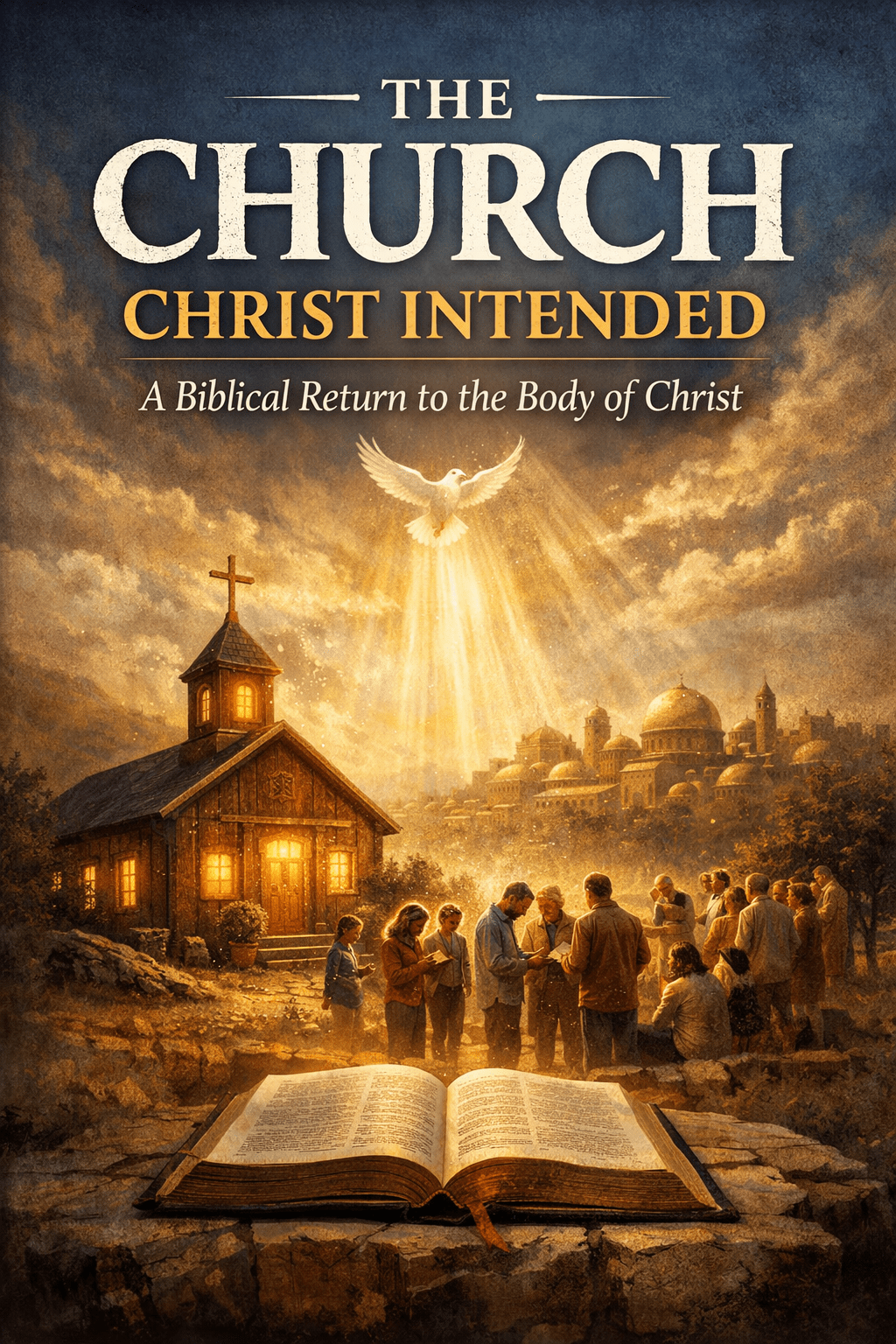
Introduction: Defining the Church and Discerning the Times
The question of what the Church is cannot be separated from the question of what the Church has become. Scripture presents the Church as the living body of Christ—holy, Spirit-filled, grounded in truth, and submitted to Christ as Lord. Yet many believers today find themselves disoriented, sensing a growing distance between the New Testament vision of the Church and the expressions of church life they encounter in modern culture. This tension is not imagined, nor is it merely generational or stylistic. It is theological, spiritual, and deeply pastoral.
This writing seeks to address both sides of that tension by clearly defining what is meant by the Church, the body of Christ, and local church gatherings, grounding those definitions firmly in the witness of the New Testament. It clarifies that the Church is not an institution, a performance, or a crowd, but a people—called, known, accountable, and led by the Holy Spirit. It also explains why local churches are understood as relational gatherings where believers walk together in the fear of the Lord, uphold sound doctrine, and welcome the convicting and transforming work of the Spirit.
Having established a biblical definition of the Church, this writing also addresses why this vision stands in contrast to much of modern church culture. It examines how audience-driven models, fear of man, doctrinal compromise, resistance to the Spirit’s conviction, and redefined measures of success have reshaped contemporary Christianity. This contrast is not drawn to condemn, but to discern—to help believers recognize where cultural values have quietly replaced biblical faithfulness.
This is not an attack on the Church, but a call to return to Christ’s design for it. It is written for those who love the body of Christ, who long for holiness and truth, and who desire to see the Church nourished rather than entertained, strengthened rather than expanded at the cost of faithfulness. The aim is not to create division, but clarity; not to provoke offense, but repentance and renewal.
The Church belongs to Christ, and He has not left His people without instruction. By returning to the pattern given in Scripture and listening afresh to the voice of the Holy Spirit, believers can once again understand what it means to be the Church—and why that calling will always stand apart from the spirit of the age.
What Feeding the Flock Ministry Means by “The Church”
When Feeding the Flock Ministry speaks of the Church, it is not referring primarily to a building, a brand, or an institutional structure. Biblically, the Church is the body of Christ as a whole, made up of all true believers who have been united to Christ by faith and sealed by the Holy Spirit. The New Testament consistently presents the Church as a living, spiritual body, with Christ Himself as the head, and every believer functioning as a necessary and active member. Paul explains that believers are baptized by one Spirit into one body, whether Jew or Greek, slave or free, and all are made to drink of one Spirit. This understanding forms the foundation of how Feeding the Flock Ministry uses the term the Church—the universal body of Christ across time, geography, and culture.
Yet Scripture also makes a clear distinction between the universal body of Christ and local expressions of that body. When Feeding the Flock Ministry refers to local churches, congregations, or church gatherings, it means smaller, relational assemblies, generally less than 250 people, where believers genuinely know one another, walk together, and actively share life in Christ. These are not crowds gathered primarily for passive consumption, but communities shaped by fellowship, accountability, prayer, teaching, and mutual care. The early Church modeled this clearly. In the book of Acts, believers devoted themselves to the apostles’ teaching, to fellowship, to the breaking of bread, and to prayer, meeting from house to house with sincerity of heart. Their gatherings were personal, participatory, and rooted in shared spiritual life, not anonymity.
Feeding the Flock Ministry does not define church as a place where individuals merely arrive, sit silently, listen to one person speak, and then disperse with little to no relational connection. While public teaching has its rightful place, Scripture never portrays the Church as an audience-centered institution. Instead, the Church is described as a body in which every joint supplies, every member serves, and spiritual gifts are exercised for the building up of one another. Paul emphasizes that when the Church gathers, each one may bring a hymn, a teaching, a word of instruction, or encouragement, and all things are to be done for edification. This participatory nature reflects a living body, not a religious event.
Central to this definition is the fear of the Lord. A true church, as understood by Feeding the Flock Ministry, is one that fears God rather than people. The apostles modeled this when they declared that they must obey God rather than men, even under threat of persecution. Teaching and preaching are therefore not shaped by cultural trends, social pressure, or fear of rejection, but by reverence for God and faithfulness to His Word. Paul reminded Timothy that the goal of his ministry was not to please men but to be approved by God, accurately handling the word of truth. Where the fear of the Lord is absent, compromise inevitably follows.
Accordingly, a biblical church is one where sound doctrine is upheld without compromise. The New Testament repeatedly warns against false teaching and urges shepherds to guard the flock. Elders are called to exhort in sound doctrine and refute those who contradict it. Feeding the Flock Ministry affirms that love and truth are not opposites; genuine love flows from truth rooted in Christ. A church that avoids difficult teachings to preserve comfort or numbers is not walking in faithfulness. The early churches were exhorted, corrected, and sometimes sharply rebuked by the apostles—not to condemn them, but to preserve the purity of the gospel and the health of the body.
Another defining mark of the Church is the active work of the Holy Spirit. Feeding the Flock Ministry understands the Church to be a Spirit-indwelt people, not a Spirit-excluded system. Jesus promised that the Spirit would guide His people into all truth, convict the world concerning sin, righteousness, and judgment, and empower believers to be His witnesses. In the New Testament, the Church did not merely acknowledge the Holy Spirit doctrinally; it depended on Him practically. The Spirit directed missionary journeys, set apart leaders, convicted hearts, and brought repentance. A true church therefore welcomes the conviction, guidance, and movement of the Holy Spirit rather than resisting or suppressing His work.
This includes allowing the Holy Spirit to confront sin and call believers to repentance. When the early Church faced moral compromise, as seen in Corinth, apostolic correction was not avoided. Discipline, though difficult, was exercised for the restoration of the sinner and the purity of the Church. Feeding the Flock Ministry affirms that a church led by the Spirit will not redefine sin or excuse disobedience but will lovingly call people to holiness, knowing that God disciplines those He loves.
Finally, the Church is a people on mission, not merely a place of gathering. Jesus commissioned His followers to make disciples, teaching them to obey all that He commanded. Local churches in the New Testament were centers of discipleship, prayer, generosity, and gospel witness. Believers shared their resources, bore one another’s burdens, and cared for the vulnerable. This outward fruit flowed naturally from inward faithfulness.
In summary, when Feeding the Flock Ministry speaks of the Church, it means the body of Christ in its fullness—alive, Spirit-filled, grounded in truth, and submitted to Christ as Lord. When it speaks of local churches or gatherings, it means relational, accountable communities where believers know one another, walk together in holiness, fear God above all else, and welcome the convicting and empowering work of the Holy Spirit. This vision is not innovative or modern; it is thoroughly biblical, rooted in the pattern established by Christ and His apostles, and preserved for the Church in the pages of the New Testament.
Why This Biblical Vision of the Church Stands in Contrast to Modern Church Culture
The definition of the Church upheld by Feeding the Flock Ministry stands in clear contrast to much of modern church culture because contemporary expressions of Christianity have increasingly drifted from the New Testament pattern. This contrast is not rooted in nostalgia or personal preference, but in a concern for faithfulness to Christ, His Word, and the work of the Holy Spirit. When Scripture defines the Church as a living body, modern culture often reshapes it into an institution, an event, or a consumer experience.
One of the most visible differences is the shift from body life to audience culture. In many modern churches, growth is measured primarily by attendance numbers, platforms, and visibility rather than by spiritual maturity, obedience, or holiness. Large gatherings often function like religious presentations where the majority of attendees are passive listeners rather than active participants in the life of the body. By contrast, the New Testament portrays gatherings where believers knew one another, shared life together, exercised spiritual gifts, and bore one another’s burdens. Paul’s description of the Church as a body, in which every member is necessary and active, stands at odds with models that concentrate ministry almost entirely in the hands of a few while the rest observe from a distance.
Modern church culture also frequently replaces the fear of the Lord with the fear of people. Scripture teaches that the fear of the Lord is the beginning of wisdom, yet many churches shape their message to avoid offense, discomfort, or cultural resistance. Hard truths about sin, repentance, judgment, and costly discipleship are often softened or avoided altogether. Jesus, however, never adjusted His message to preserve popularity. When crowds followed Him for miracles but rejected His words, He allowed them to leave rather than compromise truth. The apostles followed this same pattern, preaching Christ crucified even when it resulted in persecution, rejection, and suffering.
Another point of contrast lies in doctrinal compromise. The New Testament repeatedly warns that false teachers will arise from both outside and within the Church, distorting the gospel and drawing disciples after themselves. In response, church leaders are commanded to guard the flock, teach sound doctrine, and refute error. Modern church culture, however, often treats doctrine as divisive or secondary, prioritizing unity defined by tolerance rather than unity grounded in truth. Feeding the Flock Ministry affirms that biblical unity is never achieved by minimizing truth but by submitting together to the Word of God.
There is also a significant difference in how the Holy Spirit is understood and welcomed. In many contemporary settings, the Holy Spirit is acknowledged in language but functionally sidelined in practice. Services are tightly controlled, outcomes are carefully managed, and room for conviction, repentance, or divine interruption is minimal. Yet in the New Testament, the Spirit actively directed the Church, convicted hearts, appointed leaders, and empowered witness. When the Spirit brought conviction, believers responded with repentance and obedience rather than resistance. A church that avoids the convicting work of the Spirit may preserve comfort, but it forfeits spiritual depth and transformation.
Modern church culture also tends to redefine success. Faithfulness is often measured by numerical growth, social influence, or cultural relevance rather than by obedience to Christ. Yet Scripture consistently presents faithfulness as obedience regardless of outcome. The prophets were faithful even when the people did not listen. Jesus was faithful even when He was rejected. The apostles were faithful even when their obedience led to imprisonment and death. Feeding the Flock Ministry holds that the Church is called to be faithful, not fashionable.
Another area of contrast is the loss of meaningful accountability and discipline. In the New Testament, believers were exhorted to encourage one another daily, to confess sin, and to restore those who strayed. Church discipline, though difficult, was practiced as an expression of love and concern for holiness. In modern church culture, accountability is often viewed as intrusive or unloving, and discipline is avoided for fear of losing members. This shift reflects a cultural understanding of love rather than a biblical one.
Finally, modern church culture often emphasizes gathering over discipleship. Many believers are encouraged to attend services but are rarely equipped to obey Christ in daily life. Jesus’ command was not merely to gather crowds, but to make disciples who would learn to obey all that He taught. The early Church devoted itself to teaching, fellowship, prayer, and mutual care, resulting in transformed lives and enduring faith. Feeding the Flock Ministry affirms that a church faithful to Christ will prioritize spiritual formation over religious routine.
In light of these contrasts, the biblical vision of the Church upheld by Feeding the Flock Ministry may feel uncomfortable or countercultural. Yet it is precisely this faithfulness that the New Testament calls believers to pursue. The Church was never meant to mirror the world, but to bear witness to the kingdom of God in the midst of it. Where modern culture prioritizes comfort, popularity, and control, Christ calls His Church to humility, obedience, truth, and dependence on the Holy Spirit. This contrast is not a failure of the Church’s mission; it is often evidence that the Church is walking in faithfulness to its Lord.
Conclusion: Returning to Christ’s Design for His Church
Taken together, this writing is not merely an explanation of ecclesiology, nor is it a critique for critique’s sake. It is a call to remember what the Church is and to recognize why that biblical vision so often feels foreign in the present age. The contrast between the New Testament pattern and modern church culture is not accidental. It emerges wherever the fear of the Lord gives way to the fear of people, where sound doctrine is exchanged for cultural acceptance, and where the convicting work of the Holy Spirit is resisted rather than welcomed.
The Church, as Scripture presents it, is the body of Christ—alive, holy, and dependent upon its Head. It is sustained not by charisma, systems, or size, but by obedience to Christ and submission to His Word. Local gatherings are meant to be places of real fellowship, shared life, mutual accountability, and spiritual growth, where believers are known and shepherded rather than managed or entertained. This vision may appear small or unimpressive by worldly standards, yet it is precisely through such faithful communities that God has always worked powerfully.
Modern church culture often promises influence, relevance, and numerical success, but Scripture consistently emphasizes faithfulness, perseverance, and holiness. Jesus warned that the path of life is narrow and that few find it, not because God withholds grace, but because the cost of discipleship is real. The apostles did not build crowds by avoiding offense; they built the Church by proclaiming Christ, calling people to repentance, and entrusting the results to God. Their confidence rested not in human approval but in the presence and power of the Holy Spirit.
Feeding the Flock Ministry holds that the solution to the Church’s present confusion is not reinvention, but repentance and return. A return to Christ as the true Head of the Church. A return to Scripture as the final authority for faith and practice. A return to the fear of the Lord as the foundation of wisdom. And a return to dependence on the Holy Spirit, whose work is to convict, transform, and glorify Christ in His people.
This writing invites believers to examine not only church structures, but their own hearts. The question is not merely where one attends, but how one lives as part of the body of Christ. The Church is not sustained by spectators, but by disciples who love the truth, walk in obedience, and care for one another in humility and faith. Where such faithfulness exists—whether in homes, small gatherings, or simple assemblies—Christ is present, His Spirit is at work, and His Church is being built according to His design.
The call of Scripture remains unchanged: to be the Church Christ purchased with His own blood, to shepherd the flock of God with care and integrity, and to stand firm in the truth until He returns. In every generation, this calling stands in contrast to the spirit of the age. And in every generation, Christ remains faithful to sustain those who seek to follow Him.
 Feeding the Flock Ministry