
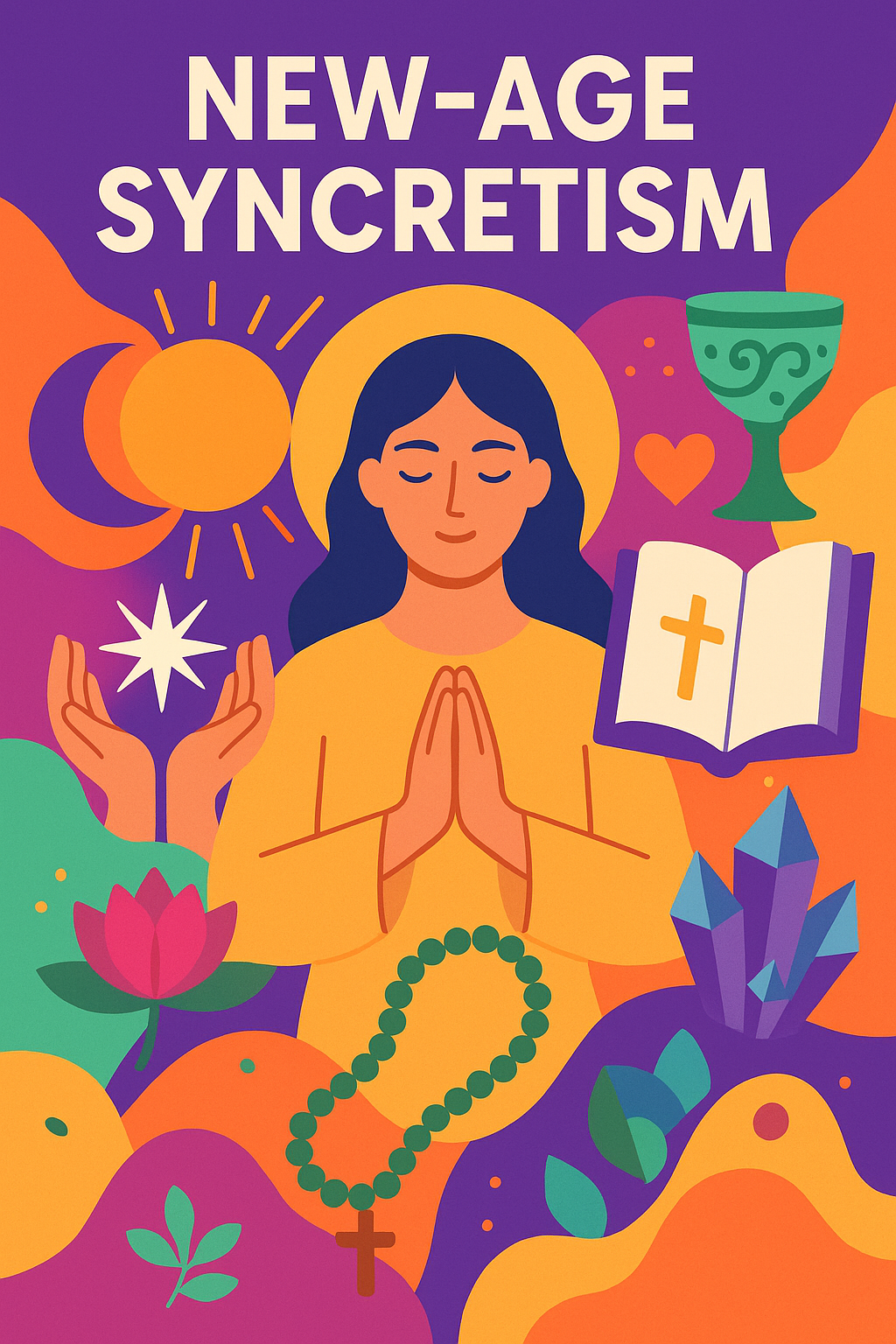
1) What is “New-Age syncretism”?
Syncretism means “mixing things together.”
New-Age syncretism happens when people take ideas from New-Age spirituality (like energy healing, crystals, Eastern meditation, or astrology) and mix them with Christianity.
It often sounds Christian on the outside, but underneath it changes the gospel and how we think about God.
2) Where did New-Age ideas come from?
The New-Age movement grew in the late 1800s and 1900s. It borrowed from Hinduism, Buddhism, occult practices (like fortune-telling and spirit guides), and the self-help movement of the 1960s–70s.
Today, many of these ideas have gone mainstream. Words like energy, meditation, mindfulness, inner light, and the universe are common in books, wellness apps, and even in some churches.
3) How does it show up in churches?
Here are some common ways:
• Meditation methods – Some churches use prayer methods copied from Buddhist or Hindu meditation. Instead of talking to God in prayer, the focus becomes emptying the mind or repeating a “sacred word.”
• God as “energy” – Instead of teaching God as a personal Creator and Father, some describe Him as a force or energy that flows through all things.
• Occult-style practices – Crystals, healing vibrations, or looking for secret spiritual experiences.
• Many paths to God – Some preachers suggest that Jesus is a way to God, not the only way.
4) Why is this dangerous?
1. It denies the uniqueness of Jesus. The Bible says Jesus is the only way to the Father (John 14:6).
2. It confuses God with creation. The Bible shows God made everything, but He is not the same as His creation (Colossians 2:8–10).
3. It opens the door to practices God forbids. Things like divination, fortune-telling, or spirit-contact are clearly condemned in Scripture (Deuteronomy 18:10–12).
4. It can lead to “another gospel.” Paul warned about people accepting “another Jesus” or “a different spirit” (2 Corinthians 11:3–4).
5) Bible verses that speak against it
• John 14:6 – Jesus said, “I am the way, and the truth, and the life. No one comes to the Father except through me.”
• Colossians 2:8–10 – Paul warns not to be taken captive by false philosophies and “elemental spirits.”
• Deuteronomy 18:10–12 – God forbids occult practices like fortune-telling, spirit mediums, or witchcraft.
• 2 Corinthians 11:3–4 – Paul warns the church about being led astray by another gospel or spirit.
6) Where do we see this today?
Some examples where New-Age influence has been noted:
• Richard Rohr and the Center for Action and Contemplation. Rohr talks about the “universal Christ.” Critics say his teaching blends Christianity with panentheism (the idea that God is in everything).
• Centering Prayer movement. This prayer practice, taught by people like Thomas Keating, often borrows meditation methods from Buddhism and Hinduism. Some Charismatic/
• Experiential ministries. For example, critics have said Bethel Church (Redding, CA) sometimes uses language or practices that look like New-Age spirituality (energy, mystical experiences).
• Christian yoga / mindfulness programs. Some retreats or books repackage Eastern spiritual practices with Christian labels.
Important: not everyone who uses words like “meditation” or “spiritual formation” is teaching error. But when those practices are rooted in non-biblical spirituality, they can pull people away from Christ.
7) How to test teachings and practices
Ask these questions:
1. Does it keep Jesus as the only way? (John 14:6)
2. Does it describe God as the Creator, separate from creation? (Col. 2:8–10)
3. Does it avoid occult-like practices? (Deut. 18:10–12)
4. Does it produce holiness and love for God, not just “spiritual experiences”? (2 Cor. 11:3–4)
8) Final encouragement
Not everything labeled “spiritual” is safe. Some practices sound peaceful or helpful but pull us away from the gospel. The Bible calls us to test everything and hold fast to what is good (1 Thess. 5:21).
Christ is enough. We don’t need secret knowledge, special techniques, or mystical tools to reach God. We already have Jesus, who gives us full access to the Father by His death and resurrection.
Leave a Reply