
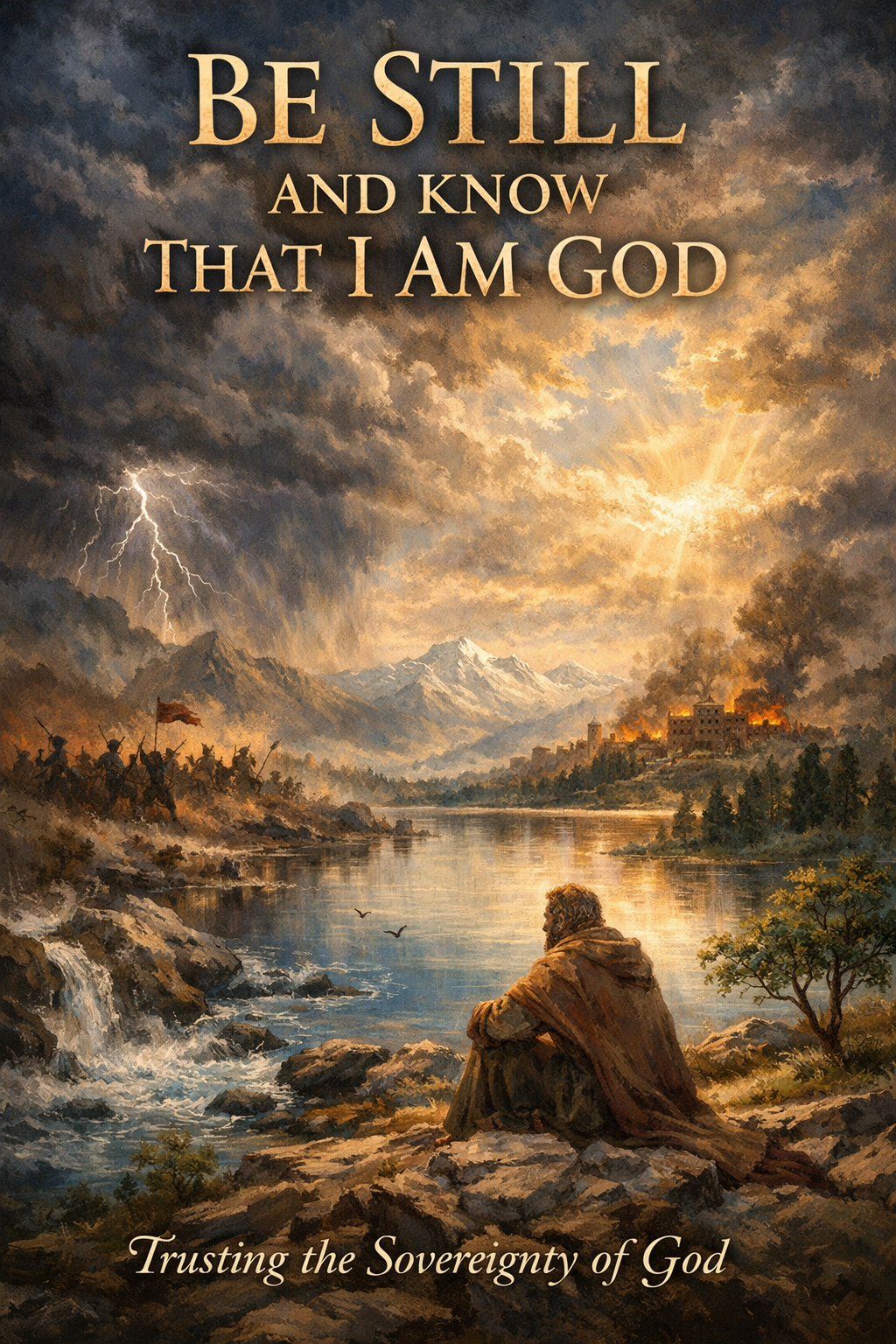
The command “Be still, and know that I am God” (Psalm 46:10) stands among the most quoted and yet most misunderstood verses in all Scripture. It is often lifted from its context and turned into a kind of spiritual slogan, something to soothe the anxious mind or calm the frazzled nerves. But a deeper, more faithful reading — attentive to the original language, the context of the psalm, and the broader witness of Scripture — reveals that God’s word here is far more potent, demanding, and transformative. This verse is not primarily a call to quiet meditation or interior emotion, but a command to cease striving, relinquish control, and acknowledge the supremacy of God over the world, the nations, and the believer’s own heart.
Psalm 46 is a song of confidence in the midst of overwhelming chaos. The psalm opens with words that could describe many moments in human history: “God is our refuge and strength, an ever‑present help in trouble” (Psalm 46:1). The scenes that follow are dramatic: “Though the earth give way and the mountains fall into the heart of the sea” (Psalm 46:2). Waters roar, nations rage, kingdoms totter (Psalm 46:3–6). These are not mild disturbances; they are metaphors of total disarray — political instability, cosmic upheaval, existential threat. Into this landscape God speaks: “Be still, and know that I am God” (Psalm 46:10). To understand this, we need to hear the force of the Hebrew term translated “be still.” The verb רָפָה (raphah) does not primarily mean silence or meditation as in the modern contemplative sense. Rather, it carries the sense of letting go, ceasing from striving, releasing one’s grasp — a command to stop exerting control and to recognize where true authority lies.
Viewed this way, Psalm 46:10 is not escapism; it is a call to surrender amid the storm. God is not inviting the worshiper to shrink from reality but to see reality accurately: God is sovereign over it. The psalmist’s world was politically uncertain; Israel’s neighbors waged wars, and shifting empires threatened Israel’s existence. Yet the psalm insists that even when human structures crumble and nature convulses, the Lord of hosts is with us; the God of Jacob is our fortress (Psalm 46:7). This fortress image echoes throughout Scripture. In God’s sovereignty, believers find refuge, not because their problems vanish, but because a faithful God remains immovable.
This theme of turning from human effort toward divine trust echoes elsewhere in the Old Testament. When Moses confronted Israel at the Red Sea with Pharaoh’s army behind them and no escape ahead, he declared, “Do not be afraid. Stand firm and you will see the deliverance the Lord will bring you today… The Lord will fight for you; you need only to be still” (Exodus 14:13–14). Here, stillness involves confidence in God’s power, not passivity. Israel’s deliverance required God’s action, not their flailing efforts. Their obedience was to trust, to stand firm — to be still as God acted.
Similarly, when Elijah fled from Jezebel and stood at Mount Horeb discouraged and exhausted, God’s presence was not in the earthquake, the wind, or the fire, but in the “gentle whisper” (1 Kings 19:11–12). Elijah had been running — a picture of frantic struggle — yet God’s response was calm, quiet, transformative presence. There is a pattern in Scripture: God’s salvation is often revealed not through human striving but through his sovereign initiative. Stillness, in this biblical sense, is a posture of trust in the God who speaks in what is steady, faithful, and ultimately powerful — even if quiet.
The wisdom literature of the Old Testament also teaches that wisdom begins with trust in God rather than self. “The fear of the Lord is the beginning of wisdom” (Proverbs 9:10), meaning that true understanding arises when we acknowledge God’s authority over our knowledge, our plans, and our lives. Proverbs contrasts trust in the Lord with reliance on human understanding: “Trust in the Lord with all your heart and lean not on your own understanding; in all your ways acknowledge him, and he will make your paths straight” (Proverbs 3:5–6). This is the very heart of Psalm 46:10’s implication — stillness emerges from trust, not from emotional control.
The prophets reaffirm God’s sovereignty over creation and nations. Isaiah declares that God sits enthroned above the nations (Isaiah 24:23; 40:22) and that sovereign counsel will stand (Isaiah 46:10). God’s word here anticipates Psalm 46’s announcement: God reigns not only over Israel, but over all the world’s powers. Micah declares that God will make nations “like a potter’s vessel” and that the nations’ strength will shrink in the day of judgment (Micah 4:13–14). These prophetic voices broaden our understanding of “Be still, and know that I am God.” It is not merely a personal exhortation but a theological proclamation: God’s sovereignty extends over nations, history, and every force that seems to defy him.
When we turn to the New Testament, we see the same theme carried forward in the life and teaching of Jesus Christ. Jesus repeatedly called people away from self‑effort and toward reliance on his authority. In his encounter with the storm on the Sea of Galilee, the disciples were terrified, yet Jesus “rebuked the winds and the waves, and it was completely calm” (Matthew 8:26). Then he rebuked the disciples’ fear: “You of little faith, why are you so afraid?” Jesus demonstrates that the true object of trust is not human strength but the One who commands the storm itself. The stillness Jesus offers is not merely external calm but inner confidence rooted in relationship with him.
Jesus further teaches that true rest is found in union with him. In calling the weary to come to him, he promises rest: “Take my yoke upon you and learn from me, for I am gentle and humble in heart, and you will find rest for your souls” (Matthew 11:28–29). The rest Jesus offers is not withdrawal from life but surrender of self‑rule; his yoke is gentle because it is shared with him. The Apostle Paul echoes this profound trust in Christ when he declares that Christians should present their burdens to God in prayer rather than be consumed by anxiety: “Do not be anxious about anything, but in everything, by prayer and petition, with thanksgiving, present your requests to God” (Philippians 4:6–7). This passage captures the heart of biblical stillness: release worry by bringing everything to God in prayer.
Paul also reminds believers that apart from Christ, “you can do nothing” (John 15:5), not as a statement of weakness, but as a proclamation of dependence on Christ. Our capacity to live faithfully, to endure suffering, to love others, to serve God — all are grounded in union with Christ, not in autonomous self‑effort. The writer of Hebrews similarly frames the Christian life in terms of rest. God’s rest remains for the people of God (Hebrews 4:9–11), a rest entered not through our works but by ceasing from our own labors and trusting God’s sustaining power. Rest in this context is theological trust expressed in obedience, not passive quietism.
The New Testament authors continually testify that human striving is insufficient for salvation, righteousness, or peace with God. Ephesians 2:8–9 proclaims that we are saved by grace through faith, not by works. If salvation does not come from human effort, then the life of faith after salvation likewise depends on God’s grace at work in us, not our own striving. James, writing to believers who face trials, urges them to “count it all joy” when facing trials (James 1:2–4) because trials test and strengthen faith. Rather than striving against circumstances, believers are called to trust God’s refining work within them.
The Apostle Peter exhorts Christians to cast all their cares on God because he cares for them (1 Peter 5:7), and he reminds them that the Lord’s patience with them demonstrates God’s desire for them to grow in holiness. This echoes the broader biblical pattern that stillness — letting go of control and trusting God — is a spiritual discipline that shapes character and deepens trust in God’s promises. Stillness, then, is not passivity; it is active trust in the context of obedience and hope.
The early church understood this posture of trust as central to the Christian life. The writer of Romans declares that nothing can separate believers from the love of God in Christ Jesus — neither death nor life, angels nor rulers (Romans 8:38–39). When Paul wrote to the Corinthians about weakness and strength, he declared that God’s power is made perfect in weakness (2 Corinthians 12:9). Again, the biblical pattern is clear: strength does not come from self‑assertion but from reliance on God’s power.
Returning to Psalm 46:10, we should hear this command in light of all these biblical voices. In the face of a trembling world, God calls his people to stop striving for control and to acknowledge his sovereign rule. Stillness is not emotional numbness or quietism; it is a theological posture of surrender. It is turning from self‑trust to divine trust, from fear to confidence in God’s character. And this posture finds its fullest expression in Jesus Christ, the one in whom the fullness of God dwells (Colossians 1:19) and through whom all things hold together (Colossians 1:17).
In practice, this means surrendering our anxieties, ambitions, and illusions of control to the Lord. It means coming to him in prayer, bringing our burdens, and trusting his timing and power. It means resting in his promises, even when circumstances seem overwhelming. It means believing that God is at work — in our lives, in our world, and in history itself — even when we cannot see the outcome.
Modern life constantly tempts us to control our own destiny, to manipulate outcomes, and to fear the unknown. But the Bible calls us instead to a deeper trust: to relinquish control and know God — not merely intellectually, but experientially, relationally, and obediently. God’s command to be still is both an invitation and a judgment: an invitation to trust him, and a judgment on the idolatry of self‑reliance.
In learning to obey this command, believers discover a peace that surpasses understanding (Philippians 4:7), a peace grounded not in circumstances but in the unchanging character of the God who reigns. The stillness God calls us to is the surrender of control, and the knowledge he invites us into is trust in his sovereign love. In this surrender, we discover that God truly is our refuge and strength, an ever‑present help in trouble — not distant, not indifferent, but present and powerful, carrying his people through every storm.
Leave a Reply