
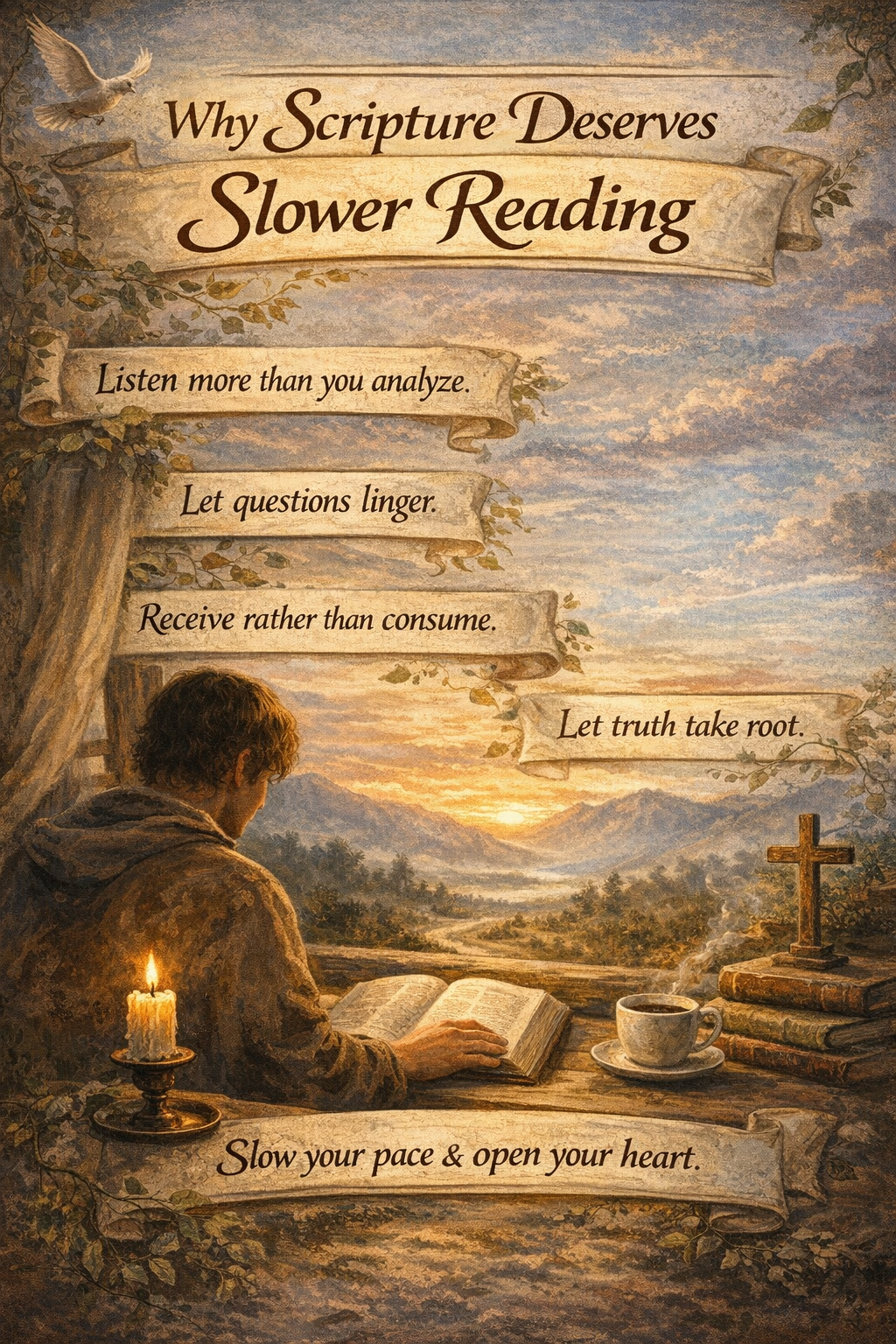
We live in an age trained to skim. Headlines are scanned, videos are sped up, and opinions are formed before a paragraph has finished loading. Efficiency is celebrated; patience is quietly discarded. And without realizing it, many Christians have brought this same posture to the Scriptures—treating the Bible less like holy ground and more like searchable content.
But Scripture was never meant to be rushed.
The Bible does not yield its deepest truths to hurried eyes or distracted minds. It asks for stillness. It requires attention. And it often resists the very pace modern life demands.
The Difference Between Consuming and Receiving
There is a profound difference between consuming Scripture and receiving it.
Consumption seeks information: What does this verse say? How can I apply it quickly? How can I use it to support a point? Receiving Scripture, on the other hand, is relational. It listens. It lingers. It allows the text to question us before we question it.
When we read too quickly, we often reduce Scripture to slogans—familiar verses detached from their context, weight, and intention. We move fast enough to feel informed but not slow enough to be transformed. The Word becomes something we master rather than something that masters us.
The irony is that many theological errors and spiritual anxieties are not born from ignoring Scripture, but from rushing it.
God Reveals Himself Gradually
One of the clearest testimonies of Scripture itself is that God reveals Himself over time.
He does not explain everything at once. He unfolds His purposes through covenants, promises, failures, exiles, silences, and fulfillments. The story of redemption moves slowly—often painfully so—because formation takes time. Character takes time. Understanding takes time.
To read Scripture quickly is to fight against its very nature.
Jesus did not overwhelm His disciples with instant clarity. He spoke in parables that confused before they clarified. He repeated Himself. He allowed misunderstanding to linger. Even after the resurrection, some still doubted. This was not inefficiency—it was discipleship.
Slow reading aligns us with the patience of God.
Speed Breeds Certainty; Slowness Cultivates Wisdom
Fast reading often produces fast conclusions. We highlight verses, make immediate judgments, and walk away confident we’ve “got it.” But confidence formed too quickly is often shallow.
Slower reading introduces friction—and friction produces humility.
When we linger over a difficult passage, we are forced to wrestle. We notice tensions instead of resolving them prematurely. We sit with questions that have no easy answers. We recognize how much context matters—historical, literary, and theological.
This kind of reading does not weaken faith; it deepens it. It forms Christians who are less reactionary and more discerning, less defensive and more rooted.
Wisdom rarely shouts. It speaks slowly, and it expects us to listen.
The Bible Is Not Optimized for Outrage
In a digital culture fueled by controversy, Scripture is often mined for ammunition. Verses are pulled into debates, reduced to proof texts, and deployed without care for tone, audience, or intent. Speed makes this easy—and dangerous.
Slow reading resists this misuse.
When we take time with a passage, we notice who is speaking, to whom, and why. We see that some words are corrective, some are poetic, some are descriptive rather than prescriptive. We realize that Scripture is not always addressing us directly, even when it is meant for us.
This kind of attentiveness protects us from distorting the Word in order to win arguments or stoke fear. It teaches us to handle Scripture with reverence rather than urgency.
Scripture Shapes Us Through Repetition, Not Novelty
Much of modern Christian engagement with the Bible is driven by the search for something new—a fresh insight, a viral angle, a surprising take. But Scripture forms us less through novelty and more through repetition.
The Psalms return again and again to the same themes: fear, trust, lament, praise. The prophets repeat warnings that go unheeded for generations. Jesus revisits the same truths with different illustrations. The apostles remind their readers of things they already know.
Slow reading allows repetition to do its work.
When we move patiently through familiar texts, we notice layers we missed before—not because the text changed, but because we did. Scripture meets us differently at different stages of life, but only if we give it the time to speak.
Slowness Is an Act of Reverence
To slow down before Scripture is not a technique; it is a posture.
It says, This Word is weighty.
It says, I am not in control of this encounter.
It says, God is not rushed, and neither should I be when listening to Him.
In a culture that prizes productivity, slow reading feels almost subversive. But perhaps that is exactly the point. The Kingdom of God has always moved at a pace that frustrates the impatient and forms the faithful.
Scripture deserves slowness because God deserves our attention.
And in giving it, we often discover that the Word has been patiently waiting for us all along.
Leave a Reply