
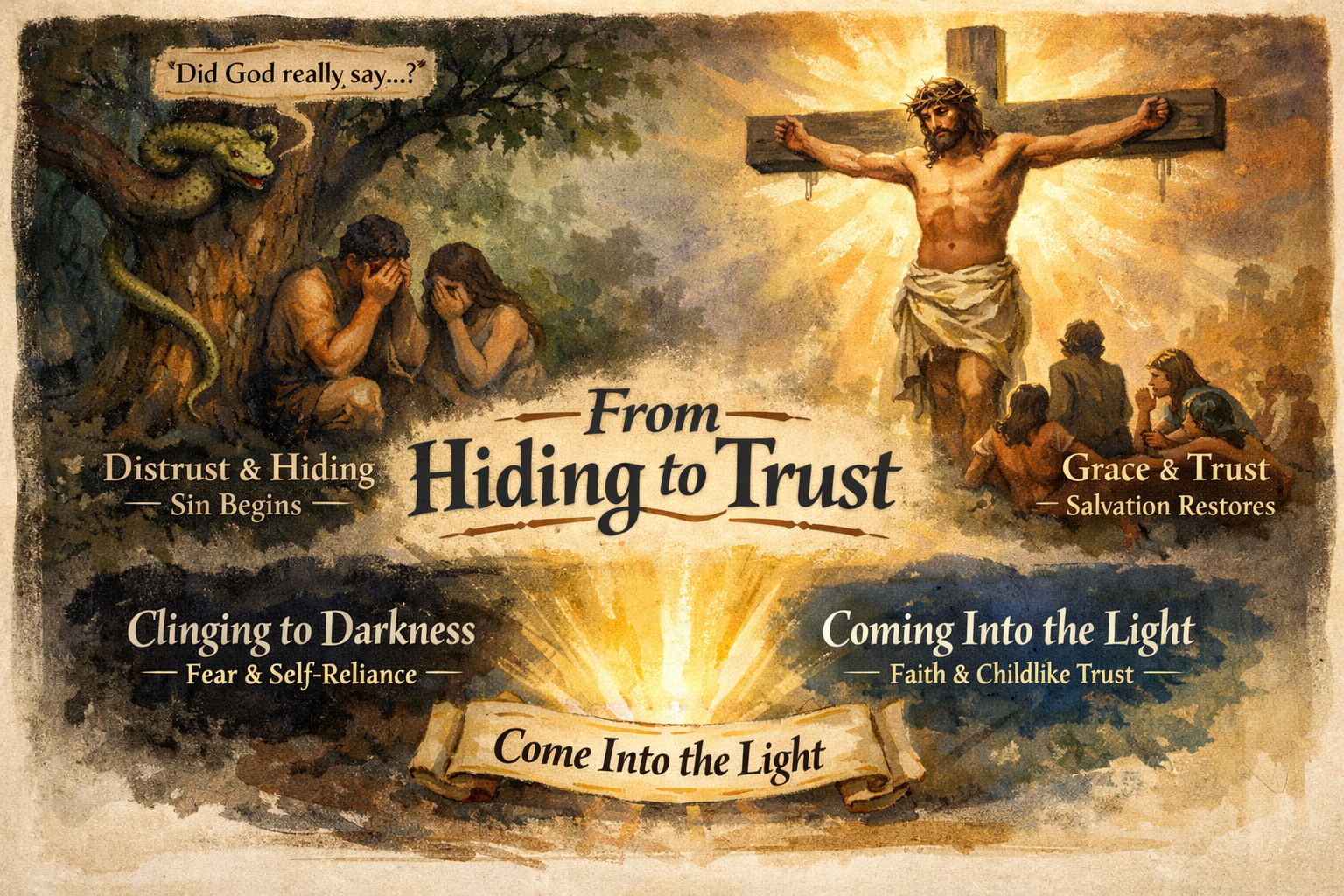
Many Christians grow up learning to think of sin primarily as rule-breaking and faith primarily as belief in correct doctrine. While neither of these ideas is wrong, they are incomplete. Scripture tells a deeper, more relational story—one that helps explain why people can obey outwardly and still feel distant from God, why fear so often masquerades as reverence, and why Jesus repeatedly calls people not to try harder, but to come.
At the heart of that story is a simple yet unsettling truth: sin is rooted in distrust of God, and salvation is the slow, gracious restoration of that trust.
The First Sin Was Not Appetite, but Distrust
When sin first enters the biblical story in Genesis 3, it does not begin with violence, excess, or open rebellion. It begins with a question: “Did God really say…?” The serpent does not directly deny God’s existence or authority. Instead, he plants doubt about God’s word, and then about God’s character. Is God telling the truth? Is He withholding something good? Can He really be trusted?
Eve’s decision to eat the fruit is not merely a lapse in self-control. It is the outcome of a deeper shift. God’s word is no longer assumed to be reliable, and His command is reframed as restrictive rather than protective. Trust fractures first. Disobedience follows.
But the story goes further. When Adam and Eve hear the sound of the Lord walking in the garden, they hide. This is not simply fear of punishment; it is evidence of how sin has altered their perception of God Himself. The presence that once meant safety now feels dangerous. The hiding is not a separate failure—it is the continuation of the same distrust. Eating the fruit questioned God’s word. Hiding questions God’s heart.
God’s response is revealing. He does not arrive with accusation, but with invitation. “Where are you?” Not because He lacks information, but because relationship requires openness. God is calling them back into the light they have fled. Even after their failure, God is still safer than hiding—but they no longer believe that.
Darkness Is Chosen Not Because Sin Exists, but Because Trust Is Broken
Jesus names this same dynamic centuries later in John 3. After proclaiming that God so loved the world that He gave His Son, Jesus explains why people remain judged. It is not because they sin—everyone sins. It is because light has come into the world, and people loved darkness rather than light because their deeds were evil.
This distinction is crucial. Condemnation is not triggered by the presence of sin, but by the refusal to come into the light with that sin. Darkness is chosen not because people believe they are righteous, but because they fear what will happen if they are fully seen. Exposure feels unsafe. Light feels threatening.
For many, this fear did not originate in conscious rebellion against God, but in experiences—sometimes deeply religious ones—where being seen led to shame, punishment, or rejection rather than mercy. In such environments, hiding felt like survival. Scripture does not ignore this reality; instead, it exposes how deeply the instinct to conceal ourselves can take root.
If God already knows our sin, why does coming into the light matter at all? Because confession is not about informing God; it is about aligning ourselves with reality. Hiding sustains the lie that we must protect ourselves from God. Coming into the light is the act of trusting that God’s response to truth will be mercy rather than rejection. Fellowship cannot exist where concealment is maintained. Healing happens in the light because trust is being rebuilt there.
Faith Under Pressure: When Trust Wavers Without Disappearing
Peter walking on the water gives us a living picture of how trust works—and how it falters. Peter steps out of the boat because he trusts Jesus’ word. He does the impossible as long as his attention remains fixed on Christ. But when the wind and waves overwhelm his senses, fear eclipses focus, and he begins to sink.
Jesus’ response is telling. “O you of little faith, why did you doubt?” This is not condemnation. Peter’s faith has not vanished; it has been strained. His doubt is not a rejection of Jesus, but a moment where circumstances are treated as more authoritative than Christ’s call. Even then, Peter cries out, “Lord, save me!”—a plea that reveals continued trust. Jesus immediately reaches out His hand.
Here we see the difference between struggling faith and hardened unbelief. Faith can tremble without collapsing. Doubt becomes destructive not when questions arise, but when fear leads us to withdraw rather than cry out.
When Doubt Is Part of Faith, and When It Becomes Sin
Scripture makes room for wrestling. The Psalms are full of prayers that question God’s timing, justice, and silence—yet they remain prayers. They are directed toward God, not away from Him. This is doubt within relationship, and God receives it.
Doubt becomes sinful when it hardens into refusal—when a person chooses self-protection over openness, darkness over light, distance over relationship. The dividing line is not between certainty and uncertainty, but between remaining relationally open and closing oneself off. Faith grows when doubt stays in conversation with God. It withers when doubt justifies hiding.
Why Children Enter the Kingdom First
When Jesus places a child among a group of adults and says that unless they become like children they will never enter the kingdom of heaven, He is not praising innocence or ignorance. He is naming posture.
Children do not manage their image. They do not build spiritual résumés. They do not negotiate worthiness before approaching a parent. They live in dependence. When afraid, they run toward safety, not away. When in need, they ask. Their posture is unguarded trust.
Adults—especially religious adults—learn self-management. They learn how to appear righteous while hiding fear and failure. Jesus says the kingdom cannot be entered this way. It is entered through trust, dependence, and openness—the very posture sin destroyed in Eden.
The Lie of Self-Reliant Religion
This is why the saying “God helps those who help themselves” sits so uneasily beside the gospel. It implies that divine help is activated by human competence. Scripture teaches the opposite. God helps the helpless. His power is revealed in weakness. Grace is not a reward for self-improvement; it is the means by which trust is restored.
Obedience matters, but it is always responsive, never initiatory. We act because God is already at work, not to convince Him to be.
The Cross: God Stepping Fully Into the Light
All of this finds its clearest expression at the cross. If hiding is humanity’s instinctive response to distrust, then the cross is God’s unambiguous declaration that He is not afraid of exposure. In Jesus, God steps fully into human shame, vulnerability, rejection, and suffering. He allows Himself to be seen, misunderstood, mocked, and condemned—not because He deserves it, but to dismantle forever the lie that exposure before God leads to destruction.
The cross is where God proves that His light heals rather than annihilates. God does not demand that humanity come into the light alone; He enters the darkness Himself and brings the light with Him. In Christ, God shows that He would rather bear our sin than lose relationship with us.
Judgment as the Consequence of Refused Trust
This reframes judgment itself. God’s judgment is not God becoming hostile; it is God honoring a person’s persistent refusal to trust Him. When people reject the light, God does not force intimacy. Judgment is not imposed from the outside—it is the result of remaining hidden. God’s holiness does not destroy those who come to Him; it exposes and heals. What destroys is clinging to darkness when light is freely offered.
Restoring Trust, Not Managing Sin
From Genesis to the Gospels, God’s work is consistent. He is not primarily managing sin; He is restoring trust. He seeks the hiding. He welcomes the exposed. He draws near before faith is strong. He remains faithful while trust is being rebuilt.
Salvation is not about becoming safe enough for God. It is about discovering that God is safe enough for us. Sin isolates because it convinces us otherwise. Grace heals because it proves the lie wrong again and again.
When the Thorn Remains: Trust That No Longer Depends on Outcomes
The Apostle Paul gives us a final, mature picture of what restored trust looks like when suffering remains. After pleading three times for his thorn in the flesh to be removed, Paul receives an answer—not of deliverance, but of assurance: “My grace is sufficient for you, for my power is made perfect in weakness.”
Paul’s response is striking. He does not hide his limitation or resent God’s refusal. Instead, he says he will boast all the more gladly in his weakness, so that Christ’s power may rest upon him. This boasting is not celebration of pain, but refusal to conceal. Paul steps fully into the light with his weakness still present.
Where Adam hid, Paul remains open. Where sin taught humanity to protect itself from God, grace teaches Paul that God can be trusted even when circumstances do not change. Trust here no longer depends on outcomes, but on relationship. God does not wait for Paul to become strong to be present. He meets him in acknowledged weakness.
Paul shows us the destination of the journey Scripture has been tracing all along: faith that no longer needs to manage appearances, explain unanswered prayer, or secure control. Faith that rests.
Coming Into the Light
The kingdom of heaven belongs to the unhidden—not the flawless, but the trusting. Not the self-sufficient, but the dependent. Not those who never doubt, but those who bring their doubt into the presence of God.
For many, the most difficult step is not obedience, but exposure—not moral effort, but trust. And even that trust is often fragile at first. Coming into the light is rarely a single, brave moment. More often, it is a slow relearning of safety. A tentative step. A whispered prayer. A willingness to be seen just a little more than before.
If you feel hesitant, weary, or unsure, that does not disqualify you. God is not standing at a distance, waiting for you to gather courage. He is already near. The desire to trust Him—even when mixed with fear—is itself evidence that grace is already at work.
Where have you been managing yourself instead of trusting God? Where have you learned to stay in the dark while still appearing faithful? Where might God be asking, not with accusation but with patience and care, “Where are you?”
From Eden’s garden to Jesus’ invitation, and even to Paul’s weakness that remained, the call has never changed—and it has never been rushed:
Come into the light—not because you are strong enough, and not because you have resolved all your doubts, but because God is gentle enough to meet you exactly where you are. Sin begins with distrust, faith begins with coming, and the kingdom is entered not by those who help themselves, but by those who discover—sometimes slowly—that God is already helping them, and always has been.
Leave a Reply