
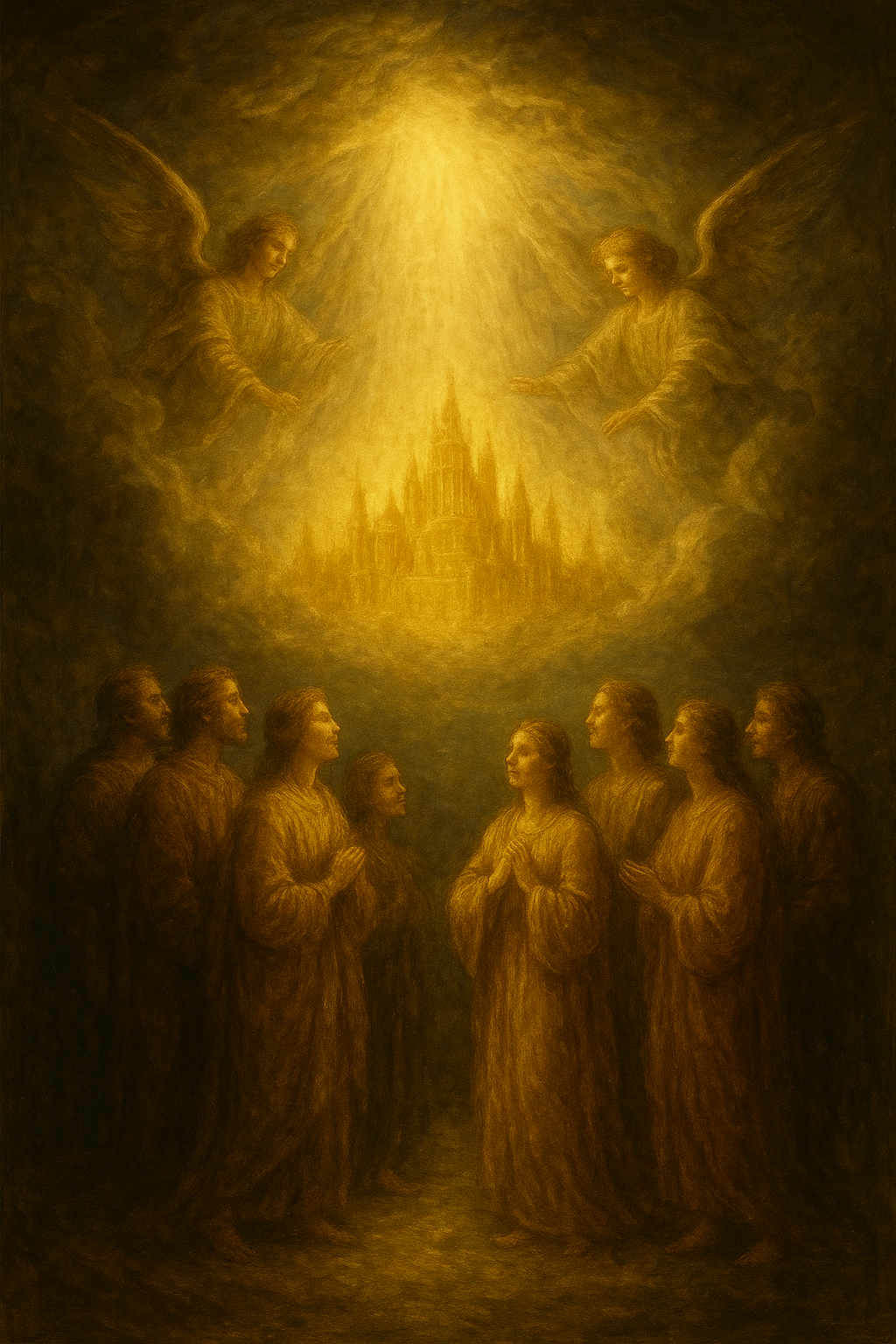
Introduction: A Question Worth Asking
“Doesn’t Scripture say we are not to speak to the dead?”
It’s one of the most sincere and necessary questions any believer can ask. The Bible is clear: God’s people are not to seek the dead, nor to look for secret wisdom from spirits (Deuteronomy 18:10–12; Isaiah 8:19).
And yet, for many centuries, Christians — especially within the Catholic and Orthodox traditions — have spoken about asking the saints to pray for them. To some, that sounds dangerously close to necromancy. To others, it sounds like family prayer across heaven and earth.
So what’s really going on?
Are Catholics and Orthodox Christians doing something the Bible forbids?
Or are they drawing from a deeper truth about what it means that “God is not the God of the dead, but of the living” (Luke 20:38)?
To answer that, we must journey from Scripture through history — across the first believers, the martyrs, the reformers, and the present — to see how the people of God have wrestled with this mystery for two thousand years.
1. The Bible’s Foundation: One Mediator, One Body
The New Testament speaks with unmistakable clarity:
“For there is one God and one mediator between God and mankind, the man Christ Jesus.”
— 1 Timothy 2:5
Jesus alone bridges the infinite gap between a holy God and fallen humanity. He is both Priest and Sacrifice, the One through whom all prayer rises and all grace flows.
But Scripture also shows that within that one Mediator, believers are bound together as one body:
“If one member suffers, all suffer together; if one member is honored, all rejoice together.”
— 1 Corinthians 12:26
That’s why Paul constantly urges the Church to pray for one another. Prayer is not a solo act — it’s the heartbeat of the family of God.
So in the beginning, there is no competition between Christ’s mediation and the prayers of His people. Christ is the bridge; the Church is the community that lives and breathes upon that bridge.
2. The Warning Against Seeking the Dead
At the same time, Scripture draws a strong line:
“Let no one be found among you who… consults the dead.”
— Deuteronomy 18:10–12
In the ancient world, pagans tried to summon spirits to gain secret knowledge or power. This practice, called necromancy, was an attempt to bypass God’s authority. Israel was to seek God’s voice — not whispers from the grave.
So the question naturally arises:
Is asking for the saints’ prayers the same thing?
The biblical answer depends on what you believe about death itself.
3. Are the Saints “Dead” or Alive in Christ?
Jesus confronted this question directly:
“He is not the God of the dead, but of the living, for all live to Him.”
— Luke 20:38
For those who belong to Christ, death is not destruction — it is transformation. The saints who have gone before us are not silent dust, but living members of the Body of Christ in His presence.
That’s why Hebrews 12 describes our life of faith as surrounded by “a great cloud of witnesses.”
Not spectators who simply watch from heaven’s bleachers — but fellow believers who have finished their race and now cheer us onward in Christ’s victory.
So from the earliest days, Christians saw no contradiction between saying:
- “Christ alone mediates salvation,” and
- “Those who live in Him continue to love, pray, and intercede.”
4. The Early Church: Love Stronger Than Death
In the first three centuries, when Christians often faced persecution and death, this truth became vividly real. The Church buried her martyrs with honor and gathered to celebrate their faithfulness. They would meet near their tombs — not to worship them, but to remember the triumph of Christ in them.
The Martyrdom of Polycarp (around A.D. 155) says plainly:
“We worship Christ as the Son of God, but we love the martyrs as disciples and imitators of the Lord.”
Over time, believers began asking those martyrs — who had already entered the Lord’s presence — to pray for the Church still struggling on earth.
It wasn’t about replacing Christ; it was about the unity of His body.
If death cannot separate us from the love of God (Romans 8:38–39), then it cannot separate us from one another in that love.
5. The Church Fathers: From Memory to Theology
By the fourth and fifth centuries, teachers like Cyril of Jerusalem, Basil the Great, and Augustine gave voice to what had already become the Church’s experience.
- The saints are alive in Christ.
- They pray continually for God’s will to be done.
- We may ask for their intercession, just as we ask a friend to pray for us.
Still, these early fathers were careful: worship belongs to God alone. Saints were honored, never adored. The distinction was crucial — and for centuries, the Church held it firmly.
By the late 700s, at the Seventh Ecumenical Council (Nicaea II), the Church formally clarified this difference:
- Worship (latreia) is for God alone.
- Veneration (dulia) is for saints and holy things, in honor of what God has done through them.
The Church on earth and the Church in heaven were understood as one choir — different voices, one song of praise.
6. East and West: One Faith, Two Expressions
By the year 1054, the Christian world divided into the Eastern Orthodox and Roman Catholic branches.
Both upheld belief in the intercession of the saints, but their emphasis diverged:
- The Orthodox Church focused on union with God (theosis) — seeing the saints as shining examples of what it means to share in God’s divine life.
For them, icons of the saints were windows to heaven, drawing worshipers into the reality of Christ’s victory over death. - The Catholic Church, shaped by the legal and hierarchical culture of the West, developed a theology of intercession and merit — seeing saints as elder brothers and sisters in God’s household who could pray for the Church and assist her in grace.
Though their language differed, both East and West agreed:
The saints do not replace Christ.
They magnify Him.
7. The Reformation: A Cry for Christ Alone
Fast-forward to the sixteenth century.
By then, devotion to saints in the Western Church had become, at times, excessive. Pilgrimages, relics, indulgences, and prayers directed to saints for favors blurred the line between veneration and worship.
The Reformers — Martin Luther, John Calvin, Ulrich Zwingli, and others — cried out for reform, calling the Church back to the simplicity of the gospel.
Luther’s View
Luther did not deny that the saints live and pray in heaven.
He simply said, Scripture gives us no command to invoke them.
For him, such invocation was unnecessary because believers already have direct access to the Father through Christ.
Calvin’s View
Calvin took an even firmer stance:
“To invoke the saints is to rob God of the honor due to Him.”
(Institutes of the Christian Religion, III.20)
He feared that any appeal to saints, however well-intended, could draw hearts away from the sole sufficiency of Jesus Christ.
Thus, the Protestant Reformation re-centered all prayer and mediation on Christ alone.
Salvation, intercession, and grace were seen as immediate gifts of the Savior, not to be sought through any heavenly intermediary.
8. The Catholic Response: Clarifying, Not Competing
In response, the Council of Trent (1545–1563) reaffirmed that:
- Christ is the one true Mediator and Redeemer.
- Saints intercede through Him, not apart from Him.
- The faithful may ask the saints for prayers, but worship is due to God alone.
- Superstitious abuses are to be rejected.
In other words, the Church defended the practice but sought to purify it — keeping Christ at the center.
9. The Orthodox Continuity: Heaven and Earth United
Meanwhile, in the Orthodox East, very little changed.
For them, the question was never about “many mediators” — it was about the living unity of the Church.
When they gather for worship, they believe heaven and earth are joined in one liturgy.
In their Divine Liturgy, they pray:
“Remembering our most holy, pure, blessed, and glorious Lady, the Theotokos, and all the saints, let us commend ourselves and one another and our whole life unto Christ our God.”
To the Orthodox, that prayer expresses what Revelation depicts — the saints and angels offering the prayers of the faithful before God’s throne (Revelation 5:8 and Revelations 8:3–4).
It’s not a competition between heaven and earth, but a communion of love that death cannot dissolve.
10. The Three Streams Today
After two millennia, the Church universal stands in three great traditions, each shaped by the same root but grown in different directions:
Protestant: They emphasize Christ Alone. Their understanding of the Saints is all prayer directed to God; they are honored as examples, not intercessors.
Catholic: They emphasize Communion and Intercession. Their understanding of the Saints is they intercede through Christ; prayer is family fellowship across heaven and earth.
Orthodox: They emphasize Union and Worship. Their understanding of the Saints is they participate in the Church’s heavenly worship; veneration honors God’s work in them.
All three confess one God, one Lord Jesus Christ, and one Spirit who gives life.
The difference lies not in who saves, but in how believers understand the living fellowship of that salvation.
11. What Unites Us All
Despite centuries of disagreement, there remains profound unity:
- God alone is worthy of worship.
- Jesus Christ alone is Savior and Mediator.
- The saints, whether in heaven or on earth, are all members of one Body.
- Death cannot sever the love that joins us in Christ.
Wherever one stands — Catholic, Orthodox, or Protestant — the ultimate invitation is the same:
Come boldly to the throne of grace. (Hebrews 4:16)
If the saints intercede, they do so only because Christ’s grace overflows through them.
And if we pray directly to God, it is only because the same Christ has torn the veil and brought us near.
12. The Living Fellowship
So, are Catholics and Orthodox “speaking to the dead”?
Not if those in Christ are truly alive.
Not if the Church is truly one body.
Not if Christ’s victory over death is as complete as Scripture declares.
But are Protestants right to guard against anything that clouds the glory of Christ’s unique mediation?
Absolutely. Every practice — ancient or new — must bow before that truth.
In the end, this isn’t about dividing lines, but about the mystery of love stronger than death.
The saints remind us that we belong to something far bigger than ourselves — a living Church that stretches across centuries, continents, and even the grave itself.
Conclusion: One Song, One Savior
From the first disciples to the present day, the people of God have asked the same questions, sometimes in different languages, sometimes through tears and fire.
But through it all, one truth has endured:
“Christ is all, and in all.” (Colossians 3:11)
He alone is the Mediator, the Bridge, the Life that death cannot touch.
And whether we speak of the saints above or the believers beside us, we speak of the same family — alive in Him.
When the Church prays — whether from pulpits or catacombs, monasteries or living rooms — heaven joins in.
Because in Christ, no prayer is ever prayed alone.
Leave a Reply