
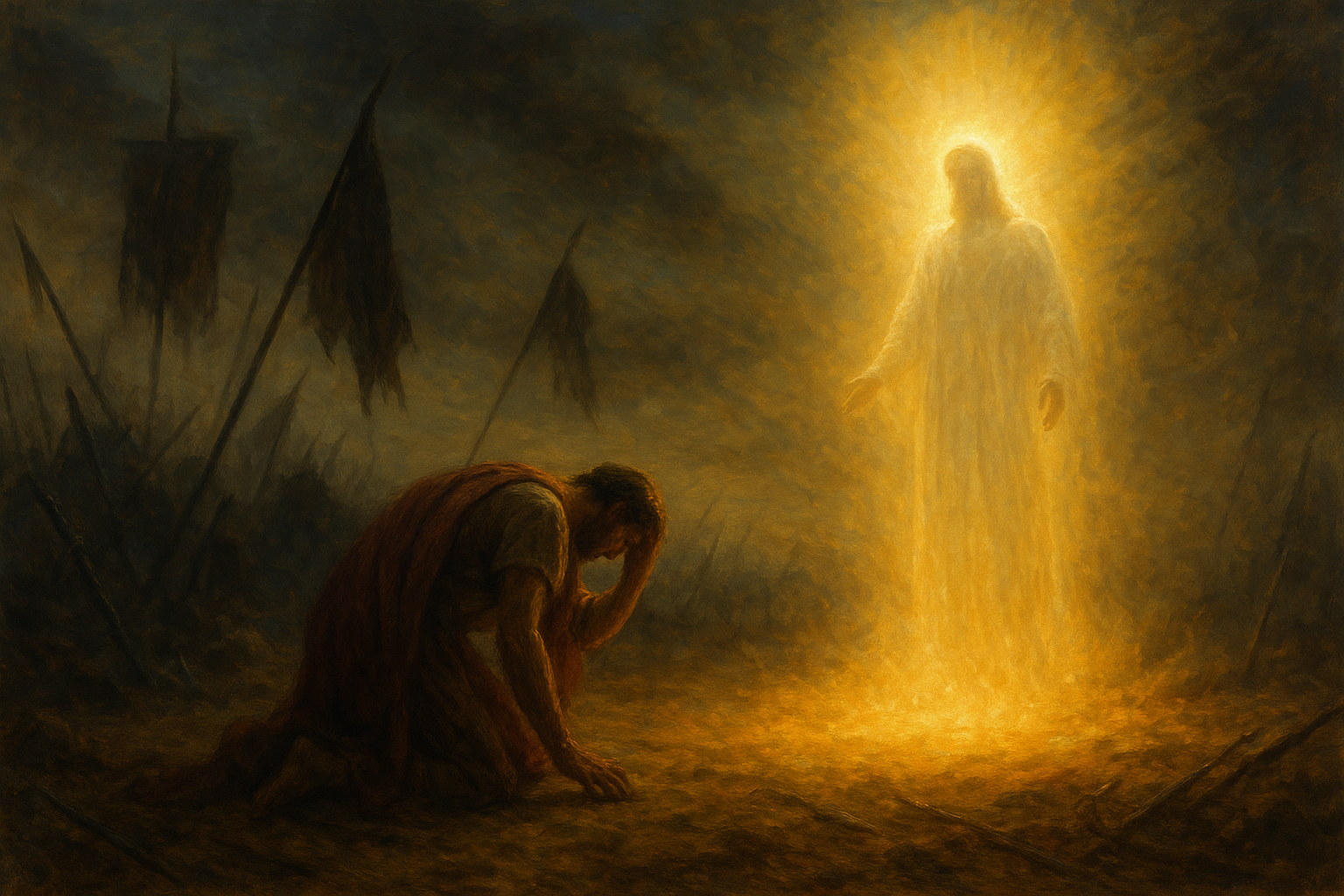
When Joshua stood before the walls of Jericho, he encountered a mysterious figure—a warrior with a drawn sword. Joshua, a seasoned commander, asked the obvious question: “Are you for us or for our adversaries?” (Joshua 5:13). The reply was stunning:
“Neither,” he replied, “but as commander of the army of the Lord I have now come.” (Joshua 5:14)
Joshua fell facedown in reverence. The lesson was unmistakable: God does not come to take sides in human struggles. He comes to establish His own kingdom, His righteousness, His holiness. The question was not whether God would align with Israel’s cause, but whether Joshua and Israel would align with God’s.
This same principle echoes throughout the whole of Scripture—from the prophets of old, to the teachings of Christ, to the counsel of the apostles. God is not a partisan deity, a tribal god, or a mascot for human agendas. He is the Lord Almighty, whose kingdom is not of this world (John 18:36).
God’s Grief Over Sin
From the beginning, God has grieved over humanity’s rebellion. Before the flood, we read: “The Lord regretted that He had made man on the earth, and it grieved Him to His heart” (Genesis 6:6). His grief was not that He had erred in creating us, but that sin had so corrupted His image-bearers that violence and wickedness filled the earth.
Through the prophets, God’s heart breaks again and again. Hosea captures it powerfully: “My heart recoils within me; all my compassion is aroused” (Hosea 11:8). Jeremiah weeps with God over the devastation of His people: “Since my people are crushed, I am crushed; I mourn, and horror grips me” (Jeremiah 8:21).
God does not take pleasure in judgment. “Do I take any pleasure in the death of the wicked? declares the Sovereign Lord. Rather, am I not pleased when they turn from their ways and live?” (Ezekiel 18:23). Sin wounds His holiness and grieves His Spirit (Ephesians 4:30).
God’s Compassion for the Righteous
Yet God’s grief is not limited to sin alone. He is deeply moved by the suffering and loss of His people. The psalmist declares: “Precious in the sight of the Lord is the death of His saints” (Psalm 116:15). Isaiah explains that when the righteous perish, sometimes it is to spare them from evil, and they enter into peace (Isaiah 57:1–2).
Jesus Himself revealed this heart. At Lazarus’s tomb, though He knew He would raise His friend, He wept (John 11:35). He was not indifferent to death’s sting or the sorrow of Mary and Martha. Likewise, He wept over Jerusalem, lamenting their blindness to God’s peace (Luke 19:41–42).
This same compassion is expressed eternally: “He will wipe every tear from their eyes. There will be no more death or mourning or crying or pain” (Revelation 21:4).
God Is Not on Our Side, but Calls Us to His
Joshua’s encounter reveals a truth the Church desperately needs today: God does not pledge allegiance to human banners. He is not Republican or Democrat, not American or Middle Eastern, not capitalist or socialist. He transcends every nation, ideology, and culture.
“No king is saved by the size of his army” (Psalm 33:16). “Some trust in chariots and some in horses, but we trust in the name of the Lord our God” (Psalm 20:7). “My thoughts are not your thoughts, neither are your ways my ways, declares the Lord” (Isaiah 55:8).
Jesus carried this forward when He declared, “My kingdom is not of this world” (John 18:36). Paul reminds us that “we do not wrestle against flesh and blood, but against… the spiritual forces of evil” (Ephesians 6:12). James exhorts us that “the wisdom from above is first pure, then peace-loving, considerate, submissive, full of mercy and good fruit” (James 3:17).
In other words: God is on the side of righteousness, justice, mercy, love, and peace. The real question is never, “Is God on my side?” but rather, “Am I on His?”
The Apostolic and Prophetic Call Today
The Church in our time is tempted—just as Israel was—to co-opt God for worldly purposes. Many pulpits preach messages shaped more by culture than by the cross. Churches rally behind politics, entertainment, or wealth, seeking influence more than holiness.
But the prophetic word resounds: “Come out from among them and be separate, says the Lord” (2 Corinthians 6:17). We are called not to be conformed to this world, but transformed by the renewing of our minds (Romans 12:2). Our mark is not political loyalty, but Christlike love: “By this everyone will know that you are my disciples, if you love one another” (John 13:35).
The apostolic charge is clear: align with the kingdom of God, not the kingdoms of men. Love righteousness. Pursue holiness. Walk humbly with your God (Micah 6:8).
A God Who Weeps and Wars for Righteousness
The God of Scripture is both warrior and Father—holy and compassionate. He grieves over sin, He mourns with the broken, and He calls His people to His side, not theirs. His war is not for land or politics, but for souls. His tears are not weakness, but love revealed.
At the cross, we see both grief and compassion collide: Jesus bore the grief of our sins and the pain of our death, so that through Him we might be reconciled. And in the resurrection, He triumphed, proving once and for all that His kingdom will stand forever.
Conclusion: Aligning With God’s Side
So how should we live? We must:
Refuse to drag God into our earthly factions, Surrender our agendas to His holy purposes, Love one another as Christ has loved us, Grieve over sin as He does, and comfort the suffering as He does, Live as pilgrims and strangers, whose citizenship is in heaven (Philippians 3:20).
God is not on our side. He calls us to be on His—on the side of truth, righteousness, mercy, peace, and eternal love.
As Joshua learned before Jericho, the true question is not, “Whose side is God on?” but, “Have I bowed before Him, laid down my sword, and taken my stand on His holy ground?”
Leave a Reply