
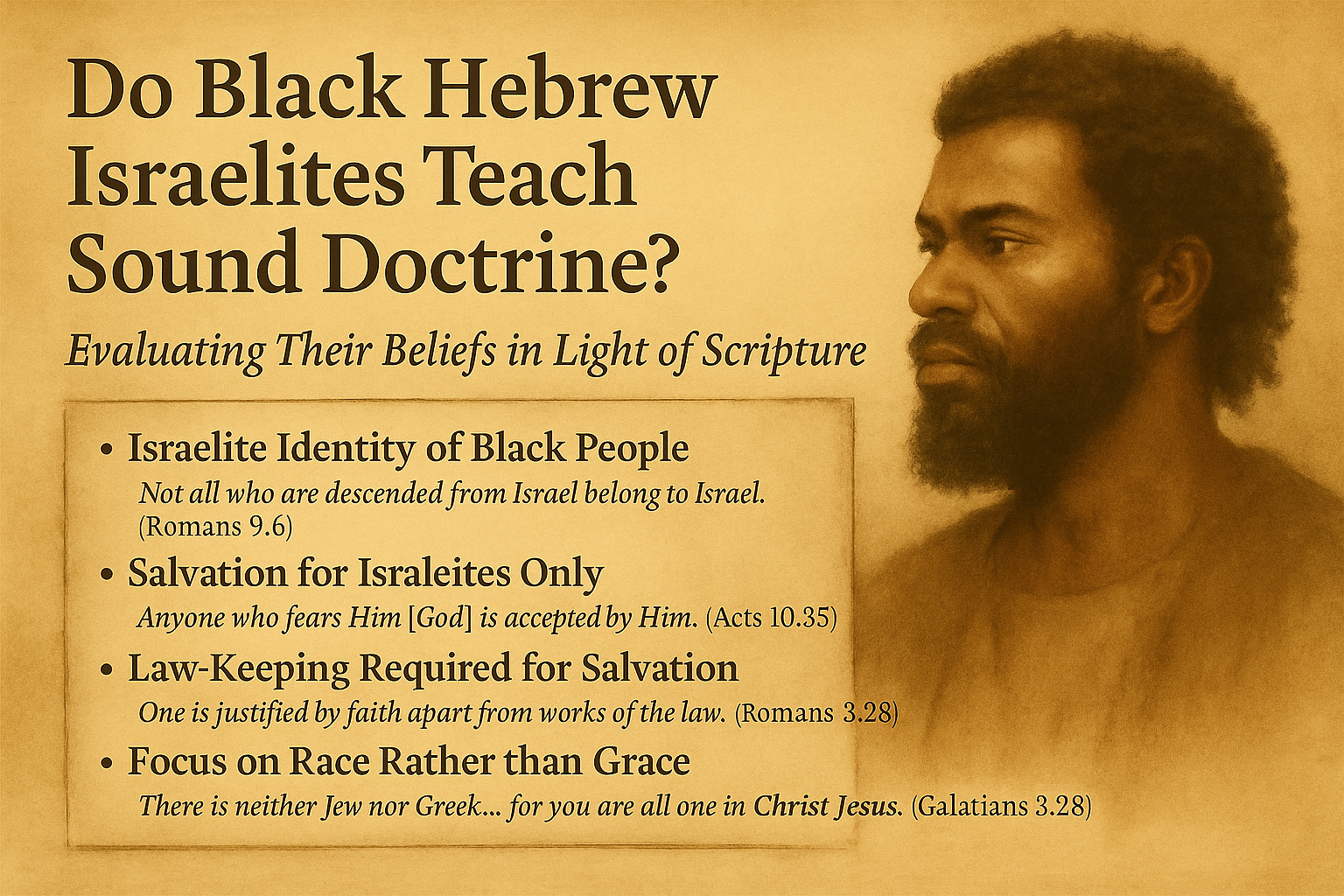
The Black Hebrew Israelites (BHI) are a movement of religious groups who believe that African Americans (and often Latino and Native American communities) are the true descendants of the ancient Israelites. While their claims resonate with some because of historical injustices and identity struggles, their beliefs and practices often diverge sharply from the teachings of the Bible and New Testament salvation through Christ.
📜 Historical Origins of the Black Hebrew Israelites
Late 1800s–Early 1900s: The Founders
Frank Cherry and William Saunders Crowdy were two of the earliest BHI leaders. They claimed to receive visions that revealed African Americans as the true descendants of biblical Israel. Crowdy founded the Church of God and Saints of Christ in 1896, mixing Old Testament laws with some New Testament practices.
These early movements focused on biblical observance, moral living, and black identity but were not typically hostile or radical.
🏛️ Institutional Growth & the Move to Israel
In the 1960s, Ben Ammi Ben-Israel led a migration of BHI followers from the U.S. to Israel, forming the African Hebrew Israelites of Jerusalem. After initial tension, Israel granted them residency in 2003. This branch is more peaceful and community-focused than later urban BHI sects.
🔥 Radicalization in the Streets and Online
In recent decades, some BHI groups (e.g., ISUPK, IUIC, GOCC) became known for aggressive street preaching, claiming:
Modern Jews are imposters Salvation is only for Israelites (Blacks, Latinos, Native Americans) Jesus (Yahawashi) was a Black man and only came to save Israelites
They often preach using a 12 Tribes Chart, which is not found in the Bible, assigning racial groups to the tribes of Israel.
🌐 21st Century Spread: Social Media and Controversy
BHI messages have gone viral on platforms like YouTube and TikTok, particularly among younger Black and Latino audiences. Their confrontational style draws attention, but it has also led to accusations of promoting hate speech. Some fringe groups have been labeled extremist by the Southern Poverty Law Center (SPLC) and ADL.
📖 Do Their Teachings Align with Scripture?
❌ Key Errors in Doctrine
Racial Salvation: The idea that only Israelites are saved contradicts John 3:16, Romans 10:12–13, and Galatians 3:28, which affirm salvation is available to all through faith in Christ. Legalism Over Grace: Many groups emphasize keeping the Torah to be saved, ignoring Ephesians 2:8–9, which teaches that salvation is by grace through faith. Denial of Gentile Inclusion: The New Testament repeatedly shows Gentiles becoming part of God’s people (Acts 10, Romans 11).
✅ What They Get Right
Emphasis on moral living and lawfulness Observance of biblical feasts and Sabbath (though not required under the New Covenant) Desire to reclaim lost history and heritage
💬 What Did Jesus and the Apostles Teach About Salvation?
Jesus taught that salvation is for all who believe in Him, regardless of ethnicity:
“For God so loved the world, that He gave His only Son, that whoever believes in Him shall not perish but have eternal life.” – John 3:16
Paul echoes this:
“There is no difference between Jew and Gentile—the same Lord is Lord of all and richly blesses all who call on Him.” – Romans 10:12
The New Testament never teaches that salvation is racially exclusive. Instead, it calls for faith in the Son of God and new life through the Spirit.
Final Reflection
The desire for identity and dignity is real—and Scripture offers both. But salvation does not come through race, nationality, or law-keeping. It comes through faith in Jesus Christ, the Lamb of God who takes away the sin of the world.
“Everyone who calls on the name of the Lord will be saved.” – Romans 10:13
Quick Comparison: Black Hebrew Israelites vs. Biblical Christianity
The Black Hebrew Israelite (BHI) movement teaches that salvation is based on racial identity—specifically being a descendant of the 12 tribes of Israel—while biblical Christianity teaches that salvation is available to all people through faith in Jesus Christ (Romans 10:9). BHI focuses on physical lineage and the law, but Scripture emphasizes spiritual rebirth (John 3:3).
In terms of the Messiah, some BHI sects teach that Jesus (often referred to as Yahawashi) came only for Israelites, while the Bible clearly states that Jesus died for the sins of the whole world (1 John 2:2). While BHI groups often include extra-biblical writings like the Apocrypha, biblical Christianity holds to the 66 books of the Old and New Testaments as the inspired Word of God.
Their outreach styles also differ—many BHI camps use a confrontational tone, especially in public preaching, while Christian evangelism is centered around speaking the truth in love with gentleness and respect (1 Peter 3:15).
Leave a Reply