
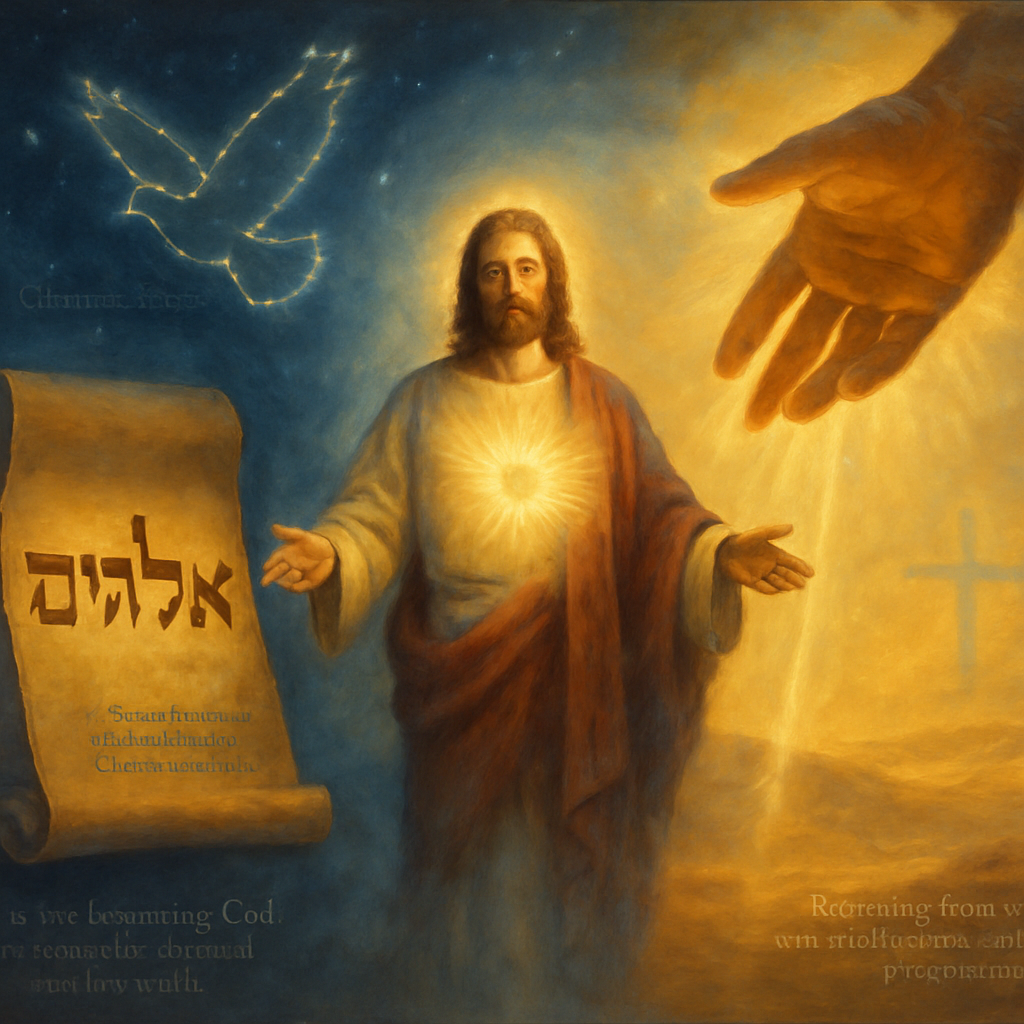
“In the beginning God created the heavens and the earth.” (Genesis 1:1)
Most believers know this verse well, but few pause to notice that the Hebrew word used for “God” is Elohim—a grammatically plural noun. Yet the verb “created” (bara) is singular. Why the mismatch?
From the very first sentence of Scripture, God reveals something about Himself: He is plural in persons, yet united in action. Not gods, but one God expressed in more than one person.
The Spirit Hovering – Genesis 1:2
“And the Spirit of God was hovering over the waters.”
The Spirit (Ruach Elohim) is mentioned distinctly, yet still acting in perfect unity with Elohim. The verb “hovering” is singular—again showing one divine action, though more than one divine person is present.
Ancient Jewish sages imagined the Spirit hovering like a dove. This image becomes clearer in the New Testament when the Spirit descends upon Yeshua at His baptism “like a dove” (Matthew 3:16). Just as the Spirit hovered over the waters in the first creation, He now rests upon the Son to begin the work of new creation.
The Light Before the Sun – Genesis 1:3
“Then God said, ‘Let there be light,’ and there was light.”
Before the sun or moon were created, there was Light. Yeshua later said, “I am the Light of the world. Whoever follows Me will not walk in darkness” (John 8:12). This Light is more than physical—it’s spiritual life through the Son.
Creation shows us a pattern: The Spirit prepares, the Word speaks, and Light enters. The same happens in salvation. The Spirit convicts, the Son is revealed, and those who believe become a new creation (2 Corinthians 5:17).
Let Us Make Man – Genesis 1:26
“Let Us make man in Our image, according to Our likeness.”
Why does God say “Us” and “Our” if He is one? Again, Elohim is plural. Just as man is created as male and female—two persons with shared nature—so God reveals a plurality within His one divine nature.
Yet immediately after, it says, “God created man in His own image.” Singular again. This pattern of plural and singular continues throughout Scripture to show unity without confusion of persons.
The Word Who Was God – John 1:1-5
“In the beginning was the Word, and the Word was with God, and the Word was God.”
John mirrors Genesis 1 on purpose. He shows us that the Word (Yeshua) was not only present at creation—He was God Himself. All things were created through Him.
Then in John 1:14, “The Word became flesh and dwelt among us.” God became man—not another god, but the same divine nature made visible in the Son.
And John adds: “No one has ever seen God; the only begotten God who is in the Father’s bosom, He has made Him known” (John 1:18). The Father is unseen, but the Son reveals Him.
The Great Commission – Matthew 28:18-20
“All authority in heaven and on earth has been given to Me… baptizing them in the name of the Father, and of the Son, and of the Holy Spirit.”
Notice: one name, yet three persons. The Son speaks of the Father, the Son, and the Spirit—not as roles or titles, but distinct identities sharing one name. This is the clearest teaching of the Triune nature of God from Yeshua Himself.
And Yeshua receives worship—something reserved for God alone (Matthew 28:17). If He were not God, He would have rebuked them. But instead, He affirms His divine authority and promises His abiding presence: “I am with you always.”
How the Triune God Works
A child once explained it like this: The Father is like the architect who wills and plans, the Son is the voice who speaks the will, and the Spirit is the power who brings it to pass. This simple picture reflects the truth of Scripture:
The Father sends (John 20:21), The Son obeys and speaks (John 12:49), The Spirit proceeds and empowers (John 14:26).
And yet Deuteronomy 6:4 remains true: “Hear, O Israel: The Lord our God, the Lord is one.”
Why This Matters
Understanding who God is matters deeply. We are not saved by vague belief in a higher power, but by trusting in the true God who has revealed Himself as Father, Son, and Holy Spirit.
We must study Scripture carefully—not just in English, but where possible looking into the Hebrew and Greek roots. Many misunderstandings and divisions arise when we miss the fullness of what God has revealed.
The early believers knew this God personally. They worshiped the Father, followed the Son, and walked in the power of the Spirit. We are called to the same life of communion with all three—yet One.
Final Encouragement
Don’t be content with secondhand teaching. Ask, seek, and knock (Matthew 7:7). Let the Holy Spirit guide you into truth (John 16:13). Test all things by the Word. And honor Elohim—not as an idea, but as the living, Triune God who made you, saved you, and now lives in you.
If this teaching has helped you, share it with others. The more we know the One true God, the more we grow in love, unity, and truth.
Leave a Reply