
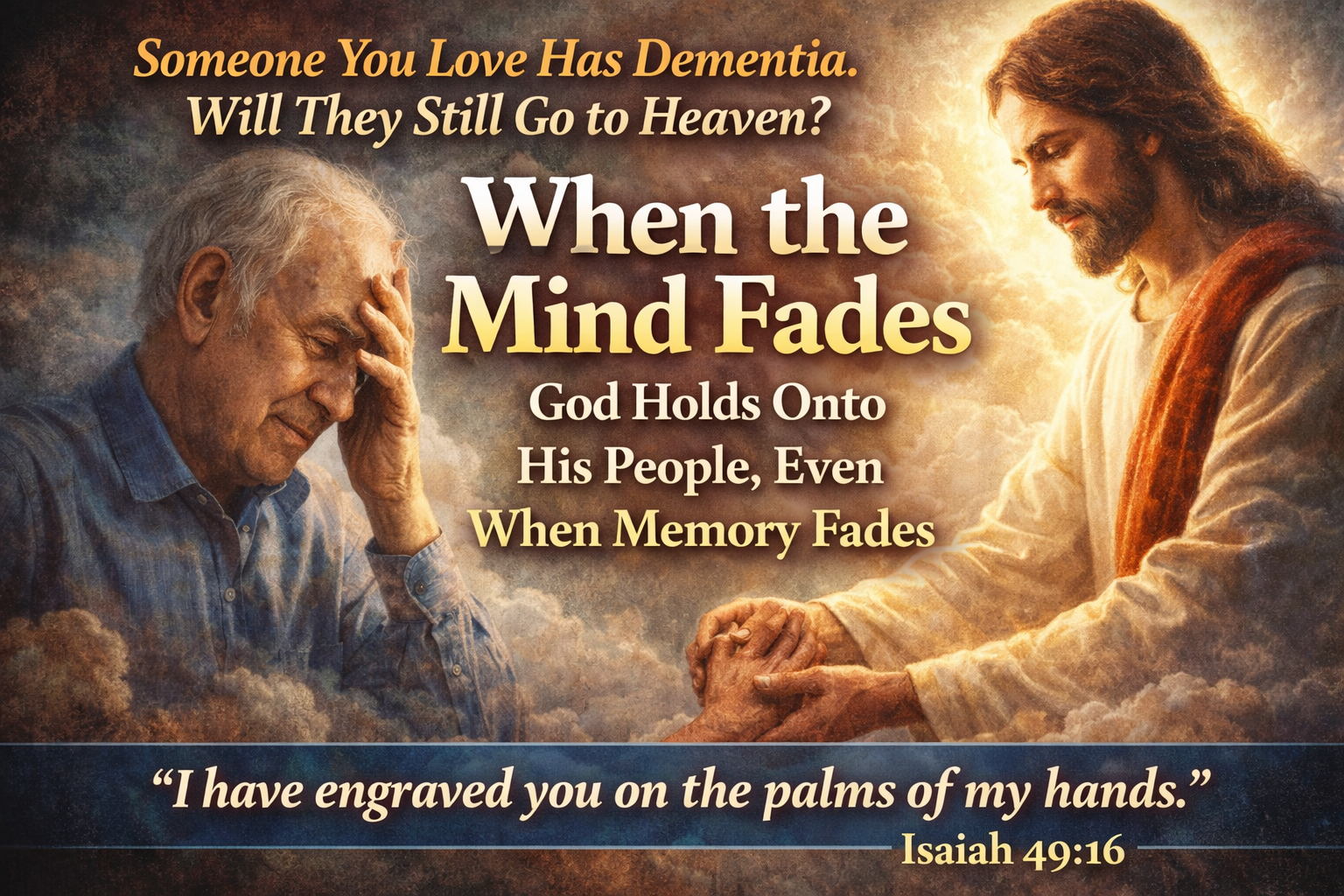
Few experiences are more painful for a family than watching a loved one slowly lose their memory. Diseases such as Dementia and Alzheimer’s disease can gradually erode a person’s ability to remember names, recognize loved ones, control their emotions, and understand their own behavior. A person who once spoke clearly about their faith may eventually struggle to form sentences. Someone who was gentle and thoughtful may begin saying harsh or inappropriate things that seem completely out of character.
For many Christian families, this leads to a deeply troubling question: If someone develops dementia and becomes unaware of their behavior, will they still go to heaven? Some worry that the loss of mental clarity might somehow separate a believer from Christ. Others fear that if a person no longer remembers God, confesses sin, or understands their actions, their salvation may somehow be at risk. These concerns are understandable, but when we look carefully at Scripture, we find that the Christian hope does not depend on the stability of the human mind. It depends on the faithfulness of God.
The Bible consistently teaches that salvation rests on the grace of God, not on the ongoing strength or clarity of a person’s mental abilities. The apostle Paul writes in Ephesians 2:8–9, “For by grace you have been saved through faith. And this is not your own doing; it is the gift of God, not a result of works, so that no one may boast.” Salvation is not sustained by perfect memory, emotional stability, or intellectual sharpness. It is sustained by the work of Christ and the faithfulness of God to keep His people. Jesus Himself emphasized this when He said in John 10:27–28, “My sheep hear my voice, and I know them, and they follow me. I give them eternal life, and they will never perish, and no one will snatch them out of my hand.” The security of the believer rests not in the believer’s ability to hold onto Christ, but in Christ’s promise to hold onto His people.
Understanding the nature of dementia also helps clarify why these fears, though understandable, do not align with the biblical picture of salvation. Dementia is not primarily a spiritual condition; it is a medical condition that affects the brain. Neurologically, diseases like Alzheimer’s damage brain cells and disrupt the networks responsible for memory, judgment, emotional regulation, and behavior. As the disease progresses, the brain loses the ability to process information in the same way it once did. A person may say things they never would have said before or behave in ways that do not reflect their character or convictions. In many cases, they are genuinely unaware of what they are doing or saying. This loss of awareness is not a moral failure; it is the result of physical deterioration within the brain.
Scripture recognizes the distinction between the physical body and the inner person. The apostle Paul speaks about this reality in 2 Corinthians 4:16 when he writes, “So we do not lose heart. Though our outer self is wasting away, our inner self is being renewed day by day.” Illness can affect the body, including the brain, without destroying the deeper spiritual reality of a person’s relationship with God. A damaged brain may prevent someone from expressing faith clearly, but that does not mean the faith that once existed has vanished. In many ways, dementia limits the outward expression of the inner life, much like a damaged instrument can distort the music played through it. The musician remains the same, even if the instrument no longer functions properly.
The Bible also teaches that God judges human beings with perfect knowledge of their understanding and ability. Jesus acknowledged different levels of accountability when He said in Luke 12:47–48 that the servant who knew his master’s will and failed to act would receive a harsher judgment than the servant who acted in ignorance. This principle reveals that God evaluates human actions in light of what a person actually knows and understands. When a disease like dementia destroys a person’s awareness or self-control, their actions are not evaluated in the same way as someone acting with full understanding. Scripture never presents God as a judge who ignores human limitations. Instead, He is portrayed as perfectly just and deeply compassionate.
The character of God is one of the strongest sources of comfort when confronting questions that Scripture does not address in precise medical terms. The Bible repeatedly describes God as both just and merciful. Deuteronomy 32:4 declares, “The Rock, his work is perfect, for all his ways are justice.” At the same time, Psalm 103:13–14 says, “As a father shows compassion to his children, so the Lord shows compassion to those who fear him. For he knows our frame; he remembers that we are dust.” These passages remind believers that God understands human frailty far more clearly than we do. He is not surprised by neurological disease, and He does not hold people morally responsible for what they cannot understand or control.
Mental health professionals who work with dementia patients often observe something that many families find both mysterious and comforting. Even when memory and reasoning deteriorate significantly, certain deeply embedded emotional or spiritual patterns may remain. Some patients who can no longer remember the names of their children still respond emotionally to familiar hymns or prayers. Others show moments of peace or recognition during spiritual conversations even when they struggle with ordinary communication. While such moments do not prove anything doctrinally, they illustrate an important reality: human consciousness and identity are deeper than surface-level memory. The brain may lose the ability to retrieve information, yet the deeper aspects of a person’s identity can remain present in ways that are difficult to measure medically.
From a biblical perspective, this observation aligns with the idea that the human person is more than the brain alone. Scripture teaches that human beings are created in the image of God and possess both physical and spiritual dimensions. When disease damages the brain, it affects the physical mechanism through which thoughts and memories are expressed. However, the soul itself is not reduced to the neurological processes of the brain. This is why believers have historically affirmed that the self continues beyond physical death. Dementia may obscure a person’s personality and memory in this life, but it cannot erase the deeper reality of who they are before God.
Another important truth emerges when we consider the future hope promised in the gospel. The Christian hope is not merely survival after death but complete restoration. In 1 Corinthians 15, the apostle Paul describes the resurrection of believers and explains that the body that is buried in weakness will be raised in power. What is sown in corruption will be raised in incorruption. This promise includes the restoration of the whole person. The believer who struggled with confusion, memory loss, or mental illness in this life will not carry those limitations into eternity. When Christ raises His people, their minds and bodies will be made whole. The fog of dementia will disappear completely in the presence of God.
For families caring for loved ones with dementia, this truth provides both theological clarity and emotional comfort. Watching someone decline mentally can feel like losing them little by little. Conversations become shorter, memories fade, and sometimes the person you knew seems to vanish behind the disease. Yet the gospel assures believers that this is not the final chapter of their story. The confusion we see now is temporary. The identity God knows and loves remains intact, even when we struggle to recognize it.
Caregivers often carry an additional burden of guilt when their loved one begins acting aggressively, speaking harshly, or behaving in ways that conflict with their former character. It is important to understand that these behaviors are frequently the direct result of neurological damage affecting impulse control, emotional regulation, and judgment. In many cases, the individual would be deeply distressed if they could fully understand their own actions. Recognizing this can help families respond with compassion rather than interpreting the behavior as a spiritual failure. Just as we would not blame someone for losing the ability to walk after a stroke, we should not interpret dementia-driven behavior as a reflection of the person’s moral or spiritual condition.
Ultimately, the question of dementia and salvation directs us back to the foundation of Christian hope: the faithfulness of God. Salvation does not depend on a believer’s ability to maintain perfect understanding or consistent behavior throughout life. It depends on the finished work of Christ and the promises of God to preserve those who belong to Him. Romans 8:38–39 declares that neither death nor life, nor anything else in all creation, will be able to separate believers from the love of God in Christ Jesus. If nothing in creation can separate us from God’s love, then the deterioration of the brain caused by disease certainly cannot do so.
In the end, dementia reminds us of the fragile nature of the human body and the deep compassion of God toward His creation. The Lord who formed the human mind also understands its limitations. He knows the difference between rebellion and illness, between deliberate sin and neurological confusion. When the mind fades and memory fails, the believer’s hope does not fade with it. The same Savior who called His people to Himself remains faithful to keep them, even when they can no longer remember His name.
For those caring for someone with dementia, this truth offers profound reassurance. The disease may take memories, words, and awareness, but it cannot erase the grace of God or undo the promises of Christ. The believer who once trusted in the Lord is not forgotten, even if they themselves forget many things. As the prophet Isaiah records in Isaiah 49:16, the Lord declares to His people, “Behold, I have engraved you on the palms of my hands.” The God who remembers His people perfectly will not lose them simply because illness has clouded their minds.
One day, when Christ restores all things, the confusion of dementia will give way to perfect clarity. The believer who struggled to remember even the simplest truths will see the Lord face to face with a fully renewed mind and heart. Until that day, families can rest in the assurance that the security of salvation rests not in the strength of human memory but in the unchanging faithfulness of God.
Leave a Reply