
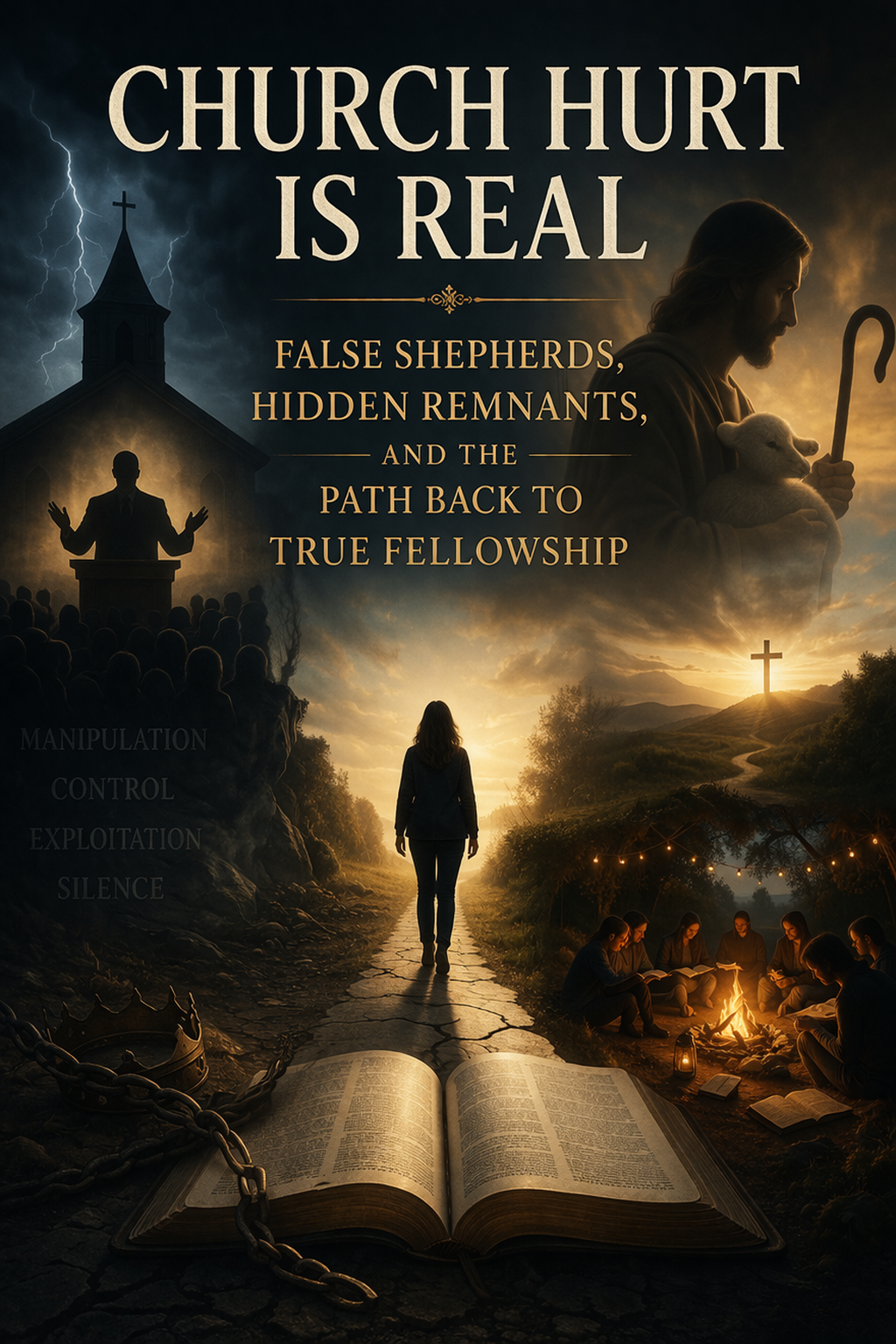
There is a growing chorus of voices—on stages, in short clips, and across various ministries—attempting to address what is often called “church hurt.” Yet much of what is being said fails to carry the true weight of the issue. It is frequently reduced to minor offenses, personality conflicts, or overly sensitive reactions, as though those who step away from church life simply lacked resilience or maturity. But this reduction does not tell the whole truth. For many, what is labeled “church hurt” is not rooted in fleeting discomfort but in profound betrayal by those entrusted with spiritual care. It is the pain of manipulation cloaked in the language of obedience, financial pressure disguised as spiritual urgency, authority exercised without accountability, and leadership that reflects more of human ambition than the character of Christ.
If this conversation is to be honest and fruitful, it must begin with a necessary distinction: many who have been hurt were not wounded by the true body of Christ, but by those who falsely represented it. And this matters deeply, because Christ Himself—the Good Shepherd—does not wound His sheep through coercion, exploitation, or control. He leads, He calls, He lays down His life. Any leadership that consistently reflects the opposite is not merely flawed; it is misaligned at its root.
The Failure to Tell the Truth
A troubling pattern has emerged in how this issue is publicly addressed. Many appeals that urge people to “come back to church” are built upon incomplete and selective narratives. While hurt is acknowledged, it is often framed only in its most superficial forms—someone felt overlooked, someone was offended, someone did not feel welcomed. Meanwhile, the deeper and more destructive realities remain largely unspoken. Rarely is there open acknowledgment of spiritual manipulation that binds rather than frees the conscience, financial exploitation that burdens rather than shepherds, leadership structures that demand submission while resisting accountability, or systems that protect reputation at the expense of righteousness.
Scripture, however, does not ignore these realities. It confronts them with clarity and authority. God rebukes shepherds who feed themselves instead of the flock, the apostles warn that wolves will arise even from among leaders, and elders are commanded to lead by example rather than domination. Corrupt leadership is not a modern anomaly; it is an ancient problem, and one that God takes seriously. Indeed, Scripture goes even further—declaring that judgment begins within the household of God. This means that what has been done in hidden systems, under spiritual language, is neither unseen nor excused. God does not merely comfort the wounded; He confronts what wounded them. To minimize these realities, then, is not pastoral wisdom—it is avoidance dressed in religious language.
At times, this minimization is not merely the result of poor judgment, but a convergence of deeper forces at work. Scripture presents a sobering pattern in which pride, self-preservation, and spiritual blindness can align in subtle ways. Truth may be reframed rather than denied, and serious harm reduced to something more manageable—not always through deliberate malice, but through a posture that resists uncomfortable exposure. While the reality of spiritual deception cannot be dismissed, it often operates not in isolation but through the inclinations of the human heart itself. In such cases, what is embraced is not simply an external suggestion, but something that resonates with internal desire—making discernment all the more necessary, and humility all the more urgent.
When the System Becomes the Problem
For many who have walked away, the issue extends beyond isolated moments of hurt. The structure itself became unsafe. What they experienced was not a temporary lapse within an otherwise healthy environment, but a sustained pattern marked by control instead of care, pressure instead of pastoring, and image management instead of truth.
At the same time, it is important to speak with clarity and balance: not every wound is evidence of corruption. Scripture speaks of a kind of wounding that refines—correction that leads to growth, conviction that produces life, truth that cuts in order to heal. But this is fundamentally different from the wounds inflicted by manipulation, domination, or exploitation. One leads to freedom; the other leads to bondage. One reflects the heart of Christ; the other distorts it.
Where the pattern is consistently one of control and misuse of authority, leaving is not an act of rebellion, but a refusal to participate in what contradicts the very nature of Christ. It must be stated clearly and without hesitation: leaving a corrupt or abusive environment is not a rejection of Christ. In many instances, it is an act of obedience to Him.
The Aftermath: Withdrawal, Silence, and Searching
The aftermath of such experiences is often deeply misunderstood. There is a tendency to assume that those who leave simply reject accountability or no longer desire community. Yet the reality is far more nuanced. Many withdraw not because they despise fellowship, but because trust has been fractured at a profound level. Their faith often remains intact—they still believe, they still pray, they still engage with Scripture—but they do so with caution.
This season often becomes one not only of healing, but of discernment. What was once accepted without question is now carefully examined. Trust is no longer given quickly, but tested over time. There is a growing awareness that spiritual authority must align with Scripture, that fruit must be observed, and that truth must take precedence over personality.
Some enter seasons of solitude, while others begin seeking quieter, more intimate expressions of gathering—small groups of two or three, meeting without pretense, without institutional pressure, and without performance. These spaces are not driven by platforms or personalities, but by a shared pursuit of Christ. Such responses should not be hastily labeled as rebellion; in many cases, they are evidence of healing in process and discernment being formed.
Elijah, the Remnant, and the Illusion of Being Alone
There is a moment in the life of Elijah that speaks powerfully into this reality. In 1 Kings 19, Elijah flees in despair, convinced that he alone remains faithful in a land consumed by corruption. From his limited perspective, the visible system had collapsed into idolatry, and true faithfulness appeared to have vanished. Yet God responds with a truth that Elijah could not see: He had preserved seven thousand in Israel who had not bowed to Baal.
They were not visible, not gathered into a recognizable movement, and not known to Elijah himself—yet they existed, faithful and preserved under the watchful eye of God. This account does not suggest that isolation is the ideal state for God’s people, but it does dismantle a dangerous assumption: faithfulness is not defined by visibility or alignment with dominant religious structures. Even when corruption overtakes what is public, God’s people remain. They may be scattered, hidden, or unknown to one another, but they are never absent.
For those who feel alone after leaving broken systems, this truth offers both correction and comfort—you may be unseen, but you are not alone.
The Error on Both Sides
Within this conversation, there exist two equal and opposite errors that must be addressed. On one side are those who minimize the problem, reducing deep wounds to minor grievances, calling people back without addressing the reasons they left, and protecting systems rather than confronting sin. On the other side are those who, having been wounded, withdraw entirely—avoiding all forms of fellowship, attempting to walk the Christian life in isolation, and replacing community with self-containment.
There is also a quieter danger that can emerge over time: pain, if left unattended, can harden into bitterness; discernment can drift into suspicion; and caution can become permanent withdrawal. What began as a necessary step away from harm can, if left unchecked, become distance from the very fellowship Scripture calls believers into.
Scripture speaks against both extremes. It exposes and condemns false shepherds, yet it also calls believers into shared life, mutual encouragement, and accountability. Neither denial nor isolation reflects the fullness of biblical truth.
What the Church Actually Is
Part of the confusion stems from a distorted understanding of what the church truly is. In Scripture, the church is not a brand, a building, or a platform; it is a people formed and sustained by God. It is a community devoted to the apostles’ teaching, committed to fellowship, united in prayer, and marked by sincerity and truth in shared life.
While there is structure—elders, order, and accountability—there is no biblical model that resembles celebrity-driven leadership, corporate-style hierarchies, or systems sustained by pressure and performance. Instead, biblical leadership is marked by humility, accountability, accessibility, and a willingness to be examined in light of Scripture. True shepherds do not insulate themselves from correction; they welcome it.
The issue, therefore, is not a simplistic choice between “church” and “no church,” but rather a discernment between genuine biblical community and its distorted imitations.
The Path Forward for the Wounded
For those who have been wounded, the path forward is neither quick nor easy, but it is real and attainable. Healing begins with honest acknowledgment of the wound—not dismissing or minimizing it, but naming it truthfully. It requires a clear distinction between Christ and those who misrepresented Him, recognizing that false shepherds do not redefine the Good Shepherd.
From there, discernment must continue to grow. Trust is rebuilt carefully and wisely—not granted automatically based on titles or positions, but established through consistent character, humility, and faithfulness to Scripture. Fellowship must also be rediscovered, though it may not resemble previous experiences. For many, it begins simply—with a few people, gathered around a table, opening Scripture together, and praying with sincerity.
This is not a lesser expression of Christianity; in many ways, it reflects something closer to its original form. And yet, even in this process, there is a quiet call to remain open—to not allow past wounds to permanently close the door to future, healthy fellowship.
A Word to Those Who Lead
There is also a necessary and sobering word for pastors and leaders. If people are leaving in significant numbers, the first question should not be how to bring them back, but what has driven them away. Where there has been control instead of care, exploitation instead of stewardship, and silence instead of repentance, there must be honest acknowledgment and tangible change.
God’s concern for His people is not passive, and His warnings to shepherds are not light. Those entrusted with leadership are accountable not only to those they lead, but to God Himself. Appeals for people to return, when these issues remain unaddressed, do not promote healing—they deepen the wounds and reinforce the very problems that caused them.
Not Abandoning the Faith, but Rediscovering It
The assumption that those who leave have abandoned the faith is often inaccurate. Many have not abandoned Christ; rather, they have distanced themselves from what falsely represented Him. In doing so, they are not seeking isolation for its own sake, but searching for something authentic—something unforced, honest, and faithful to the heart of the gospel.
Their journey is not one of departure, but of rediscovery—learning again what it means to follow Christ apart from distortion, to recognize His voice apart from noise, and to pursue truth with renewed clarity.
The Final Word
Church hurt is real, and it is not always shallow or exaggerated. In many cases, it is the result of deep and grievous sin that must be taken seriously. The answer is not to deny its existence, nor to retreat into permanent isolation. The answer is to recover what the church was always meant to be: a people shaped by truth, marked by love, led with humility, and centered on Christ.
And there is still one more call—quiet but necessary—to courage. Do not allow what was false to steal your pursuit of what is true. Do not let what was distorted redefine what is real. The failures of men do not nullify the faithfulness of Christ.
Even when His people seem scattered, hidden, or difficult to find, He is still building His church. He is still preserving a remnant. He is still calling His people—not into systems of control, but into a living fellowship grounded in truth and love.
He has not lost His church.
He never has.
And He never will.
Leave a Reply