
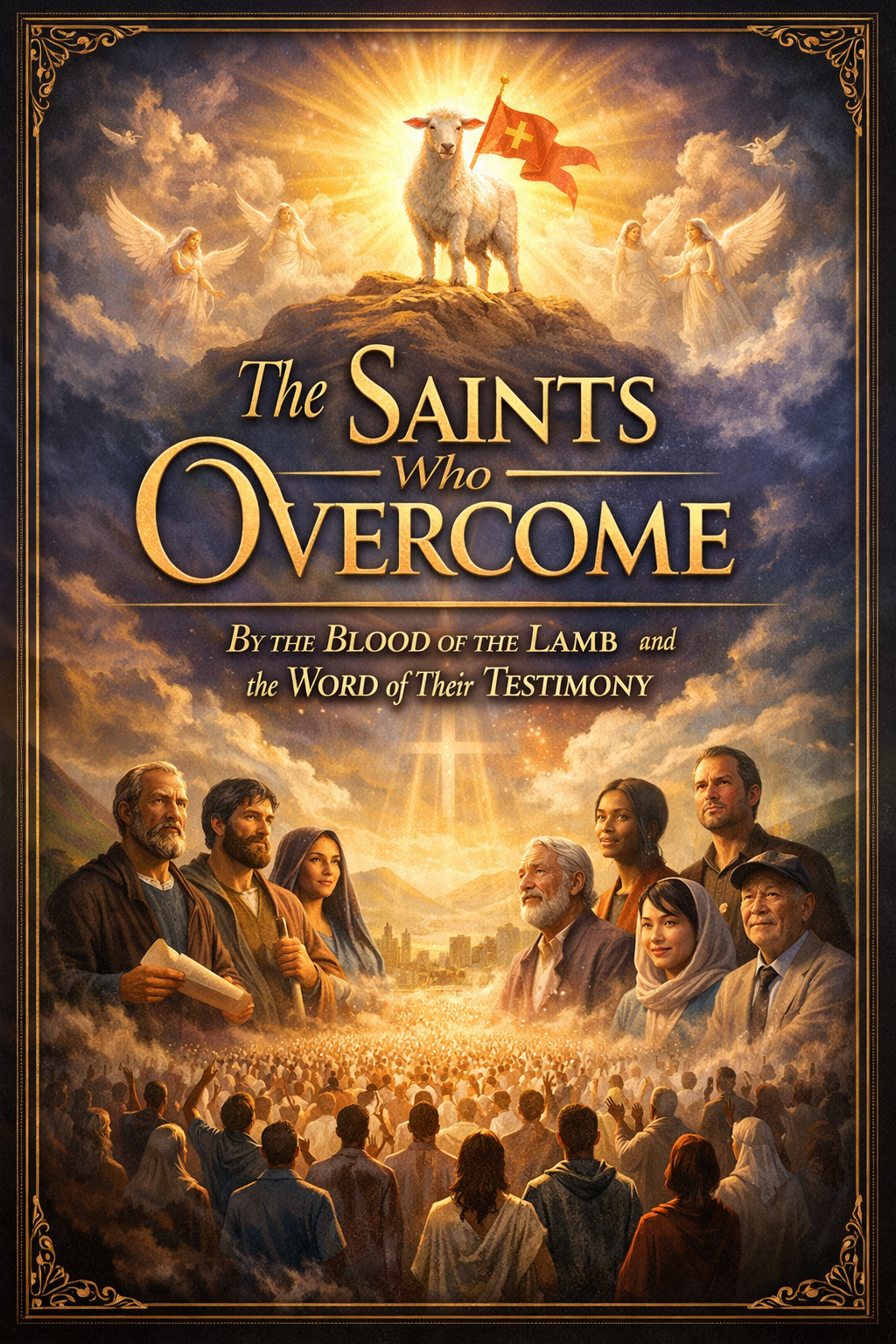
The question often arises when reading Revelation chapter 12: who are the saints who “overcame him by the blood of the Lamb and by the word of their testimony”? Some assume that these saints refer only to the figures recorded within the pages of Scripture—apostles like Peter, James, John, and Paul, or other prominent individuals in the biblical narrative. Yet a careful and comprehensive reading of the Bible reveals a much fuller and far more glorious truth. The saints described in Revelation are not limited to a select group of historical figures, but encompass all who have placed their faith and trust in Jesus Christ across all generations. They are those who have been redeemed by His blood and who bear witness to Him through their lives and testimonies. In fact, the very term “saints” comes from the Greek word hagios, meaning “holy ones” or “set apart ones,” pointing not to prominence, but to a people distinguished by God’s saving work.
From the very beginning of Scripture, God’s redemptive plan has always centered on a people set apart for Himself by faith. In Genesis, Abraham “believed the Lord, and He counted it to him as righteousness” (Genesis 15:6). This foundational truth establishes that righteousness—and thus belonging to God—has never been based on lineage, status, or proximity to biblical events, but on faith. Abraham becomes not merely the father of a physical nation, but, as later revealed, the father of all who believe. This principle is echoed throughout the Old Testament, where the faithful are repeatedly identified not merely by their role in history, but by their trust in God. The Psalms speak of the saints as those who are faithful to the Lord (Psalm 30:4), and the prophets consistently call God’s people to live as a holy remnant marked by faith and obedience. The prophet Habakkuk declares a truth that reverberates throughout all of Scripture: “the righteous shall live by his faith” (Habakkuk 2:4), a statement later taken up in the New Testament to describe the very foundation of the gospel itself.
This continuity of faith across generations is beautifully captured in Hebrews 11, where a long line of men and women are commended not for their visibility in Scripture alone, but for their trust in God’s promises. Their lives form a testimony that stretches across time, culminating in the declaration that believers are surrounded by “so great a cloud of witnesses” (Hebrews 12:1). This imagery does not isolate the saints into separate categories, but unites them as one people of God, bound together by faith.
When we come to the teachings of Jesus, this understanding becomes even clearer. Jesus consistently redefines the boundaries of God’s people, emphasizing faith over heritage. In John 1:12, we are told that “to all who did receive Him, who believed in His name, He gave the right to become children of God.” This is a universal invitation and a defining statement: all who believe—without distinction—are brought into the family of God. Likewise, in John 10, Jesus speaks of His sheep as those who hear His voice and follow Him, not those who merely belong to a particular historical group. His flock extends beyond immediate listeners, as He declares that He has “other sheep that are not of this fold,” all of whom He will gather into one. To belong to Him is to be united to Him, and this union is at the heart of the believer’s identity. As the New Testament repeatedly affirms, those who are “in Christ” are new creations (2 Corinthians 5:17), living not by their own merit, but through the life and victory of the One to whom they are joined.
The apostles continue this theme with unmistakable clarity. The apostle Paul writes in Romans 10:9 that “if you confess with your mouth that Jesus is Lord and believe in your heart that God raised Him from the dead, you will be saved.” He goes on to emphasize that “there is no distinction between Jew and Greek; for the same Lord is Lord of all, bestowing His riches on all who call on Him” (Romans 10:12). This universality dismantles any notion that sainthood is restricted to a closed group of biblical figures or a special spiritual class recognized by men. Instead, it affirms that all believers—regardless of time, place, or background—are recipients of the same grace and are counted among God’s people.
In Ephesians 2:19, Paul explicitly tells believers, “you are no longer strangers and aliens, but you are fellow citizens with the saints and members of the household of God.” This statement is profound. It does not place modern believers outside the category of saints but firmly within it. They are not observers of the saints—they are included among them. Similarly, in 1 Peter 2:9, the church is described as “a chosen race, a royal priesthood, a holy nation, a people for His own possession,” language that unmistakably identifies all believers as those set apart for God. This identity flows directly from union with Christ, not from human recognition, and it is grounded entirely in His finished work.
When we return to Revelation 12:11, the description of those who overcome becomes deeply personal and widely inclusive: “they have conquered him by the blood of the Lamb and by the word of their testimony, for they loved not their lives even unto death.” This victory is rooted first and foremost in the blood of the Lamb—Christ’s atoning sacrifice—which is applied to all who believe. Their overcoming is not achieved by human strength, but flows from what Christ has already accomplished. The “word of their testimony” is the outward expression of that inward reality: a public allegiance to Christ, a confession of His lordship that endures even in the face of opposition. Their perseverance does not earn the victory; it reveals that they belong to the One who has already secured it.
This same redemptive pattern is affirmed earlier in Revelation itself, where Jesus Christ is described as the One “who loves us and has freed us from our sins by His blood and made us a kingdom, priests to His God and Father” (Revelation 1:5–6). The language is unmistakably collective and inclusive, pointing to a redeemed people who share in His victory and identity. Later, in Revelation 7, a great multitude that no one can number, from every nation, tribe, people, and language, stands before the throne of God. These are identified as those who have “washed their robes and made them white in the blood of the Lamb.” The scope is global and transhistorical, encompassing all who have been redeemed.
Furthermore, the consistent use of the term “saints” throughout the New Testament reinforces this understanding. Paul addresses entire congregations as saints, as seen in the openings of his letters to the Romans, Corinthians, Ephesians, Philippians, and Colossians. These were ordinary believers—men and women living in cities, raising families, enduring trials—yet they are called saints because they belong to Christ. The designation reflects their position before God, not their prominence among men.
To restrict the identity of the saints in Revelation to only those mentioned in Scripture is to overlook the unified testimony of the Bible itself. From Abraham’s faith to the prophets’ declarations, from Christ’s invitation to the apostles’ teaching, the message is consistent: the people of God are defined by faith in Him. The saints are all those who have been redeemed by the blood of the Lamb, united to Christ, and who bear witness to Him through their lives.
Therefore, the saints in Revelation 12 are not a distant, exclusive group confined to the pages of biblical history. They are the collective body of believers—past, present, and future—who have trusted in Christ. They are those who overcome not by their own strength, but by His sacrifice, and who proclaim His work through their testimony. Even now, every true believer stands within this same victory, sharing in the triumph of the Lamb, bearing witness to His grace, and living as one set apart among the saints who overcome by the blood of the Lamb.
Leave a Reply