
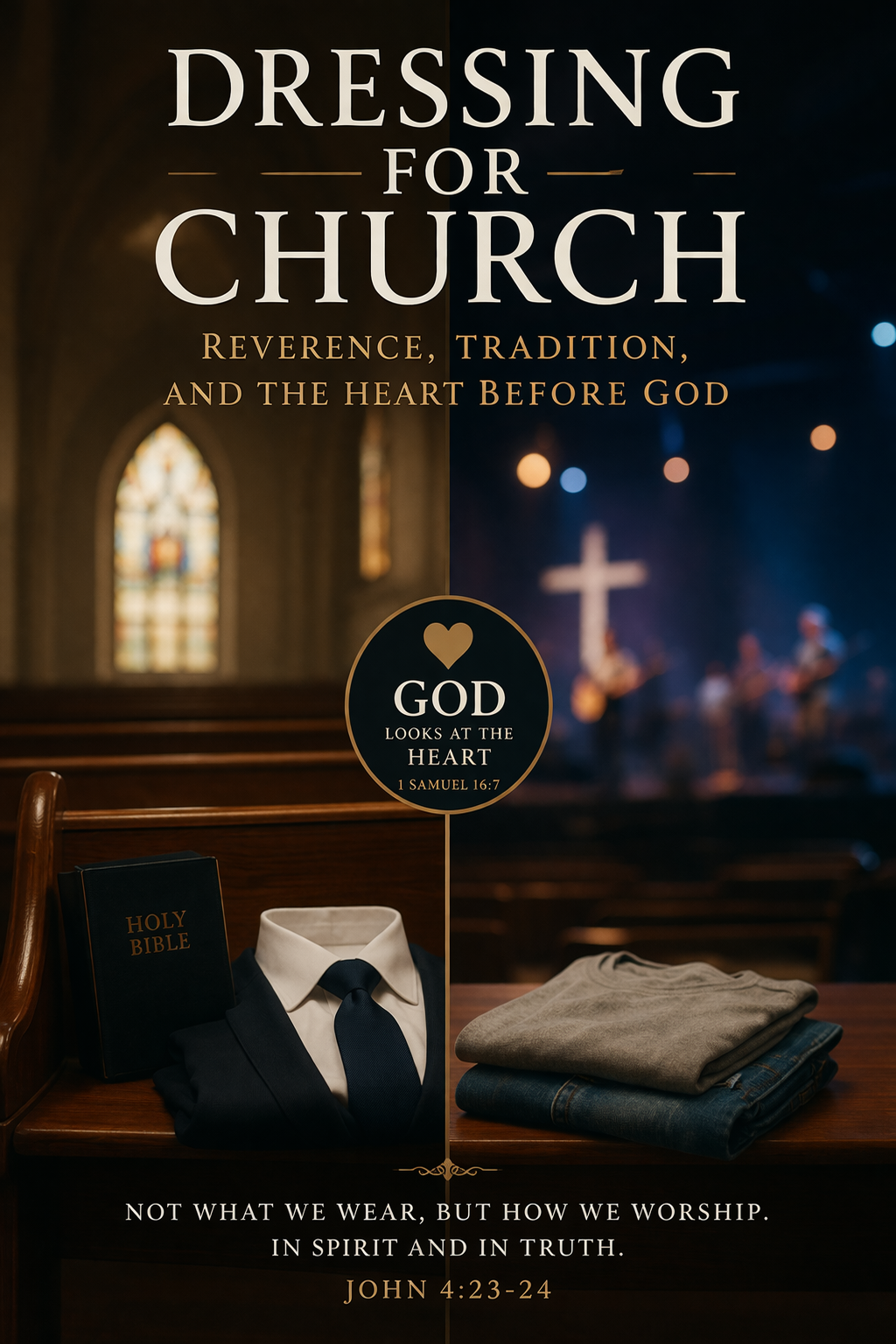
There is a quiet but persistent belief found in many churches—especially among older generations—that what you wear to church carries deep spiritual significance because you are “coming before the Lord.” The reasoning often sounds compelling: if you were meeting an important earthly authority, you would present yourself with care and respect; therefore, how much more should you do so when approaching God. At first glance, this seems not only reasonable, but reverent. Yet the question that must be asked is not whether the intention is sincere, but whether this way of thinking is actually grounded in Scripture, or whether it has gradually developed through tradition and cultural reinforcement.
The Root of the Idea: A Biblical Desire for Reverence
The instinct behind dressing respectfully is not inherently wrong, because Scripture consistently affirms that God is holy and is to be approached with reverence. In the Old Testament, the holiness of God is not an abstract concept but a weighty reality, often communicated through visible encounters and divine commands. When Moses stood before the burning bush, he was told to remove his sandals, for the ground had been made holy by the presence of God. The Hebrew word used for holy, קָדוֹשׁ (qādôsh), carries the idea of being set apart, distinct, and utterly other. This moment was not about external ritual for its own sake, but about recognizing the infinite distinction between God and man. Similarly, the priestly system, garments, and ceremonial laws in books like Leviticus reinforced that approaching God required intentionality, order, and reverence. However, these outward forms were always meant to reflect an inward posture, not replace it.
The Transition Under the New Covenant
With the coming of Christ, there is a decisive shift in how God is approached. Worship is no longer tied to a specific place, system, or external code, but is fulfilled in a person—Jesus Christ. When Jesus speaks in John 4:23–24 about worshiping the Father “in spirit and truth,” He is not abolishing reverence, but relocating it. The Greek word for worship used there, προσκυνέω (proskyneō), literally conveys the idea of bowing down or expressing deep honor, yet Jesus connects this act not to a location or external display, but to the inner life of the worshiper. This reorientation is critical, because it establishes that true worship is not defined by visible form, but by spiritual reality shaped by truth.
This transformation is reinforced throughout the New Testament. Believers themselves are described as the temple of God, meaning that the presence of God is no longer confined to a building but dwells within His people. This reality dismantles the notion that one must prepare externally in a particular way to enter a sacred space, because in Christ, the believer is already brought near. The emphasis shifts from approaching a holy place to living as a holy people.
What Scripture Actually Teaches About Clothing
When the New Testament addresses clothing, it does so with a focus that is strikingly different from modern assumptions about “dressing for church.” In 1 Timothy 2:9–10, Paul instructs that believers are to adorn themselves in respectable apparel, with modesty and self-control. The Greek word translated as modesty, αἰδώς (aidōs), conveys a sense of reverence, humility, and an awareness of moral boundaries, while σωφροσύνη (sōphrosynē) refers to soundness of mind and self-restraint. The concern here is not formality or impressiveness, but a disposition that reflects godliness rather than drawing attention to oneself. The emphasis is ethical and spiritual, not ceremonial.
Likewise, James 2:1–4 directly confronts the human tendency to assign value based on outward appearance. In this passage, a man dressed in fine clothing is given preferential treatment over a poor man in humble attire, and this behavior is sharply rebuked. The point is unmistakable: external appearance must not become a basis for spiritual judgment or distinction within the body of Christ. This passage does not merely discourage favoritism; it dismantles the very mindset that elevates outward presentation as spiritually meaningful.
This principle is deeply rooted in the broader testimony of Scripture. In 1 Samuel 16:7, the Lord declares that while man looks at the outward appearance, He looks at the heart. The Hebrew word for heart, לֵב (lēb), refers not merely to emotion, but to the inner person—the seat of thought, will, and intention. This truth carries forward into the New Testament, where the inward life is consistently prioritized over external conformity.
High Church, Low Church, and the Cultural Layer
The conversation surrounding clothing in church often intersects with what has historically been described as “high church” and “low church” expressions, a distinction frequently discussed by conservative voices when addressing generational and cultural shifts within Christianity. “High church” traditions tend to emphasize structure, liturgy, formality, and visible expressions of reverence, while “low church” contexts emphasize simplicity, accessibility, and a less formal approach to worship. Over time, these categories have come to shape expectations about everything from service structure to attire.
Within a high church framework, dressing formally can become a natural extension of reverence, as outward form is seen as a reflection of inward honor. Conversely, in lower church contexts, casual attire is often embraced as an expression of authenticity and the removal of unnecessary barriers. However, the danger in both approaches lies in allowing cultural expressions to take on theological weight. When formality is equated with reverence, or casualness with sincerity, a subtle but significant shift has occurred, where human preferences begin to function as spiritual standards.
When Tradition Becomes Burden
Tradition, in itself, is not inherently wrong. It can serve as a meaningful way of expressing values and preserving a sense of continuity and identity within the church. The problem arises when tradition is elevated to the level of obligation, particularly in areas where Scripture has not spoken definitively. When expectations about dress begin to function as measures of spiritual maturity, or when individuals feel judged, excluded, or pressured based on their appearance, the church has moved beyond biblical teaching into the realm of man-made standards.
This concern echoes the warnings of Jesus, who rebuked religious leaders for elevating human traditions above the commands of God. The issue was not that they had traditions, but that those traditions obscured the true intent of God’s Word and placed burdens on people that God Himself had not required. The same dynamic can unfold today when cultural expectations about clothing are presented as though they carry divine authority.
A Biblically Faithful Perspective
A faithful reading of Scripture leads to a balanced and liberating conclusion. Believers are called to approach God with reverence, but that reverence is fundamentally a matter of the heart. Clothing, while not irrelevant, is secondary and must be governed by principles such as modesty, humility, and consideration for others rather than by rigid standards of formality. There is wisdom in dressing in a way that is respectful and not distracting, and in being mindful of the context and the people around you, but Scripture intentionally leaves room for freedom in these matters.
The apostle Paul’s broader teaching reinforces this principle, particularly in passages that address Christian liberty and conscience. Believers are not to judge one another over disputable matters, nor are they to bind the conscience where God has not bound it. This framework allows for diversity of expression within the unity of the body, while maintaining a shared commitment to honoring God in all things.
The Deeper Issue: Externalism vs. True Worship
Ultimately, the discussion about clothing is a surface-level expression of a deeper issue that runs throughout Scripture: the tension between externalism and genuine devotion. Externalism seeks to define spirituality by visible actions and appearances, while true worship flows from a transformed heart that loves and honors God in sincerity and truth. This is why the New Testament repeatedly emphasizes inner transformation, the renewal of the mind, and the fruit of the Spirit as the true markers of a life pleasing to God.
The danger of externalism is not merely that it misplaces emphasis, but that it can create a false sense of righteousness while neglecting the very things that matter most. A person may appear outwardly reverent while lacking humility, repentance, or genuine faith, while another may appear ordinary or unimpressive outwardly yet possess a heart that is fully devoted to God. Scripture consistently affirms that it is the latter that God receives.
Conclusion
Dressing respectfully can be a meaningful and sincere expression of reverence, and for many, it is a deeply ingrained way of honoring God. However, it is not a biblical command, and it must never be elevated to the level of spiritual requirement or used as a measure of faithfulness. The distinction between high church and low church expressions can help explain how different traditions approach this issue, but it cannot define what is ultimately a matter of biblical teaching.
What God desires is not a particular style of clothing, but a people who approach Him with hearts that are humble, sincere, and anchored in truth. Reverence is not found in fabric, but in faith. And in the gathering of the church, what matters most is not what is seen on the outside, but what is true on the inside—a people who worship not merely in appearance, but in spirit and in truth.
Leave a Reply