
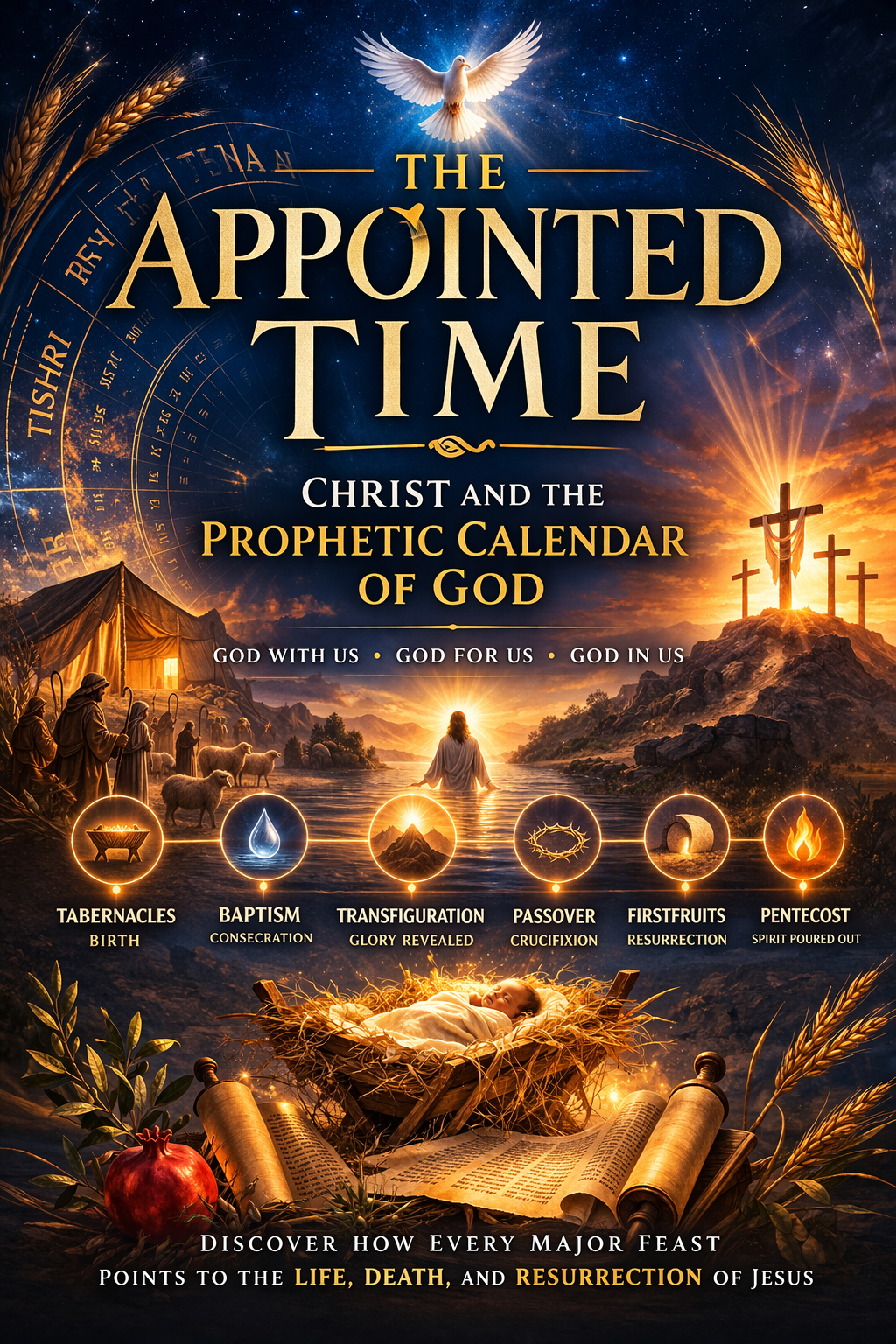
What if one of the most widely accepted dates in Christianity is not rooted in Scripture, but in tradition? And what if the Bible has been quietly pointing to a different answer all along? For many, the timing of Christ’s birth feels secondary—interesting, perhaps, but ultimately unimportant. Yet Scripture consistently reveals that God does not act randomly in history. He moves according to appointed times, moments established by divine intention long before their fulfillment. If that is true, then the birth, life, and mission of Jesus Christ would not simply occur in time, but at the right time—aligned with a structure already embedded within the biblical narrative. What emerges upon closer examination is not guesswork, but a pattern. And that pattern points to design.
Luke begins his Gospel with a detail that functions as a hidden timestamp: Zechariah, the father of John the Baptist, belonged to the division of Abijah. According to 1 Chronicles 24, the priesthood was divided into twenty-four rotating divisions, each serving one week at a time. The division of Abijah was the eighth. When mapped onto the Jewish calendar beginning in Nisan, this places Zechariah’s service in late May to early June. After completing his service, Luke tells us that he returned home, and shortly after, his wife Elizabeth conceived. From that moment, a timeline begins to unfold. John the Baptist is conceived around June. Six months later, the angel Gabriel appears to Mary, announcing the conception of Jesus. This places the conception of Christ around December. Allowing for a normal gestation period, John is born around March, and Jesus approximately six months later—around September. While this does not establish an exact date, it strongly suggests a fall birth, not a winter one.
This brings us to the appointed times outlined in Leviticus 23, particularly the Feast of Tabernacles, which occurs in the fall on the fifteenth day of the month of Tishri. This feast commemorates a singular and profound reality: God dwelling among His people. Israel lived in temporary shelters, recalling their wilderness journey when God’s presence was with them. With this in mind, the words of John take on deeper meaning: “The Word became flesh and dwelt among us.” The Greek term used for “dwelt,” skēnoō, literally means “to tabernacle.” This is not casual language. It is deliberate and loaded with theological significance. A strong convergence of biblical, calendrical, and thematic indicators suggests that Jesus may have been born during or near the Feast of Tabernacles, likely around Tishri 15, which corresponds to late September. Eight days later, Luke records that Jesus was circumcised and named. This aligns with the Eighth Day Assembly, a sacred day symbolizing completion and new beginning. While not definitive, the alignment is compelling: He is born as God dwelling with man and publicly enters covenant identity on a day that represents new creation.
Even the environmental details support this timeframe. Luke notes that shepherds were in the fields at night, keeping watch over their flocks. In Judea, shepherds typically remained in the fields during the milder seasons, not during the cold and rainy winter months. This detail aligns more naturally with a fall setting. Some have also pointed to astronomical events around 3–2 BC, including notable planetary alignments involving Jupiter, as possible explanations for the star seen by the Magi. While such interpretations should be approached with caution, they provide an additional layer of correlation that fits within the same general timeframe.
Luke also tells us that Jesus began His ministry at “about thirty years of age.” This detail is far from incidental. In the Torah, thirty marked the age at which Levites entered into full priestly service. Numbers 4:3 establishes this clearly, while Numbers 8:24–25 shows that preparation began earlier, but full responsibility began at thirty. This pattern is echoed elsewhere in Scripture. Joseph stood before Pharaoh at thirty years old, moving from obscurity into authority. David also began to reign at thirty. In each case, the age marks a transition from preparation to public commission. When Jesus is baptized at about thirty, He steps into this same pattern. He is washed, the Spirit descends upon Him, and the Father declares His identity. This is not merely a baptism—it is a consecration.
At that moment, something extraordinary occurs: the heavens open. This language echoes the cry of the prophet Isaiah, who longed for God to rend the heavens and come down. It also reaches back even further, to the opening of Genesis, where the Spirit of God hovered over the waters. The Spirit descending like a dove at Jesus’ baptism evokes both creation and new creation imagery. In the days of Noah, a dove signaled that judgment had passed and new life had begun. Now, at the Jordan, the Spirit marks the beginning of something even greater—not merely a renewed world, but a renewed humanity in Christ.
As His ministry unfolds, Jesus teaches, heals, and reveals the kingdom of God. Then, on a mountain, the veil is pulled back in a different way. At the transfiguration, His face shines, His garments become radiant, and a cloud overshadows those present. A voice speaks from the cloud, affirming His identity. Standing with Him are Moses and Elijah, representing the Law and the Prophets. This moment mirrors Sinai, where God’s glory descended upon a mountain. Yet there is a crucial difference. At Sinai, the glory of God was external and distant. Here, the glory is revealed in Christ Himself. Peter’s instinct is to build tabernacles, to preserve the moment in familiar structures. But the point is not to construct a dwelling place. The dwelling place is already present. The structure has given way to the Person.
The culmination of this pattern comes at the cross. As Jesus breathes His last, the veil of the temple is torn in two from top to bottom. This veil had separated the Holy Place from the Most Holy Place, restricting access to the presence of God. Only the high priest could enter, and only once a year, with blood. But now everything changes. As explained in the Epistle to the Hebrews, Jesus becomes both the High Priest and the sacrifice. Through His body, the barrier is removed. Hebrews declares that we now have confidence to enter the holy places by a new and living way, through the veil—that is, His flesh. The separation is not gradually diminished; it is decisively ended.
Just as His birth aligns with the fall feasts, His death and resurrection align precisely with the spring feasts. At Passover, He is crucified as the Lamb. During Unleavened Bread, He is buried, untouched by corruption. On Firstfruits, He rises, the beginning of a new harvest of life. And at Pentecost, the Spirit is poured out, marking the birth of the Church and the indwelling presence of God among His people. The pattern is not loose or symbolic—it is exact.
At this point, a question naturally arises: is this reading too much into the text? Yet the New Testament itself teaches us to read Scripture this way. Paul explicitly calls Christ our Passover Lamb. The book of Hebrews presents Him as the fulfillment of the priesthood and sacrificial system. John intentionally uses Tabernacle language to describe His incarnation. These are not speculative connections; they are rooted in the interpretive framework of Scripture itself. What we are seeing is not imposed meaning, but revealed pattern—what theologians have long called typology, where earlier realities point forward to greater fulfillment in Christ.
Why does this matter? It matters because it reveals the intentionality of God. It shows that Scripture is not a collection of disconnected events, but a unified narrative moving toward fulfillment. It demonstrates that Christ fulfills not only individual prophecies, but the very structure of God’s appointed times. The calendar was not waiting for Christ—it was built for Him.
When we step back and view the whole, the pattern becomes clear. The fall feasts reveal God coming to man. The spring feasts reveal man being brought to God. At the center stands Christ. Born during the Feast of Tabernacles, He is God with us. Crucified at Passover, He is God for us. And through the outpouring of the Spirit at Pentecost, He becomes God in us.
The question, then, is not simply whether Jesus was born in December or during the Feast of Tabernacles. The deeper realization is that He came at the appointed time. The feasts were not merely traditions looking forward; they were shadows cast backward from Christ Himself. His birth, ministry, death, and resurrection are not isolated events. They are woven into a divine pattern that reveals the precision and purpose of God.
He did not arrive at a convenient moment. He did not act randomly. He came when the time was full.


Leave a Reply