
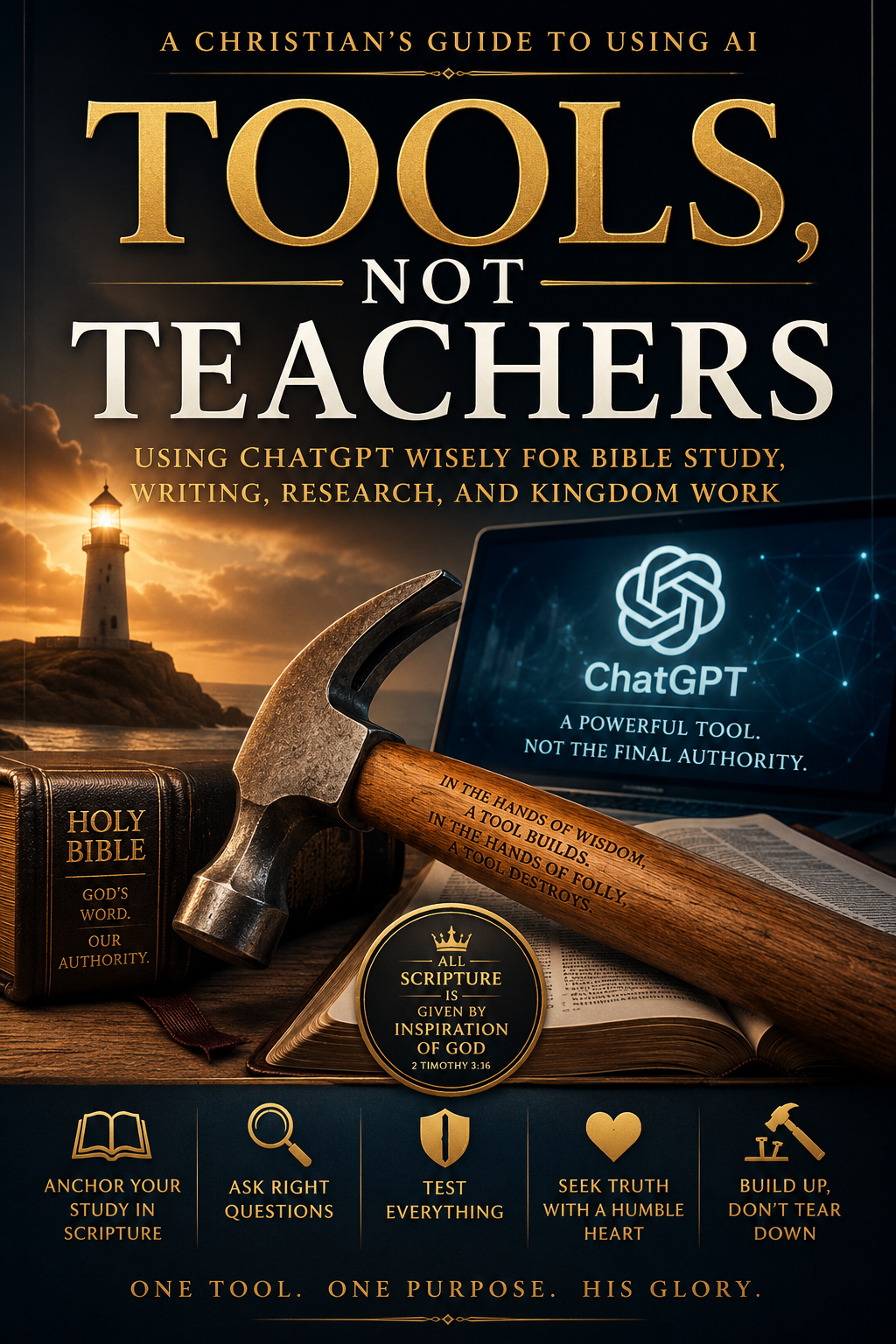
A Tool in the Hands of the User
A hammer is a useful tool in the hands of a skilled builder. In the hands of someone who understands its purpose, it can help construct something strong, useful, and lasting. But in the hands of someone careless, untrained, or reckless, the very same hammer can become an instrument of damage. It can wound instead of build, tear down instead of establish, and destroy what was meant to be protected. The hammer itself is not the issue. The issue is the wisdom, intent, and skill of the one who uses it.
The same principle applies to ChatGPT and other AI tools. They are not Scripture, they are not inspired, and they are not a substitute for prayer, discernment, or the careful reading of God’s Word. Yet they are still tools, and like any tool, their usefulness depends on whether they are used rightly. In the right hands, a tool can serve a noble purpose. In the wrong hands, it can contribute to confusion or distortion.
Scripture Remains the Final Authority
When it comes to Bible study, article writing, research, and other biblical work, the final authority must always be Scripture itself. The Bible is “given by inspiration of God” and is profitable for teaching, correction, and instruction in righteousness (2 Timothy 3:16–17). No technology, no matter how advanced, can stand above the Word of God. No machine can replace the voice of Scripture, the conviction of the Holy Spirit, or the humble posture of a believer who longs to know truth.
That said, a tool should not be rejected simply because it is a tool. Believers are called to wisdom, and wisdom includes learning how to use helpful resources in a God-honoring way. Proverbs tells us to “get wisdom,” and Scripture repeatedly calls us to walk in discernment and understanding (Proverbs 4:7). The issue is not whether a tool exists. The issue is whether it is being used under the authority of God’s Word.
Why Some People Get Poor Answers from AI
Many of the bad theological answers people receive from AI do not come from the tool alone, but from the way the question is asked. A vague question often produces a vague answer. A biased question often produces a biased answer. A question built on hidden assumptions often produces an answer shaped by those assumptions.
This is not unique to artificial intelligence. Human teachers, commentaries, articles, and sermons can also go astray when they are built on preferences rather than careful study. That is why believers must not accept something simply because it sounds polished, confident, or modern. Proverbs warns that “the simple believeth every word” (Proverbs 14:15), and that warning still matters. The Bereans were commended because they searched the Scriptures daily to see whether what they were hearing was true (Acts 17:11). That same spirit should guide the way Christians use AI. Everything must be tested by the Word of God.
The Importance of Proper Parameters
If ChatGPT is to be used well in Bible study or biblical writing, it must be given proper parameters. It should be instructed to stay anchored to Scripture, to compare Scripture with Scripture, to read passages in their immediate and broader context, and to distinguish between what the text plainly says and what may only be inferred. It should be asked to avoid importing modern assumptions into ancient passages. It should also be asked to recognize when a passage is descriptive rather than prescriptive, and when multiple interpretations exist.
This is where careful prompting becomes so important. A thoughtful prompt can help keep the conversation centered on what the Bible actually says. A careless prompt can easily lead the discussion away from the text and into speculation. Paul told Timothy to “rightly divide the word of truth” (2 Timothy 2:15). That is a fitting principle here. The goal is not to force an answer, but to handle truth carefully and faithfully.
A good prompt might ask ChatGPT to examine a topic by prioritizing the full counsel of Scripture, comparing relevant passages, acknowledging contextual limits, and making a clear distinction between direct biblical teaching and later theological conclusions. That kind of approach does not replace study; it strengthens it.
A Helpful Assistant, Not a Final Teacher
One of the greatest strengths of ChatGPT is that it can help organize and synthesize information quickly. It can assist with outlining articles, tracing themes through Scripture, comparing related passages, summarizing historical background, and helping the writer or student think through an issue in a more structured way. Used properly, it can save time and support deeper study.
But it must never be mistaken for a final teacher or spiritual authority. A hammer can help build a house, but it cannot design the house. It can drive a nail, but it cannot determine whether the foundation is sound. In the same way, ChatGPT can assist with gathering and arranging information, but it cannot replace discernment, prayer, or the believer’s responsibility to search the Scriptures. It can serve the study process, but it cannot rule over it.
This is an important distinction, because many problems begin when people start treating a tool like a teacher. At that point, the tool is no longer being used to support biblical understanding. It is being allowed to shape biblical understanding. That is a dangerous place to be. Jesus warned about traditions and human systems that make the Word of God of none effect (Mark 7:13), and that warning reminds us to keep every tool in its proper place.
A Tool Does Not Believe
It is also important to remember that ChatGPT does not possess beliefs, convictions, faith, or spiritual understanding the way a person does. When people ask it questions such as, “What do you believe about this?” or try to draw it into speculative questions like, “Were there people before Adam and Eve?” they are often testing the limits of the tool rather than carefully studying Scripture. That kind of question may reveal how AI responds to prompts, but it should not be confused with biblical authority or spiritual insight.
ChatGPT is not a soul, not a witness, and not a thinker in the human sense. It does not stand before God, possess convictions, or hold theological beliefs of its own. It generates responses based on patterns, prompts, and available information. Because of this, a poorly framed question can easily move the discussion away from Scripture and into speculation. A believer should not approach AI as though it were a theologian with personal convictions. The better question is always, “What does Scripture say?” or, “What passages should be examined to understand this issue faithfully?”
Some people attempt to discredit AI tools entirely by asking speculative or philosophical questions and then pointing to weak or inconsistent answers as proof that the tool has no value. But that misunderstands the purpose of the tool itself. A hammer cannot explain architecture, yet it remains useful for building. In the same way, ChatGPT may not provide satisfying answers to speculative questions, but that does not mean it cannot assist in organizing information, tracing biblical themes, or helping a student examine Scripture more carefully.
The real danger comes when a person begins expecting AI to function as a spiritual authority rather than a study aid. Scripture warns against being “carried about with every wind of doctrine” (Ephesians 4:14). That warning applies not only to human voices, but to every source of information that can influence the mind. The Christian’s responsibility is not to ask a machine what it believes, but to test every claim by the truth of God’s Word.
The Heart Matters as Much as the Method
There is also a deeper issue beneath the method itself: the condition of the heart. A tool can be used honestly or dishonestly. ChatGPT can be used to help someone ask, “What does the Bible say?” or it can be used to help someone force Scripture to agree with a preconceived conclusion.
That difference matters. A humble heart seeks truth. A proud heart seeks confirmation. A teachable heart welcomes correction. A stubborn heart resists it. The psalmist prayed, “Shew me thy ways, O LORD; teach me thy paths” (Psalm 25:4). That is the proper attitude for every believer, whether studying with a commentary, a concordance, a search engine, or AI. The aim is not to make Scripture say what we want. The aim is to hear what God has said.
When a person approaches ChatGPT with that spirit, the tool can become useful. When a person approaches it with an agenda, the tool can become part of the distortion. The difference is not merely technical. It is spiritual.
A Responsible Way to Use ChatGPT in Biblical Work
Used responsibly, ChatGPT can be a helpful assistant in several areas. It can support Bible study by helping locate passages related to a theme. It can assist article writing by organizing thoughts into a clear structure. It can help with research by summarizing historical context, literary structure, and major interpretive questions. It can even help writers refine their language so their work is clearer and more readable.
It can also help users compare interpretations carefully rather than blindly accepting one viewpoint without examination. When properly guided, it can encourage deeper study by directing attention back to the biblical text itself. This can be especially valuable when studying difficult subjects that require comparing many passages across both the Old and New Testaments.
Still, all of this must remain under the authority of Scripture. The Bible is not one source among many; it is the measuring line by which every idea must be tested. “Prove all things; hold fast that which is good” (1 Thessalonians 5:21). That instruction applies to every claim, every conclusion, and every tool that claims to help us think. ChatGPT may help gather material, but it cannot decide truth apart from the Word of God.
Wisdom Over Fear, Discernment Over Blind Trust
The proper Christian response to ChatGPT is neither fear nor blind trust. It is wisdom. God’s people are not called to live in panic over every new tool, nor are they called to embrace every tool uncritically. They are called to walk carefully, thoughtfully, and faithfully before the Lord.
James says that if anyone lacks wisdom, let him ask of God, who gives generously (James 1:5). That is the heart of the matter. Human tools may assist, but divine wisdom must lead. Knowledge without wisdom can become a weapon, but knowledge under wisdom becomes a servant of truth. That is the way of mature Christian thinking. The goal is not to avoid helpful tools, but to use them in a way that honors Christ and serves the truth of His Word.
Christians should also remember that fear has often accompanied new tools throughout history. Printing presses, translations of the Bible into common languages, study aids, commentaries, and even the internet itself have all been viewed with suspicion by some. Yet every generation must learn the difference between rejecting misuse and rejecting usefulness. A tool may be abused, but abuse does not cancel proper use.
Conclusion: Let the Word Lead
ChatGPT should not be worshiped, feared, or blindly trusted. It should be used wisely, carefully, and always under the authority of Scripture. It is a tool, not a teacher in the ultimate sense. It can help gather, compare, and organize information, but it cannot replace the Bible, the Holy Spirit, or the believer’s own responsibility to study faithfully.
“Thy word is truth” (John 17:17). That remains the great anchor. Not a trend, not a machine, and not a technology can take the place of God’s Word. But when ChatGPT is used with clear boundaries, humble intentions, and biblical discernment, it can serve as a useful assistant in the work of study and writing.
Like a hammer in the hands of a builder, it can help construct something useful and lasting. Like that same hammer in the hands of the careless, it can be misused and destructive. The difference lies not in the tool alone, but in the one who wields it. For the Christian, the call is simple: let every tool serve the truth, and let the truth of God’s Word remain foremost in all things.
Leave a Reply