
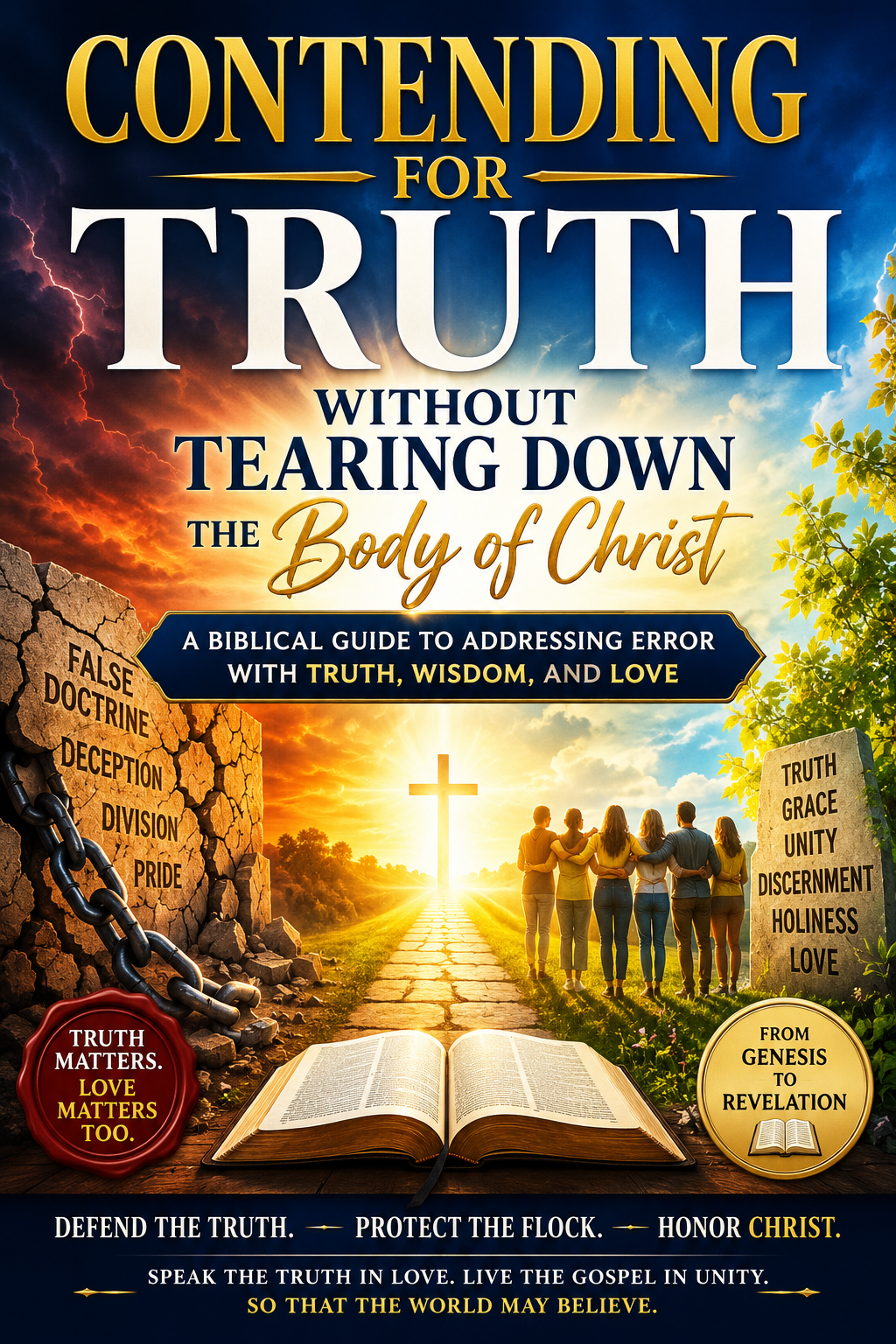
From Genesis to Revelation, the Bible presents truth as holy, necessary, and inseparable from the character of God Himself. God does not merely speak truth; He is true. His words are pure, His ways are righteous, His judgments are just, and His covenant faithfulness stands forever. Because of that, falsehood is never a small matter in Scripture. Deception damages worship, distorts doctrine, confuses souls, and leads people away from the living God.
At the same time, the Bible also teaches that truth must be handled with wisdom, humility, patience, and love. Scripture never presents believers with a simple choice between silence and aggression, or between compromise and combat. Instead, it calls the people of God to speak faithfully, discern carefully, and correct error in a manner worthy of Christ.
That balance matters greatly in a day when Christian disagreement is often displayed publicly before the watching world.
The Question Behind the Controversy
The issue is not whether truth should be defended. Scripture makes it clear that it must be. The deeper question is how Christians should address error in a way that is faithful to God, protective of the flock, and consistent with the spirit of Christ.
That question becomes especially important when believers publicly criticize one another over doctrine, secondary disagreements, ministry style, or matters that are not the gospel itself. In such moments, the church must ask not only whether something is wrong, but also whether the correction is being carried out in a way that helps or harms the body of Christ.
The Bible gives a full answer. It does not teach us to ignore falsehood. But it also does not teach us to turn correction into spectacle.
God Is Truth, and Truth Matters Because He Matters
The Bible begins with God speaking creation into existence. His word is not uncertain, evolving, or contradictory. It stands. It orders reality. It reveals His will. It gives life.
In Genesis, deception enters the world when the serpent twists God’s word and questions what God has said. The first false teaching was not merely a minor mistake; it was an attack on God’s authority, God’s character, and God’s word. The serpent’s strategy was subtle, but its goal was deadly.
From that moment forward, Scripture shows that truth and error are never neutral matters. God confronts deception. He warns His people. He judges falsehood because falsehood destroys. The seriousness of false teaching is rooted in the seriousness of God Himself. Because He is holy, truth cannot be treated casually. Because He is faithful, lies cannot be treated lightly.
The law of Moses also treats false prophecy seriously. God’s people were never told to accept every spiritual message simply because it sounded religious. They were commanded to test it. If a message led people away from the Lord, it was not to be embraced, admired, or tolerated. It was to be rejected.
This means biblical discernment is not an optional skill for a few advanced believers. It is a covenant responsibility for the whole people of God.
The Old Testament: False Prophecy Was a Covenant Danger
The prophets make this even clearer. Again and again, they confronted false teachers, false prophets, and corrupt leaders who spoke peace when there was no peace. They did not do this because they enjoyed conflict, but because they were entrusted with the word of the Lord. Their task was to warn, correct, and call God’s people back to covenant faithfulness.
Sometimes the prophets named the individuals directly. Jeremiah names Hananiah in Jeremiah 28. Jeremiah 29 names Shemaiah. Elijah confronts Ahab, Jezebel, and the prophets of Baal. Micaiah stands against the majority prophets in 1 Kings 22. Ezekiel rebukes false prophets who have seen vanity and lying divination in Ezekiel 13. Hosea, Amos, Isaiah, and others expose deception not merely as bad theology, but as rebellion against the Lord.
That matters because the Old Testament shows several important truths at once.
God’s people are responsible to test messages, not merely accept them.
False prophets can be numerous, persuasive, and religious.
Public error sometimes requires public exposure.
But the goal is always rescue, repentance, and covenant fidelity.
The prophets were not exposing error simply to humiliate people. They were warning covenant people before judgment fell. Their correction was part of God’s mercy.
Wisdom Requires Discernment, Not Reaction
The wisdom books add another layer. Proverbs repeatedly calls for discernment, restraint, timing, and measured speech. Not every fool must be answered in the same way, and not every matter deserves the same weight. Proverbs even teaches that there are times not to answer a fool according to his folly and times to answer him according to his folly.
That means biblical speech is not only about being right. It is also about being wise.
This matters a great deal when Christians discuss false teaching online. The issue is not simply, “Is the person wrong?” The issues are also: Is this worth escalating? Is this producing edification or spectacle? Is this protecting the flock or feeding the flesh? Is this clarifying Scripture or stirring up strife?
Wisdom must govern zeal.
Jesus Confronted Error, But Never Recklessly
Jesus Christ is the perfect model for how truth should be spoken. He never compromised with deception. He exposed false religion, rebuked hypocrisy, and warned repeatedly about false prophets and false teachers. He identified corrupt doctrine, empty rituals, and outward piety that lacked inward righteousness.
At times, Jesus named the people responsible. At other times, He addressed the error itself. In both cases, His purpose was not personal attack, but truth and mercy. He was never careless with His words. He was never driven by ego. He was never trying to build a following through outrage.
Even when His rebukes were strong, they were holy. Even when His words were severe, they were clean. He rebuked the Pharisees for hypocrisy, warned about the leaven of the Pharisees and Sadducees, and exposed corrupt leadership. Yet He also answered some opponents with questions, remained silent at other moments, taught in parables, and withdrew when necessary. His speech was never impulsive. It was always perfect.
And even in judgment, there was grief. Jesus wept over Jerusalem. That matters. His correction was not cold. It was the sorrow of a Shepherd confronting what would destroy the sheep.
This is the tone the church must recover.
The Church Is Christ’s Body, Not a Battlefield for Pride
One reason this issue is so serious is that the church is not a loose network of spiritual consumers. It is the body of Christ, the temple of the Holy Spirit, and the household of God. That means careless conflict is never merely “a difference of opinion.” When believers wound one another publicly, they are affecting Christ’s people and Christ’s name.
To wound the body in the name of defending truth is still to wound the body. Christ does not honor zeal that forgets His people are His own possession.
This is why tone matters so much. Truth does not need theatrics. Scripture does not need mockery. Correction does not need to be cruel in order to be clear.
The Apostles Defended the Gospel With Clarity and Care
The apostles followed the example of Christ. In Acts, Paul warned the elders that savage wolves would arise, even from within the church. He did not pretend that danger was imaginary. He did not tell the church to be quiet in the name of unity. He called them to watch, to guard, and to remain alert.
At times, Paul named individuals who had departed from the truth. At other times, he focused on the doctrine itself. Both approaches appear in the New Testament. What matters is that the apostolic goal was always the protection of the church and the preservation of the gospel.
Paul also gave clear instruction about the manner of correction. The Lord’s servant must not be quarrelsome, but kind, patient, and able to teach. Opponents are to be corrected with gentleness, in the hope that God may grant repentance. That is a vital principle. Biblical correction is not supposed to be a platform for self-promotion. It is supposed to be an act of faithful shepherding.
Paul also warned against foolish controversies, destructive disputes, and endless arguments that produce strife rather than edification. That does not mean Christians should ignore error. It means they must not turn correction into a sport.
Shepherding Is the Right Lens for Correction
The biblical pattern is not that of online commentators building audiences by perpetual critique. It is the pattern of shepherds feeding, guarding, correcting, and warning the flock under the authority of the Chief Shepherd.
Biblical correction is not merely the work of truth-tellers; it is the work of shepherds who will one day give account to the Chief Shepherd for how they handled His sheep.
That truth should sober every Christian who speaks publicly about doctrine. The issue is not only whether an argument can be made. The issue is whether the people of God are being cared for in the process.
Love in Scripture Is Not Sentimentality
The Bible says truth and love must go together, but biblical love is not the refusal to confront error. It is the refusal to let error destroy someone while remaining silent.
That distinction matters. In modern culture, love is often reduced to niceness, approval, or the avoidance of conflict. Scripture means something deeper. Biblical love is covenantal. It seeks the good of the other under God. It tells the truth, even when the truth is difficult. It warns, corrects, restores, and protects.
This means harshness is not love, and compromise is not love either. Truth without love becomes hard. Love without truth becomes empty. Scripture requires both.
Not Every Difference Is the Same
One reason this issue is so difficult is that not every doctrinal disagreement rises to the same level. Scripture clearly distinguishes between essential matters and secondary matters.
Some truths stand at the center of the faith: the deity of Christ, His bodily resurrection, salvation by grace through faith, the authority of Scripture, the reality of sin, and the coming judgment of God. Errors that strike at these foundations are serious and must be addressed clearly.
Other matters, while important, do not define the gospel itself. Christians have long differed on issues such as church governance, end-times interpretations, spiritual gifts, baptismal practice, and worship style. These subjects matter, but they are not the same as denying the resurrection or preaching another gospel.
Wise believers know the difference between a serious threat to the faith and a disagreement among brothers and sisters who still confess Christ. Not every debate calls for public exposure. Not every correction needs to become a public confrontation. Wisdom must govern zeal.
This is why a careful article should distinguish between heresy, error, immaturity, and secondary disagreement. That one distinction alone adds significant theological precision and maturity.
The Danger of Christian Infighting
In an era of constant online content, the temptation to expose, critique, and attack is stronger than ever. Videos that highlight disagreement often gain attention faster than teaching that quietly builds up the saints. As a result, Christian conflict can become a kind of entertainment. That is deeply troubling.
When unbelievers see believers constantly tearing one another down, they do not see the beauty of Christ. When new Christians are exposed to endless controversy, they may become confused, discouraged, or suspicious of the entire faith. When weak believers see constant strife, they may conclude that Christianity is just another arena for personal agendas and tribal battles.
That is why tone matters so much. Truth does not need theatrics. Scripture does not need mockery. Correction does not need to be cruel in order to be clear.
This does not mean all public rebuke is wrong. It means the motive and method must be examined carefully. Are we protecting the flock, or performing for an audience? Are we helping people discern truth, or feeding a cycle of outrage? Are we seeking repentance and clarity, or simply trying to discredit someone?
Those questions matter.
The Church’s Witness Matters
Jesus prayed in John 17 that His people would be one so that the world may believe that the Father sent Him. That does not mean Christians should fake unity by refusing to address error. But it does mean that the way we address error is part of our witness.
A church that never confronts falsehood is not loving. A church that constantly performs combat is not healthy either.
The world is watching. New believers are watching. Children are watching. The wounded are watching. Unbelievers are watching. If correction is done with cruelty, pride, or spectacle, the watching world may not hear the gospel clearly through the noise.
That does not mean we hide the truth. It means we protect the truth with wisdom.
Why Writing About Doctrine Is Often the Better Path
For this reason, many ministers wisely choose to write about doctrines, beliefs, and theological errors rather than constantly centering their articles on individuals. That approach is often more edifying, more durable, and more faithful to the overall spirit of Scripture.
When the focus stays on doctrine:
The Bible remains the authority rather than personalities.
Readers learn how to test teaching by Scripture.
The article is less likely to become gossip, speculation, or a personal feud.
The message can outlast the controversy.
The writer avoids turning correction into spectacle.
This is especially helpful when addressing complicated issues with many sincere Christians on different sides of a secondary matter. A doctrine-focused approach allows the author to be firm without becoming inflammatory. It also gives the reader a better chance to think biblically rather than emotionally.
Tone Is Theological Too
The manner of correction is never morally neutral. A harsh tone may communicate that truth matters, but it can also communicate that people do not. A gentle tone may communicate patience, but if detached from truth it becomes weakness. The Christian goal is not merely correct content, but a Christlike manner worthy of the gospel.
That means tone is not an optional extra. It reveals what we believe about God, His people, and His truth. A faith that proclaims sound doctrine but speaks with pride, sarcasm, or contempt has already begun to contradict itself.
Revelation Shows That Christ Will Judge Truth and Error
If the full Bible is taken seriously, then the book of Revelation must have a place in the discussion. There, the glorified Christ commends churches for testing false apostles. He rebukes churches for tolerating false teaching. He condemns the church in Thyatira for allowing “that woman Jezebel” to teach and seduce His servants. He warns other churches to repent.
Revelation shows that the Lord of the church does not merely care whether the church is active; He cares whether it is faithful.
This is important because it proves that doctrinal purity is not a side issue. It is central to Christ’s own evaluation of the churches.
Yet even Revelation shows that the issue is not gossip about people. The issue is fidelity to Christ, His truth, and His holiness.
Because Christ will one day judge every word and every doctrine, the church must speak now with fear of God, patience, and hope, knowing that final vindication belongs to Him.
When Naming Names May Be Necessary
The full counsel of God suggests a clear answer: yes, sometimes names should be mentioned, and no, not always.
Naming a person is biblically justified when at least some of the following are true:
The person is publicly teaching or spreading serious error.
The error threatens the gospel or the peace of the church.
Private correction has failed, or the person has shown persistent refusal to repent.
The naming serves a protective, warning function rather than a revenge function.
The facts are clear, accurate, and fair.
The manner remains consistent with love, truth, sobriety, and self-control.
But even when naming is justified, Scripture never gives believers permission to become accusatory, self-righteous, slanderous, mocking, or careless. Truth does not authorize a sinful tone.
A Better Way to Speak
A faithful Christian article about error should aim for three things.
First, it should be biblical. The claims should be grounded in Scripture, not in opinion, emotion, or internet culture.
Second, it should be fair. It should represent opposing views honestly, without caricature or unnecessary hostility.
Third, it should be edifying. Its goal should be to strengthen believers, clarify truth, and honor Christ.
That means the article should not exist simply to expose people. It should exist to expose error in a way that leads readers toward truth.
When that happens, correction becomes ministry rather than conflict.
A Biblical Summary
From the garden of Eden to the letters to the churches in Revelation, the Bible shows that God does not ignore falsehood. He warns against it, rebukes it, and calls His people to reject it. Sometimes Scripture names the person spreading the error. Sometimes it focuses on the false teaching itself. Both are biblical. But the purpose is always the same: to protect the people of God, uphold the truth, and preserve the honor of Christ.
That is why Christians must be careful. We should not be afraid to confront what is false, but we must also be cautious not to turn correction into division for its own sake. Not every difference requires a public naming. Not every error deserves the same weight. Not every disagreement should be treated as though the gospel itself is at stake.
The church must learn again how to speak truth with sobriety, humility, and love.
Conclusion
The whole counsel of God teaches that truth matters, error must be addressed, and false doctrine cannot be ignored. But Scripture also teaches that correction must be guided by wisdom, love, and reverence for Christ. Sometimes that means naming names. Often it means addressing the doctrine itself. In every case, the goal must be the same: to honor God, protect the flock, preserve the witness of the church, and keep the gospel clear before a watching world.
The strongest Christian witness is not found in endless combat, but in faithful truth spoken with grace.
That is the path of biblical discernment.
Leave a Reply