
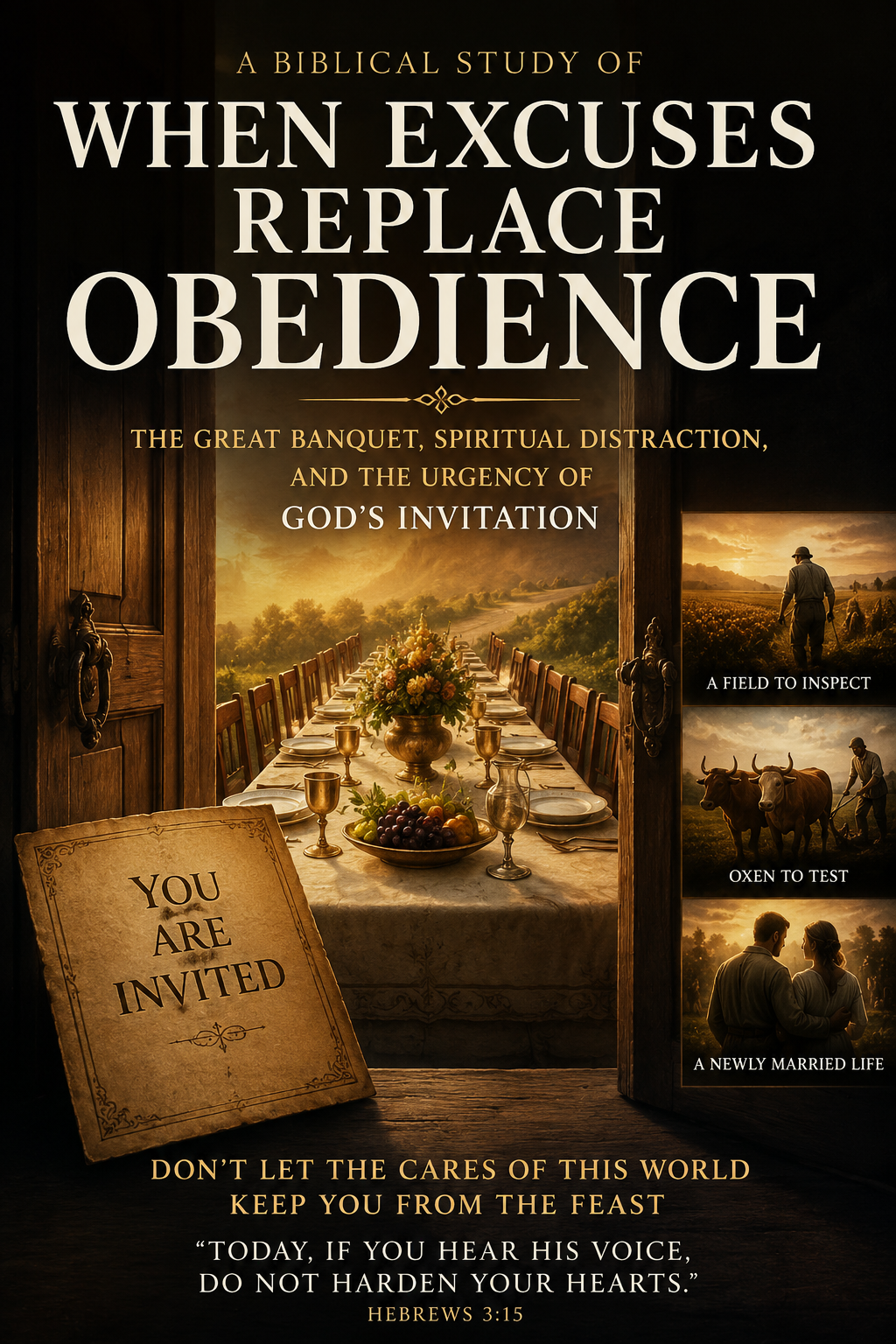
A Biblical Study of the Great Banquet, Spiritual Delay, and the Urgency of God’s Invitation
The Invitation of Grace
One of the most searching truths in all of Scripture is that God does not merely command from a distance; He invites with mercy. The Bible repeatedly presents salvation not only as law to be obeyed, but as a feast to be entered, a banquet to be received, and a table to which the hungry are called. In Luke 14:16–24, Jesus gives one of the clearest pictures of this reality. A great man prepares a banquet and sends out the invitation. Everything is ready. The feast is abundant. The welcome is genuine. Yet those who were first invited begin to refuse the call, not with open hatred at first, but with excuses that sound ordinary, reasonable, and responsible. One has a field to inspect, another has oxen to test, another has just married. These are the kinds of concerns that can fill a human life, and precisely for that reason they are so dangerous. They can seem legitimate while quietly becoming a veil over spiritual indifference.
The parable is not mainly about poor etiquette or social discourtesy. It is about the human heart before God. It is possible to be addressed by grace and still turn away because lesser things feel more urgent. It is possible to be close to the kingdom and yet miss the kingdom because the soul is crowded with business, noise, duties, ambitions, and delayed obedience. Jesus exposes the tragedy of those who do not necessarily say no to God, but say later. And in Scripture, later is often the language of lost opportunity.
The Banquet as a Picture of the Kingdom
The feast theme in Scripture is larger than a single parable. From the Old Testament onward, God’s saving purpose is often described in the language of a meal, a banquet, or a feast. Isaiah 25:6–9 portrays the Lord of hosts preparing a rich feast for His people, a feast connected to the removal of death and the wiping away of tears. Proverbs 9:1–6 presents wisdom as a woman who prepares her table and calls the simple to come and live. These images are not decorative. They reveal that the heart of God is not reluctant cruelty but generous welcome.
That is why the banquet parables in Luke 14 and Matthew 22 matter so deeply. They are not isolated moral lessons. They are invitations into the great biblical storyline of covenant mercy, kingdom joy, and final fulfillment. The feast is the sign that God is not only correcting sinners; He is gathering a people to Himself. The kingdom is not merely a rule to submit to, though it is certainly that. It is also a table to which the undeserving are called by grace. Revelation 19:6–9 brings this theme to its climax in the marriage supper of the Lamb, where redeemed people rejoice in the final union of Christ and His bride. The feast that begins in invitation ends in glory.
This means the parable of the great banquet must be read with a sense of redemptive history. The host is not only a generous man in a story. He is a picture of God Himself. The banquet is not only a social event. It is a picture of covenant blessing. The refusal is not only bad manners. It is a theological tragedy. To refuse the banquet is to refuse the kingdom. To delay the banquet is to reveal that other things sit higher in the heart.
Christ at the Center of the Feast
The invitation of the kingdom is ultimately an invitation to Christ Himself. He is not merely the messenger who announces the feast; He is the Son in whom the feast is given, the Bridegroom who brings joy, and the Lord who calls sinners to Himself. This is why the banquet theme is so Christ-centered throughout the Gospels. Jesus speaks of Himself as the One around whom wedding joy gathers. He is the One who comes eating and drinking, receiving sinners, and unveiling the nearness of God’s reign.
To miss the banquet is therefore to miss Christ. The issue is never only whether a person attends a religious gathering or takes seriously a spiritual message. The deeper question is whether the soul is responding to the Son of God. The feast is Christ. The kingdom is Christ. The call of God is Christ-centered from beginning to end. That is why the excuses of Luke 14 are so serious. They do not merely postpone an event; they postpone relationship with the King. They do not merely delay attendance; they delay surrender.
This also deepens the grace of the passage. The God who invites is not distant from human need. He has come near in His Son. He has prepared the feast at great cost. The invitation therefore carries not only duty but mercy. When people reject it, they are not refusing an inconvenience; they are resisting divine kindness.
The Offense of Ordinary Excuses
The excuses in Luke 14 and Matthew 22 are striking because they are ordinary. One man has a field. Another has business. Another has family obligations. These are not outrageous sins in themselves. That is exactly why the parable is so piercing. Scripture is not warning only against obvious rebellion. It is warning against the spiritual misuse of ordinary life. The problem is not that work, property, family, and responsibility are evil. The problem is that they can become so important that God’s invitation is treated as secondary.
Matthew 22:5 says that the invited guests “paid no attention and went off, one to his farm, another to his business.” That line reveals much about the heart. They did not all storm away in anger. Some simply drifted. They were preoccupied. Their attention was absorbed elsewhere. They were distracted by the world they could see and deaf to the kingdom they could not yet taste.
This is one of Scripture’s great warnings. Busyness is not always a sign of faithfulness. Sometimes it is a mask for avoidance. A person can fill a life with good things while quietly refusing the one thing needful. A person can maintain a farm, a household, a business, a schedule, and a reputation, and still be spiritually unprepared for the voice of God. The danger is not only rebellion with a clenched fist. It is neglect with an open calendar.
The Heart as the True Battlefield
The Bible consistently teaches that the real issue is the heart. Proverbs 4:23 says to guard the heart with all vigilance, because from it flow the springs of life. Matthew 6:21 teaches that where treasure is, there the heart will be also. This is why excuses matter so much. They are not merely words. They reveal loves. They show what the soul is clinging to and what it is willing to postpone.
When the heart is rightly ordered, earthly responsibilities take their proper place. Work remains work. Family remains family. Possessions remain gifts. Time remains stewardship. But when the heart is disordered, even legitimate duties become rival masters. The soul begins to treat the urgent as ultimate and the eternal as optional. That is idolatry in its most subtle form. It does not always look like pagan worship. Sometimes it looks like a crowded schedule and a spiritually delayed response.
This is why Proverbs 3:5–6 speaks with such force. Trust in the Lord with all your heart, and do not lean on your own understanding. The issue is not merely what a person does. It is what a person trusts. A heart that leans on itself will always find reasons to delay obedience. A heart that trusts the Lord will learn to order all things around Him.
The Cares of This World and the Choking of the Word
Jesus expands this warning in the parable of the sower. In Matthew 13:22, the seed is choked by “the cares of the world and the deceitfulness of riches.” In Luke 8:14, the word is choked by “the cares and riches and pleasures of life.” These passages reveal that the word of God can be received and still fail to flourish because other things crowd it out. The issue is not always outright unbelief. Sometimes it is congestion.
This is one of the most sobering realities in spiritual life. The word may be true, and the seed may be good, but the soil may be overrun by thorns. Cares, riches, and pleasures are not always evil in themselves, but they become spiritually deadly when they dominate the interior life. The soul can be so full that nothing lasting takes root. This is why many people hear the gospel, admire the truth, and even feel momentary conviction, yet never produce enduring fruit. Something else is already growing there.
Matthew 6:19–24 and 6:33 sharpen the issue further. Jesus warns against storing up treasure on earth, because earthly treasure pulls the heart downward. He then commands His people to seek first the kingdom of God and His righteousness. First is not a vague priority. It is an ordering principle. The kingdom must not be fitted around the margins of life. Life must be fitted around the kingdom.
Luke 21:34 adds another warning when Jesus speaks of hearts being weighed down with dissipation, drunkenness, and the cares of this life. The concern is not only moral corruption but spiritual heaviness. A heart can become dull, sluggish, and inattentive because it is burdened with too much earthly weight. The result is tragic: the day of the Lord arrives suddenly, and the soul is not ready..
The Old Testament Pattern of Forgetful Prosperity
The Old Testament repeatedly shows that prosperity can produce forgetfulness. In Deuteronomy 6:10–12, Israel is warned that when they enter houses they did not build and eat from vineyards they did not plant, they must beware lest they forget the Lord who brought them out of Egypt. This is a vital spiritual principle. The danger is not only poverty. Prosperity can be equally dangerous when it breeds self-sufficiency.
Deuteronomy 8:11–18 develops this theme even more fully. When Israel becomes full and satisfied, they must not let their hearts be lifted up in pride or imagine that their own strength produced their blessings. Every good gift remains grace. Every field, every harvest, every house, every business, every success is held by the hand of God. When people forget that, they begin to live as though they are self-made. And self-made souls rarely make room for the banquet of God.
The prophets continue this pattern. Jeremiah 2:12–13 depicts God’s people forsaking Him, the fountain of living waters, in order to hew out broken cisterns that can hold no water. Amos 8:11–12 warns of a famine of hearing the words of the Lord. These are not random images. They show the tragedy of a people who have so much earthly activity and so little spiritual appetite. They are busy, but they are thirsty for the wrong things. They are occupied, but they are not satisfied. They are moving, but not toward God.
Today Is the Day of Response
One of the great themes running through Scripture is urgency. Hebrews 3:7–15 repeats the warning, “Today, if you hear his voice, do not harden your hearts.” The call of God is not merely informative. It is immediate. God’s voice is not intended to be admired from a distance while postponed indefinitely. It is meant to be obeyed now.
Acts 24:25 gives a heartbreaking example of delay when Felix hears Paul speak about righteousness, self-control, and judgment to come, then says, “Go away for the present. When I get an opportunity I will summon you.” Felix represents a tragic pattern in human history. He is moved, but not surrendered. He is confronted, but not converted. He postpones the voice of God in the name of convenience.
James 4:13–17 exposes the same presumption when people speak confidently about tomorrow while forgetting that life is a vapor. The believer’s response is not reckless spontaneity but humble dependence: “If the Lord wills.” That phrase is not a religious ornament. It is a confession that time belongs to God. Tomorrow is not guaranteed. Delay is not harmless. The feast does not remain open forever.
The Feast of the Kingdom and the Final Judgment
The banquet parable also has an eschatological edge. It points not only to present invitation but to final accountability. Scripture teaches that there is a coming day when the present offer will no longer be extended. The kingdom invitation is gracious, but it is not endless in the way human pride assumes. Jesus repeatedly warns of a coming separation between those who received the King’s call and those who made excuses, neglected the invitation, or presumed upon mercy.
This gives the feast a solemn seriousness. It is not only a celebration to enjoy; it is a summons to respond. Revelation 19 shows the final banquet of the Lamb, but Scripture also warns that those who reject Christ will stand outside the joy they refused. The issue is not whether God’s grace is sufficient. It is. The issue is whether the heart will come when called.
This is why Luke 17:26–30 matters. People in Noah’s day and Lot’s day went on with ordinary life until judgment arrived suddenly. The warning is not against eating, drinking, buying, selling, planting, and building as such. The warning is against life lived without holy awareness. Ordinary life can continue right up to the brink of eternity while the soul remains unprepared.
The Invitation to the Poor, the Broken, and the Undeserving
One of the most beautiful elements of the banquet parable is the widening of the invitation. When the first guests refuse, the host sends his servants into the streets and lanes, into the highways and hedges, to gather the poor, the crippled, the blind, and the lame. This is not merely a social reversal. It is a theological one. The kingdom of God comes to those who know they need mercy. It comes to the weak, the overlooked, the unimportant, and the shattered. It comes to those who cannot pretend they have made themselves worthy.
This is part of the gospel’s beauty. God’s feast is not for the self-satisfied. It is for the hungry. It is not for the spiritually busy but for the spiritually needy. It is not for those who think they have better things to do, but for those who know that apart from grace they have nothing.
That is why the parable humbles pride and exalts mercy at the same time. The invited poor do not arrive with credentials. They arrive because they were called. Their presence at the table is a testimony to grace, not merit. And that grace still gathers people today.
Conclusion: Do Not Let the Invitation Pass
The full counsel of Scripture reveals that the great banquet is more than a story about excuses. It is a revelation of the heart of God, the urgency of Christ’s call, the danger of divided loyalties, and the glory of the kingdom feast prepared for the undeserving. The warnings of Deuteronomy, Proverbs, the prophets, the Gospels, the epistles, and Revelation all converge on one sobering truth: ordinary life can become a profound spiritual distraction if the soul does not keep God first.
Work is good. Family is good. Responsibility is good. But none of them may be allowed to sit on the throne of the heart. The invitation of God is not a suggestion to be considered when life slows down. It is a gracious summons from the King of glory. The feast is ready. Christ is present. The kingdom is near. The call has gone out. The only fitting response is to come.
To delay is to risk hardening the heart. To excuse oneself is to reveal disordered love. To ignore the invitation is to miss the joy of the kingdom. But to hear and to come is life, mercy, and everlasting fellowship with the Lord who prepares the table and welcomes sinners by grace.
Leave a Reply