
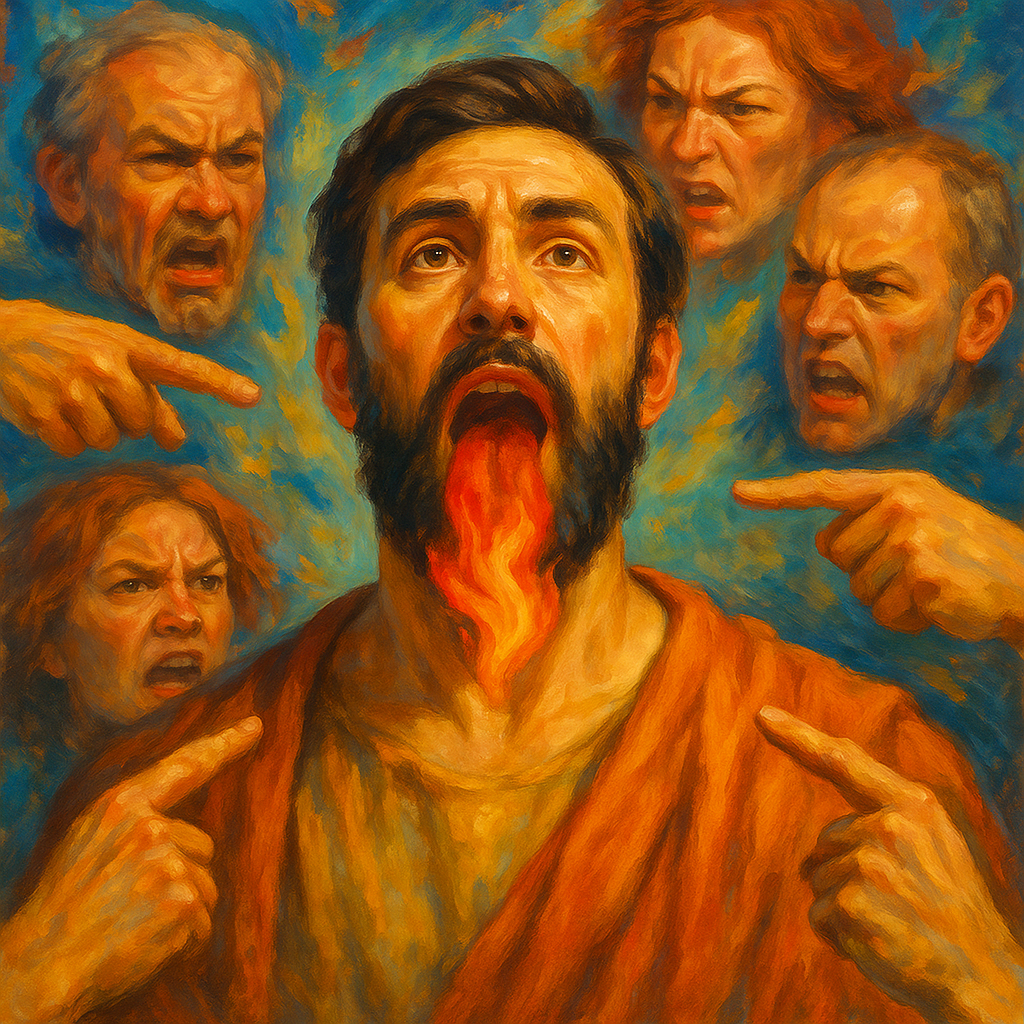
Throughout church history, one recurring problem has caused untold harm within the body of Christ — the divisive tongue. Rooted in pride, arrogance, greed, manipulation, self-promotion, envy, and a desire for control, the divisive tongue has sown discord where there should be unity, brought shame where there should be glory, and fostered hatred where there should be love.
Instead of building up the church, it has torn it down. Instead of pointing people to Jesus, it has driven them toward human leaders and worldly ideologies. In our day, this problem is magnified by the reach of social media and the influence of the pulpit, where words — whether true or false — can quickly spread across the world.
When Christians Play God
There are believers who see themselves as the self-appointed judges of all others in the faith, rebuking at the smallest perceived offense. While correction has its place in Scripture (2 Timothy 4:2, Galatians 6:1), some ignore the full counsel of God’s Word and build entire theological systems on a few out-of-context verses.
Sadly, throughout history this misuse of Scripture has been used to justify:
Anti-Semitism and hostility toward the Jewish people Changing the biblical Sabbath observance for cultural rather than biblical reasons Manipulating congregations into giving money through guilt or fear Using church authority to dominate and control people rather than serve them Covering up abuse, including the sexual abuse of children Silencing women contrary to the biblical examples of godly female leadership Mixing the gospel with politics, patriotism, and even wars Reckless and unbiblical displays, such as handling venomous snakes to “prove” faith Justifying slavery, bigamy, and the hoarding of wealth
What Scripture Actually Teaches About Leaders and Teachers
The Bible gives repeated warnings to avoid false prophets, false teachers, and those who live in unrepentant sin while claiming to follow Christ (Matthew 7:15, 2 Peter 2:1–3, 1 Corinthians 5:11). It warns against sexual immorality, greed, dishonesty, and those who stir up division.
But contrary to some traditions, Scripture does not teach that women cannot share the gospel, teach the truth of God’s Word, or hold certain roles of spiritual influence. We see:
Deborah — a prophetess and judge over Israel (Judges 4:4–5) The Samaritan woman at the well — who told her whole town about Jesus (John 4:28–30) Mary Magdalene — the first witness of the risen Christ, sent to tell the apostles (John 20:17–18) Priscilla — who, alongside her husband Aquila, taught Apollos the way of God more accurately (Acts 18:26)
Jesus affirmed and empowered these women to share His truth — not silence them.
Doctrinal Errors That Fuel Division
Many divisions in the church come from clinging to human traditions or speculative interpretations rather than Scripture itself. Examples include:
Cessationism — teaching that the gifts of the Holy Spirit ceased with the apostles, despite biblical evidence of their continuation (1 Corinthians 1:7, Acts 2:17–18) The pre-tribulation rapture theory — often presented as absolute truth despite strong biblical challenges to it (Matthew 24:29–31, 2 Thessalonians 2:1–3) Mislabeling every political or medical event (such as COVID vaccines) as the “mark of the beast” (Revelation 13 is clear this is tied to global worship of the Antichrist, not random technology or medicine) Pointing to specific individuals as “the man of lawlessness” without biblical warrant (2 Thessalonians 2)
There is also the danger of overcorrection — for example, condemning homosexuality so harshly that people are driven away from hearing the gospel, or, on the opposite extreme, welcoming unrepentant sin into leadership and normalizing what God calls sin (1 Corinthians 6:9–11). Both approaches misrepresent Christ.
The Danger of Mixing the Gospel With Politics
In some pulpits today, political agendas and nationalist ideals take precedence over proclaiming Christ crucified. The platform God intended for preaching the gospel is instead used for promoting worldly causes.
This is not new — Israel’s leaders often sought to merge political power with religious authority, and it led them into compromise and corruption. Jesus Himself rejected political messiahship (John 6:15) and declared that His kingdom is “not of this world” (John 18:36).
The pulpit, like the believer’s online presence, must remain devoted to Christ’s mission: proclaiming salvation, teaching obedience to His commands, and making disciples of all nations (Matthew 28:18–20).
Overcoming the Divisive Tongue
We all wrestle with the temptation to speak carelessly, harshly, or in a way that fosters division. James 3:6 warns us that “the tongue is a fire… set on fire by hell.”
The first step toward overcoming this is humility — admitting that we all stumble in many ways (James 3:2). From there:
Pray daily for God to set a guard over your mouth (Psalm 141:3). Immerse yourself in Scripture so your words are shaped by God’s truth. Let the Holy Spirit lead your speech — He is with us to teach, convict, and guide us into truth (John 16:13). Use your voice to build up, not tear down (Ephesians 4:29).
Final Word
The divisive tongue has no place in the mouth of a follower of Christ. Whether from a pulpit, a social media account, or casual conversation, our words must reflect the heart of Jesus — full of grace and truth.
As the apostle Paul reminds us:
“Let your speech always be gracious, seasoned with salt, so that you may know how you ought to answer each person.” — Colossians 4:6
Leave a Reply