
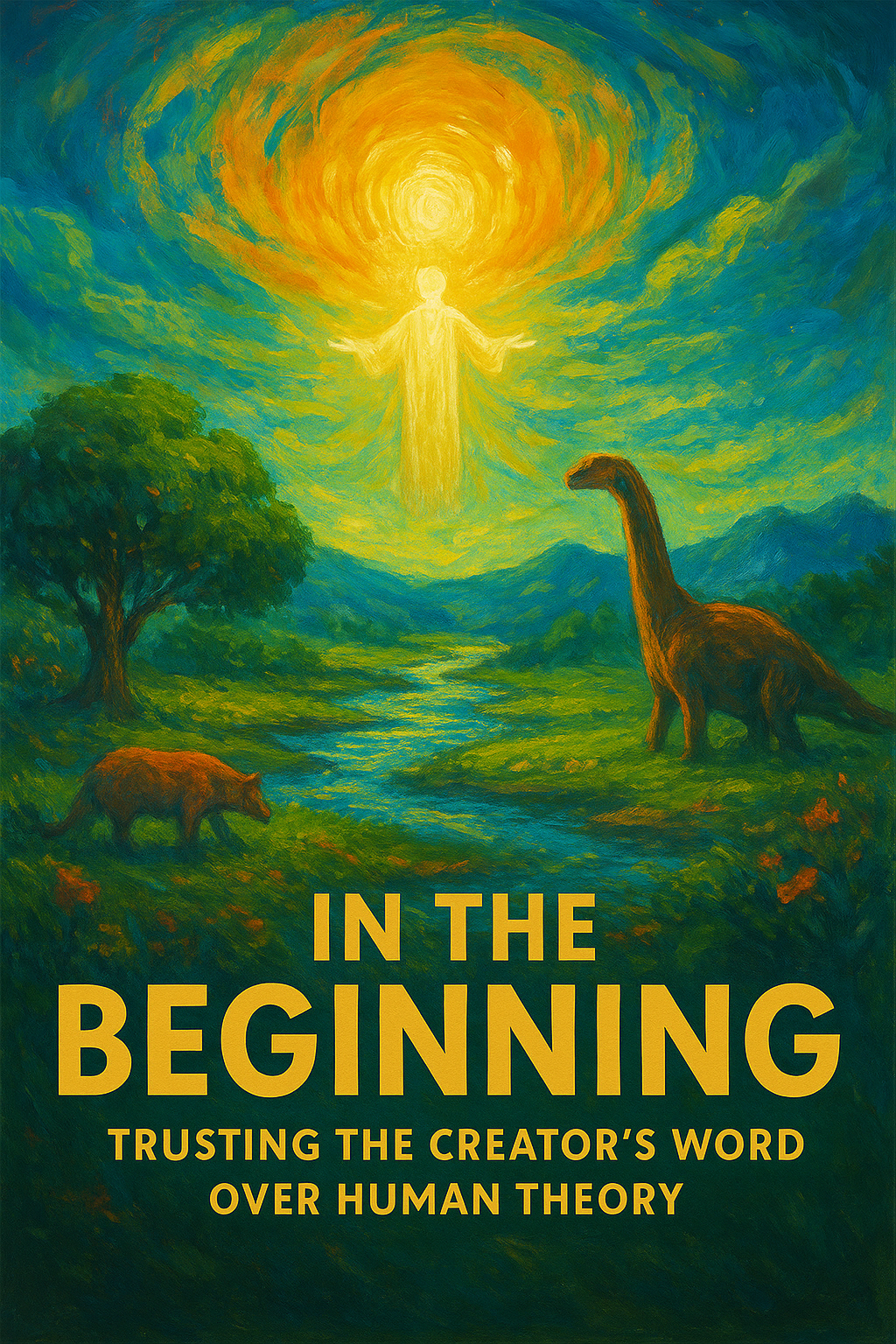
Jesus once asked, “Have you not read that He who created them from the beginning made them male and female… What therefore God has joined together, let no man separate” (Matthew 19:4–6). In defending God’s design for marriage, Jesus also affirmed the timeline of creation. He didn’t say man evolved billions of years after a cosmic explosion—He said mankind was created “from the beginning.”
This statement is foundational. Jesus is not just a prophet—He is the eternal Creator, the “I AM” (John 8:58), the same who said to Moses from the burning bush, “I AM WHO I AM” (Exodus 3:14). As the divine Word (John 1:1), He was there in the beginning when God said, “Let there be light” (Genesis 1:3). And He was present for each act of creation. The pattern is unmistakable: “And there was evening and there was morning, one day” (Genesis 1:5). This phrase is repeated throughout the six days of creation to show they were literal 24-hour days.
Genesis 2 confirms this: “By the seventh day God completed His work which He had done, and He rested… Then God blessed the seventh day and sanctified it” (Genesis 2:2–3). Later, in Exodus 20:11, God commands Israel to follow this same weekly pattern: “For in six days the Lord made the heavens and the earth… and rested on the seventh day.” The use of the Hebrew word “yom” (day) in both contexts shows they were the same kind of day: literal, not symbolic.
So how old is creation according to Scripture?
When we trace the genealogy from Adam to Noah in Genesis 5, we find specific ages for each father when his son was born. Adam lived 130 years and begot Seth; Seth lived 105 years and begot Enosh; and so on. The genealogy continues with Noah, who was 600 years old when the flood came (Genesis 7:6). From Adam to the flood, about 1,656 years had passed.
Then, in Genesis 11, we are given the genealogical record from Noah’s son Shem to Abraham. Adding these numbers, we arrive at about 2,000 years from creation to Abraham. From Abraham to Jesus is roughly another 2,000 years based on biblical history and confirmed by Matthew 1 and Luke 3. And from Christ to our present day is about another 2,000 years. So, the biblical timeline from Adam until today is roughly 6,000 years.
There is no room in this biblical framework for millions of years. To insert evolutionary time into the Genesis record is to contradict the inspired chronology of the Bible itself. Many well-meaning believers try to harmonize the Bible with science by adding gaps, stretching the days, or allegorizing the text. But these ideas aren’t found in the Word of God—they are attempts to align with secular thought.
Others point to passages like “With the Lord one day is like a thousand years” (2 Peter 3:8) or “A thousand years in Your sight are like yesterday” (Psalm 90:4). But these do not redefine the days of Genesis. They emphasize God’s transcendence over time, not that He used long ages to create. If the days in Genesis were each thousands of years long, Adam—who lived 930 years—wouldn’t have survived even one “day.”
Moreover, death entered the world through Adam’s sin. “Through one man sin entered into the world, and death through sin, and so death spread to all men” (Romans 5:12). “For since by a man came death, by a man also came the resurrection of the dead” (1 Corinthians 15:21). If death existed before Adam, then Scripture is undermined and the gospel is emptied of its power. But we are told that God saw all that He had made, and behold, it was very good (Genesis 1:31). That “very good” world did not include millions of years of death, disease, and extinction.
So what about dinosaurs?
The Bible speaks of massive, land-dwelling creatures like Behemoth in Job 40—a creature with immense strength, a tail like a cedar, and bones like bronze. It also mentions Leviathan in Job 41, a terrifying sea creature, possibly fire-breathing. These match descriptions of creatures we call “dinosaurs” today and indicate they lived during the time of Job, after the flood, not millions of years before.
What about their fossils?
The global flood in the days of Noah is the most biblically consistent explanation. A worldwide deluge would rapidly bury billions of plants and animals under layers of sediment, forming fossils quickly. Jesus affirmed this flood, saying, “Just as it was in the days of Noah, so will it be when the Son of Man returns” (Matthew 24:37).
Many still doubt, asking, “Did God really say?” (Genesis 3:1). That was the question Satan used in the garden. Eve added to God’s Word, misrepresenting His command, and that small alteration gave Satan his opening. He twisted truth, contradicted God’s warning, and appealed to human pride. That same pattern happens today when we elevate man’s word over God’s.
But Scripture urges us to trust God over man:
“It is better to take refuge in the Lord than to trust in man” (Psalm 118:8).
“Some trust in chariots and some in horses, but we trust in the name of the Lord our God” (Psalm 20:7).
“Let God be true and every man a liar” (Romans 3:4).
“The wisdom of this world is foolishness before God” (1 Corinthians 3:19).
God’s Word does not require modern science to validate it. It stands on its own. And if we cannot trust what He says about the beginning, how can we trust Him about the end?
Let us anchor our faith not in speculation or shifting theories, but in the unchanging Word of God. The God who created in six literal days is the same God who judged the world through the flood, who called Abraham, sent His Son, and will return to judge the living and the dead. The same God who raised Jesus from the dead promises eternal life to those who believe. If He cannot be trusted in Genesis, why trust Him with your eternity?
He is faithful, from beginning to end. Trust Him.
Leave a Reply